
Utilize bamboo for architectural millwork and cabinetry by specifying 3/4-inch multi-ply bamboo plywood (with exposed, oiled decorative edges) or high-density Strand-Woven bamboo (Janka hardness 3,000+ psi). Ensure all panels use certified zero-urea-formaldehyde (NAUF) low-VOC bonding resins.
At a Glance: Key Takeaways
- Rapid 5-Year Harvest Cycle: Moso Bamboo (*Phyllostachys edulis*) matures in 5 years compared to 50+ years for oak.
- Strand-Woven Janka 3,000+: High-pressure hydraulic compression makes strand bamboo harder than Brazilian cherry.
- Exposed Multi-Ply Edges: Beautiful alternating end-grain layers eliminate the need for edge-banding tape.
- NAUF Low-VOC Standard: Certified No Added Urea-Formaldehyde (NAUF) resins guarantee clean indoor air quality.
- Dimensional Stability: Cross-laminated multi-ply core resists warping in changing humidity.
In-Depth Guides in this Directory
Explore specialized subtopic blueprints, technical dimensions, and execution checklists:
Strand-Woven vs Horizontal Grain Bamboo: Janka 3000+ Math
Compare Strand-Woven vs Horizontal Grain bamboo: Janka 3000+ hardness vs 1380 psi, hydraulic compression manufacturing, pet scratch durability, and carbonized amber tones.
Bamboo Plywood Cabinet Doors: Exposed Multi-Ply Edges & Oiling
Master bamboo plywood cabinet door fabrication: 3-ply cross-laminated cores, exposed 45-degree chamfered edge profiles, natural hardwax oil sealing, and Blum European hinges.
Bamboo Sustainability & Low-VOC Resins: NAUF & Carbon Storage
Master sustainable bamboo millwork certifications: No Added Urea-Formaldehyde (NAUF) resins, negative carbon footprint lifecycle math, FSC-certified forests, and LEED v4 credits.
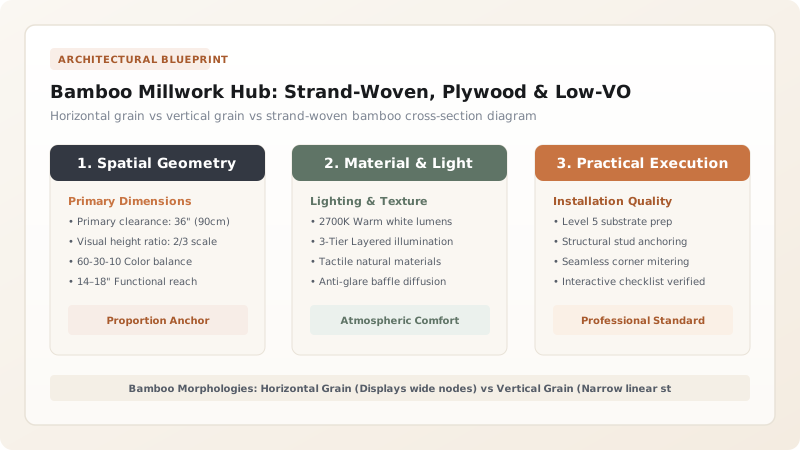
1. Material Science: Monocot Grass Fibers vs Hardwood Timber
Botanically, bamboo is not a tree; it is a giant woody monocot grass. Its hollow culms (stalks) feature ultra-dense outer fibers with a natural tensile strength (\(28,000\text{ PSI}\)) that surpasses structural steel. Unlike hardwoods that require 60 to 100 years to regenerate, Moso bamboo reaches its full 60-foot height in just 90 days and fully hardens in 5 years.
To create architectural millwork panels, bamboo stalks are planed into rectangular strips, boiled to remove sugars, kiln-dried, and cross-laminated under 2,500 tons of hydraulic pressure using non-toxic resins.

Bamboo Grain Types & Technical Specifications
Use this reference table to calculate exact physical dimensions, ratios, and specifications before purchasing:
| Bamboo Construction | Janka Hardness Rating | Visual Grain Pattern | Best Millwork Application |
|---|---|---|---|
| Strand-Woven Bamboo | 3,000 - 3,500 (Extreme) | Exotic marbled grain (Like teak) | High-traffic flooring, butcher blocks, stair treads |
| Vertical Grain (Edge-Grain) | 1,380 - 1,450 (Matches Oak) | Crisp, narrow linear pinstripes | Modern flat-panel cabinet doors, wall slats |
| Horizontal Grain (Flat-Grain) | 1,300 - 1,380 (Matches Maple) | Wide visible bamboo knuckle nodes | Architectural paneling, tabletops, open shelving |
| Multi-Ply Cross-Laminated (3-Ply) | 1,400 (Multi-directional) | Exposed decorative pinstripe core | Custom furniture, floating vanities, drawer boxes |
Carbide Saw Blade Burning Constraints
Every successful decoration project must account for physical and environmental constraints:
Bamboo Plywood Burning and Splintering When Cut with Dull Blades
High silica content in bamboo dulls standard saw blades rapidly, burning black marks on cut edges; strictly cut bamboo with an 80-tooth Hi-ATB carbide blade on table saws, cutting face-up with a zero-clearance throat plate.
How to Build Exposed-Edge Bamboo Cabinet Doors
Execute this professional sequence to achieve flawless results without backtracking:
Acclimate Bamboo Panels 72 Hours
Store 3/4" 3-ply bamboo panels flat in climate-controlled room before cutting.
Cut Doors on Table Saw with 80T Blade
Rip cabinet door blanks using an 80-tooth carbide blade with zero-clearance insert.
Rout 45° Chamfer on All Edges
Use a 1/8" chamfer router bit to expose the alternating multi-ply core edge layers.
Sand Edges to 320-Grit
Progressively sand edges from 150 to 320-grit until the exposed plies feel silky smooth.
Apply Natural Hardwax Oil
Apply 2 coats of Osmo Polyx-Oil or Rubio Monocoat to highlight the rich amber edge grain.
Common Mistakes & Countermeasures
Avoid these costly errors that compromise aesthetics, ergonomics, and budget:
Covering Bamboo Plywood Edges with Plastic Edge Banding Tape
Project Execution Checklist
Track your physical progress. Checkboxes persist automatically on this device:
Frequently Asked Questions
Does bamboo expand and contract with humidity like hardwood?
Yes, but cross-laminated multi-ply bamboo panels expand 30% to 50% less than solid hardwood due to the alternating 90-degree core grain construction, making it exceptionally stable.


