
Understanding the metallurgical differences between sand-cast iron and hand-forged wrought iron is fundamental to the engineering and conservation of Art Nouveau railings. Gray cast iron contains 3% to 4% carbon, forming flake graphite that yields exceptional compressive strength and casting fluidity, but renders it brittle in tension. Hand-forged wrought iron contains under 0.08% carbon with fibrous slag stringers, imparting supreme tensile ductility and fatigue resistance that allowed blacksmiths to hammer intricate whiplash scrolls without breaking.
At a Glance: Key Takeaways
- Carbon & Slag Matrix: Cast iron graphite flakes provide compression strength; wrought iron slag fibers provide tensile toughness.
- Plasticity Under Heat: Wrought iron is forge-welded and bent at 1,000°C; cast iron melts liquid at 1,200°C into sand cavities.
- Fracture Dynamics: Cast iron fails via sudden catastrophic brittle cleavage; wrought iron yields through ductile necking.
- Tooling Requirements: Foundries require carved wooden split-patterns; blacksmiths require scrolling forks, swages, and anvils.
- Non-Thermal Joinery: Joining cast to wrought elements requires mechanical pins, collars, and rivets rather than fusion welding.
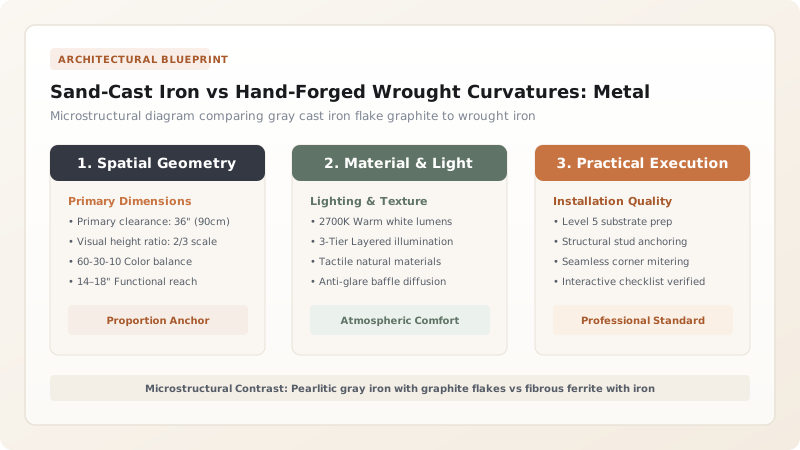
1. Microstructural Architecture: Flake Graphite vs Silicate Slag
The behavioral divergence between cast and wrought iron originates in crystal thermodynamics:
- Gray Cast Iron: Solidifies with high carbon content (3.0% to 3.8%). The excess carbon precipitates as micro-thin flakes of pure graphite embedded in a pearlitic iron matrix. These flakes act as natural internal stress-risers, preventing plastic deformation and giving cast iron zero yield ductility.
- Puddled Wrought Iron: Refined in a reverberatory puddling furnace to burn off virtually all carbon (<0.08%). The resulting iron is rolled together with 1% to 3% entrained iron silicate slag. The mechanical rolling elongates the slag into microscopic parallel threads (fibers), giving wrought iron a structure analogous to wood grain.
2. Forging Whiplash Scrolls vs Sand Mold Fluidity
Creating the whiplash curve required distinct technological pathways:
For wrought iron, the smith heats the bar to bright yellow-orange heat (1,000°C to 1,150°C). The presence of slag fibers allows the bar to be bent around tight radiuses with zero work-hardening cracking. Using specialized scrolling dogs, the blacksmith tapers the bar end and coils the whiplash by hand.
For cast iron, founders pack fine damp silica sand around carved wooden patterns inside split flasks (cope and drag). Molten iron poured at 1,250°C exhibits high fluidity, running into thin 6mm tendrils and cooling to form rigid three-dimensional relief panels.
3. Hybrid Assembly Joinery: Joining Cast to Wrought
Because cast iron cannot be safely hot-hammer-welded or electric-arc-welded to wrought iron without creating brittle interfacial cracks, historic fabricators developed sophisticated mechanical joinery:
- Hot-Shrunk Straps (Colliers): Wrought iron bands heated red-hot are wrapped around overlapping elements; upon cooling, thermal contraction clamps the components together with enormous holding force.
- Turned Tenon with Transverse Taper Pin: Forged iron scrolls terminate in round tenons inserted into sockets cast into the main posts, locked with a cross-driven copper or bronze wedge pin.
Comprehensive Metallurgical Property Matrix
Use this reference table to calculate exact physical dimensions, ratios, and specifications before purchasing:
| Property | Gray Cast Iron (Class 30) | Puddled Wrought Iron | Modern Structural Steel (A36) |
|---|---|---|---|
| Density | 7,150 kg/m³ | 7,750 kg/m³ | 7,850 kg/m³ |
| Modulus of Elasticity (E) | 105 GPa | 195 GPa | 200 GPa |
| Tensile Yield Strength | None (Brittle) | 220 - 260 MPa | 250 MPa |
| Ultimate Tensile Strength | 210 MPa | 340 - 410 MPa | 400 - 550 MPa |
| Compressive Strength | 750 - 850 MPa | 220 - 260 MPa | 250 MPa |
| Elongation at Break (%) | < 0.5% (Fractures) | 20% - 30% (High ductility) | 20% - 25% |
| Weldability | Very Poor (Requires brazing) | Forge-weldable / Brazeable | Excellent (Arc/MIG/TIG) |
Metallurgical & Manufacturing Constraints
Every successful decoration project must account for physical and environmental constraints:
Wrought Iron Supply Limits
True puddled wrought iron is an extinct industrial product; projects must source reclaimed bridge iron or use high-purity iron.
Foundry Chilling Defects
Pouring cast iron into overly cold sand creates brittle white-iron chilled surfaces that resist machining.
Protocol for Diagnostic Field Testing of Historic Ferrous Balustrades
Execute this professional sequence to achieve flawless results without backtracking:
Visual Surface & Parting Line Audit
Examine under magnification: cast iron displays sand texture and mold seams; wrought iron shows hammer facets and longitudinal grain.
Spark Testing Diagnostic
Touch unobtrusive corner with high-speed grinding disc: cast iron emits short dull-red sparks with burst stars; wrought iron emits long straight straw-yellow streamers with no bursts.
Metallographic Replication Peeling
Polish a 10mm test patch to 1-micron diamond finish; etch with 2% Nital solution and apply acetate replica film to observe graphite flakes vs slag fibers.
Ultrasonic Thickness Measurement
Measure residual solid wall thickness behind internal hollow castings to check for hidden laminar corrosion loss.
Joint Fastener Integrity Testing
Tap mechanical collars and rivets with a 200g brass hammer; clean clear ring indicates sound union, dull thud reveals severed internal tenon.
Load-Deflection Calibration
Apply horizontal 0.75 kN test load at handrail midpoint; monitor elastic return with dial indicator to verify stiffness compliance.
Common Mistakes & Countermeasures
Avoid these costly errors that compromise aesthetics, ergonomics, and budget:
Hitting bent cast-iron baluster elements with a sledgehammer to straighten them
Assuming all black-painted architectural iron is wrought iron
Project Execution Checklist
Track your physical progress. Checkboxes persist automatically on this device:
Frequently Asked Questions
Why does historic wrought iron resist outdoor corrosion better than modern mild steel?
The longitudinal silicate slag fibers inside wrought iron act as physical barriers that deflect rusting pathways, forcing oxidation into a tight, adhering protective patina rather than the deep, flaky pitting common in homogeneous modern steel.
How can cracked wrought iron balusters be repaired at the forge?
The smith cleans the fracture, heats both ends to bright sparkling heat (1,250°C), applies silica sand as a flux to dissolve iron oxides, and hammer-welds the scarfed ends together on the anvil, reforming a continuous metallurgical bond.


