
Restoring historic Art Nouveau iron balustrades requires balancing environmental hazardous material abatement with delicate metallurgical conservation. Decades of heavy lead paint must be removed safely using full negative-pressure containment and non-destructive methods such as Nd:YAG laser ablation or chemical poulticing. Once stripped, active iron rust is passivated using tannic acid chelating converters before applying a multi-tier protective system featuring zinc-rich primers and micaceous iron oxide barrier coats.
At a Glance: Key Takeaways
- Lead Hazards & Full Containment: Capturing toxic red-lead primers without environmental soil or air contamination.
- Laser Ablation Stripping: 1064nm pulsed laser vaporizing paint films while preserving original foundry skin and tooling marks.
- Tannic Acid Passivation: Chelation chemistry converting reactive rust into an insoluble, stable ferric tannate barrier.
- Micaceous Iron Oxide (MIO): Overlapping specular hematite lamellar flakes creating an impenetrable barrier against oxygen.
- Lead Caulked Anchorage: Extracting rust-jacked tenons and repouring molten lead into dovetail limestone sockets.
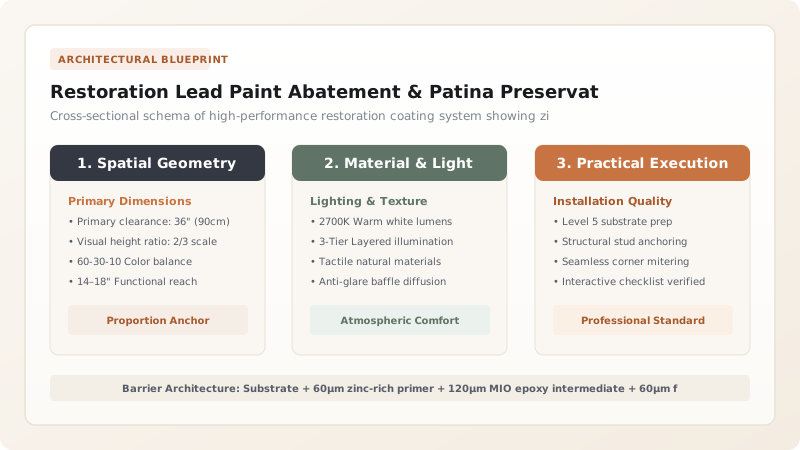
1. Lead Paint Abatement & Environmental Regulations
Historic ironwork installed before 1970 was almost universally primed with red lead (trilead tetroxide, \(\text{Pb}_3\text{O}_4\)) or white lead. Lead is a cumulative neurotoxin; conventional dry open-air abrasive blasting creates hazardous clouds of lead dust and is strictly prohibited in urban settings.
Conservation standards mandate full negative-pressure containment shrouds equipped with HEPA filtration units (minimum 99.97% efficiency at 0.3 microns). All blast residues, chemical runoff, and paint chips must be collected as hazardous industrial waste.
2. Comparative Stripping: Laser Ablation vs Chemical Poulticing
To strip heavy lead paint without pitting the underlying historic iron substrate:
- Pulsed Nd:YAG Laser Ablation (1064nm): Laser pulses vaporize the organic binder of paint layers in microseconds. The bare metal substrate reflects the beam once exposed, leaving original foundry sand-cast textures and blacksmith hammer marks completely undamaged.
- pH-Neutral Chemical Poulticing: Solvents or alkaline pastes covered with laminated fibrous blankets. The poultice draws softened paint into the paper blanket over 24 hours, allowing clean peeling with zero airborne particulate release.
3. Tannic Acid Chelation & MIO Barrier Systems
Where sound tightly adherent rust cannot be removed without thinning the metal profile, conservators apply a tannic acid conversion treatment (5% to 10% alcoholic solution). The tannic acid reacts with ferric oxyhydroxides to form a stable, insoluble, bluish-black ferric tannate polymer complex that halts electrochemical corrosion.
Over this stabilized base, a modern Micaceous Iron Oxide (MIO) epoxy barrier coat is applied. The microscopic lamellar (platelet) structure of micaceous iron oxide overlaps like fish scales, multiplying the path length moisture and oxygen molecules must travel to reach the iron surface by more than ten times.
Comparative Paint Abatement & Stripping Technology
Use this reference table to calculate exact physical dimensions, ratios, and specifications before purchasing:
| Stripping Method | Substrate Preservation | Lead Hazard Containment | Field Applicability | Relative Cost |
|---|---|---|---|---|
| Pulsed Laser Ablation (Nd:YAG) | Superior (Zero profiling) | Superior (Integrated vacuum shroud) | Moderate (Requires 400V 3-phase power) | High |
| Alkaline Chemical Poultice | Excellent (Non-abrasive) | High (Peels away as damp paste) | Excellent (Ideal for occupied facades) | Moderate |
| Micro-Abrasive Sponge Blasting | Good (Low profiling) | Moderate (Sponge absorbs dust) | High (Standard mobile blast rigs) | Moderate |
| Open Dry Sandblasting | Very Poor (Eats metal away) | Prohibited (Illegal lead contamination) | Unacceptable for heritage | Low (Unsafe) |
Safety & Environmental Constraints
Every successful decoration project must account for physical and environmental constraints:
Hazardous Waste Disposal
Lead paint residues must be manifested, tested via TCLP (Toxicity Characteristic Leaching Procedure), and sent to licensed hazardous disposal facilities.
Temperature Windows for Painting
Epoxy and polyurethane coatings require minimum 10°C ambient temperature and relative humidity < 85% to cure properly.
Protocol for In-Situ Balustrade Lead Abatement and Recoating
Execute this professional sequence to achieve flawless results without backtracking:
Scaffolding Containment Shrouding
Erect negative-pressure scaffold containment with HEPA air scrubbers and floor capture tarps.
Laser or Chemical Paint Removal
Strip multi-layer historic paint down to bare metal; vacuum all residues with certified HEPA extractors.
Rust Jacking Removal & Socket Descaling
Melt out oxidized lead anchor collars; chisel away expanded iron oxide from within limestone anchor sockets.
Tannic Acid Passivation
Apply two coats of 10% tannic acid solution to convert micro-rust into a protective ferric tannate film.
Three-Tier Coating Application
Spray zinc-rich epoxy primer (60µm DFT), followed by MIO epoxy intermediate coat (120µm DFT).
Historic Patina Topcoat & Lead Setting
Apply UV-resistant aliphatic polyurethane topcoat; re-pour and hand-caulk virgin lead around post anchors.
Common Mistakes & Countermeasures
Avoid these costly errors that compromise aesthetics, ergonomics, and budget:
Pressure-washing stripped ironwork with water and leaving it to air dry overnight
Using silicone sealant instead of lead to caulk railing anchors into stone sockets
Project Execution Checklist
Track your physical progress. Checkboxes persist automatically on this device:
Frequently Asked Questions
How do conservators recreate the historic Art Nouveau green patina?
Conservators analyze paint cross-sections under polarized light microscopy to identify original pigments (often chrome green, French ochre, and zinc white) and formulate modern aliphatic polyurethane coatings matching the exact color, gloss level, and translucent depth.
Why is lead caulking still preferred over modern epoxy mortars for stone anchor sockets?
Molten lead accommodates differential thermal expansion between iron and stone without cracking, absorbs dynamic structural vibrations from wind and pedestrian loads, and can be easily melted out for future restoration without damaging the carved stone.


