
An Andalusian Reja is a monumental hand-forged wrought iron window grille that defines the architectural identity of Seville, Córdoba, and Granada. Combining Roman, Moorish, and Spanish Baroque metalworking traditions, rejas project outward over courtyards and street facades on forged corbel brackets. Crafted from low-carbon wrought iron, they feature pierced pass-through bar joinery, hot-driven rivets, repoussé acanthus scrollwork, and natural beeswax or graphite patinas.
At a Glance: Key Takeaways
- Pierced Pass-Through Bars: Vertical and horizontal square bars threaded through hot-punched eyes without welding.
- Cantilevered Projecting Cage (Reja de Pecho): Convex bellied or boxed profiles extending 200mm to 400mm past the masonry wall.
- Repoussé & Chiseled Crestings: Hand-hammered sheet iron acanthus crests (copetes) crowning the upper transom frieze.
- Lead-Poured Masonry Anchors: Forged mounting tangs embedded into limestone or lime-mortared brick with molten lead caulking.
- Low-Carbon Charcoal Iron: Fibrous charcoal-smelted wrought iron providing exceptional tensile ductility and natural corrosion resistance.
In-Depth Guides in this Directory
Explore specialized subtopic blueprints, technical dimensions, and execution checklists:
Pierced Pass-Through Bars & Hot-Riveted Lattice Joinery
Forge techniques, drift punching, thermal shrinkage locking, and hot riveting for Andalusian wrought iron window grilles.
Repoussé Acanthus Crestings & Forged Spiral Volutes
Chasing, repoussé, and horn-anvil scroll forging of decorative acanthus crestings (copetes) and volute consoles in Andalusian rejas.
Exterior Courtyard Surrounds & Traditional Anti-Corrosion Finishes
Masonry jamb integration, courtyard microclimate dynamics, and natural beeswax-graphite corrosion finishes for Andalusian wrought iron.
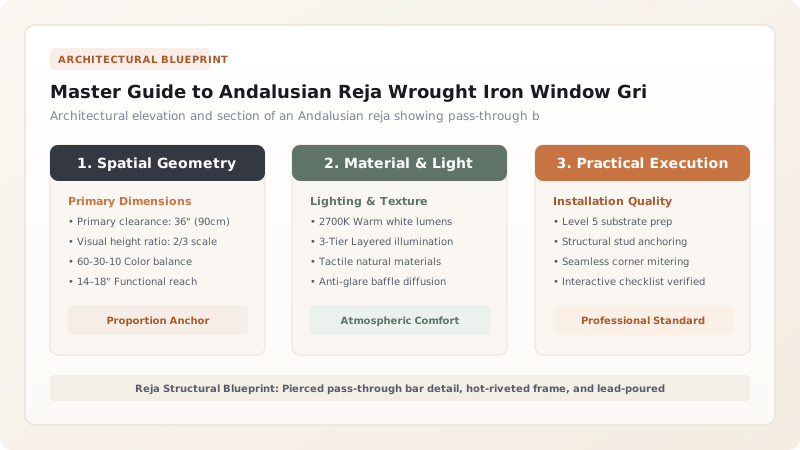
1. Cultural Evolution & Anatomy of the Andalusian Reja
Originating in medieval Moorish Al-Andalus and evolving through Renaissance and Baroque periods, the reja (from Latin regula, bar) is far more than a defensive window guard. In the domestic architecture of Seville, Córdoba, and Jerez de la Frontera, the reja serves as an intermediate micro-threshold between public street and private domestic courtyard (patio andaluz).
A monumental Andalusian reja consists of three architectural zones:
- The Guarding Lattice (El Enrejado): The primary vertical field of square or split-twist iron bars, often swelling outward in an elegant convex belly (reja de pecho de paloma or dove-breast grille).
- The Upper Cresting (El Copete): An ornamental frieze of repoussé acanthus leaves, forged scrolls, and central heraldic rosettes.
- The Corbel Brackets (Las Peanas): Forged scroll consoles anchored into the masonry beneath the stone window sill, supporting the cantilevered weight of the iron cage.
2. Blacksmithing Joinery: Pierced Pass-Through Bars
The hallmark of master Spanish ironsmithing (cerrajería artística) is the complete absence of modern electric arc welding. Where horizontal and vertical square bars cross, traditional smiths employ pierced pass-through joinery:
The blacksmith heats a vertical bar in the coal forge to bright orange heat (950°C to 1,050°C). Using a square tapered drift punch (punzón) under the anvil hammer, the smith punches a square eye directly through the center of the solid bar, upsetting the heated iron so that the metal bulges gracefully around the hole. The horizontal bar is then threaded through the punched hole while hot.
As the iron cools and shrinks, the punched eye contracts tightly around the passing bar. This mechanical connection achieves immense structural rigidity while celebrating the plastic, flowing character of hand-worked iron.
3. Anchorage Mechanics: Molten Lead Pouring into Stone
Because a solid wrought iron reja weighs between 80kg and 350kg and projects 300mm outward from the facade, the anchorage into the surrounding masonry must resist substantial cantilever overturning moments \(M = W \cdot e\).
Traditional Andalusian masons never used expanding mechanical wedge anchors or plastic rawlplugs. Mounting tangs (garras de anclaje) were forged with split, fishtailed ends and inserted 120mm to 180mm deep into pre-drilled holes in the stone masonry. Masons then poured molten lead (plomo fundido, melting point 327°C) directly into the hole around the red-hot iron tang.
As the lead cooled, it expanded slightly into the microscopic porous crevices of the limestone, locking the fishtailed iron permanently in place with zero risk of water penetration or freeze-thaw spalling.
Andalusian Reja Construction Specifications
Use this reference table to calculate exact physical dimensions, ratios, and specifications before purchasing:
| Architectural Element | Traditional Master Specification | Modern Reproduction Standard | Structural / Aesthetic Impact |
|---|---|---|---|
| Iron Stock | Fibrous charcoal-smelted wrought iron (puddle iron) | Low-carbon mild steel (ASTM A36) | Natural rust resistance; visible fibrous grain vs uniform steel |
| Bar Crossing Joinery | Hot-punched pierced pass-through eyes | Electric MIG fillet welding, ground flat | Authentic upset iron bulge vs sterile, brittle weld beads |
| Crest Detailing | Hand-hammered repoussé sheet iron acanthus | Laser-cut 3mm steel plate with stamped petals | Fluid 3D volume and shadow vs flat 2D laser edges |
| Masonry Anchors | Fishtail forged tangs caulked with molten lead | Stainless steel threaded rod with chemical epoxy | Reversible historic anchoring; zero masonry cracking |
| Protective Patina | Boiled linseed oil + beeswax + graphite flakes | Modern epoxy primer + black polyurethane paint | Silky living metallic sheen vs thick plastic paint coating |
Corrosion & Environmental Constraints
Every successful decoration project must account for physical and environmental constraints:
Maritime Salt Fog
Coastal Andalusian cities (Cádiz, Málaga) experience high salt aerosols; wrought iron requires annual linseed-beeswax nourishment.
Masonry Shear Load
Stone window jambs must have at least 150mm edge distance from the anchor holes to prevent stone corner breakout.
Forging and Installing an Andalusian Wrought Iron Reja
Execute this professional sequence to achieve flawless results without backtracking:
Bar Stock Selection & Cutting
Select solid square wrought iron bars (16mm to 20mm); cut vertical and horizontal lattice elements to finished length.
Hot Punching (Piercing)
Heat vertical bars to 1,000°C; punch square pass-through eyes at 120mm on-center intervals using a tapered steel drift on the anvil.
Assembly & Threading
Thread horizontal bars through the punched eyes of the vertical bars while warm; align layout on the forge welding platen.
Hot Riveting the Perimeter Frame
Assemble the outer channel frame; drill and drive 10mm round-head rivets at 900°C, peening heads over with a ball-peen hammer.
Acanthus Repoussé Crest Forging
Hammer sheet iron over pitch bowls using chasing punches to form 3D acanthus leaves; hot-rivet cresting to top transom.
Lead-Poured Wall Anchoring
Drill 30mm holes into stone window jambs; insert fishtailed mounting tangs and pour molten lead around iron shanks.
Common Mistakes & Countermeasures
Avoid these costly errors that compromise aesthetics, ergonomics, and budget:
Using electric spot welding to join intersecting lattice bars
Coating authentic wrought iron in thick glossy oil-based enamel paint
Project Execution Checklist
Track your physical progress. Checkboxes persist automatically on this device:
Frequently Asked Questions
Why do Andalusian rejas belly outward like a cage at the bottom?
The curved belly profile (reja de pecho de paloma) served dual practical purposes: it allowed courtyard residents to lean out and converse with visitors on the street below, and provided a safe suspended shelf for terracotta flower pots filled with fragrant geraniums and jasmine.
How does authentic wrought iron resist rust better than modern mild steel?
Historic wrought iron is not pure iron; it contains microscopic siliceous slag fibers (up to 2% by weight) distributed longitudinally through the metal. These glass-like slag fibers block moisture and oxygen from penetrating deep into the iron, causing the metal to form a stable, protective iron oxide patina rather than flaking rust.


