
Layout Art Deco sunburst feature panels by calculating angular segments radiating from a central focal hub (such as 16 rays at 22.5° each, or 24 rays at 15° each). Cut consecutive bookmatched slices of quartersawn exotic wood veneer (such as French walnut, figured sycamore, or amboyna burl) and antique mirror rays, separated by solid brass stringers.
At a Glance: Key Takeaways
- Radial Trigonometry (16-Ray & 24-Ray Formats): Divides circular or semi-circular panels into 22.5° or 15° angular rays.
- Consecutive Bookmatched Veneer Slices: Slicing successive leaves from a single veneer flitch creates perfect mirror symmetry.
- Radial Grain Direction Vectors: Wood grain flows outward along each ray, creating dynamic shifting light reflection as you walk past.
- Antique Foxed Mirror Ray Alternation: Alternating wood veneer rays with antique smoked mirror strips for dazzling Art Deco depth.
- Vacuum-Press Substrate Lamination: 29" Hg vacuum clamping ensures every delicate pie-shaped ray stays permanently flat.
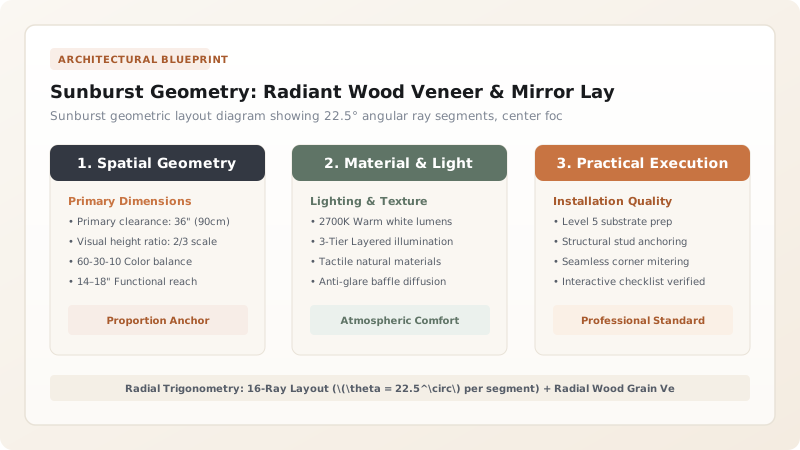
1. Radial Trigonometry: The 16-Ray (22.5°) & 24-Ray (15°) Angular Grid
The Art Deco Sunburst (*Rayon de Soleil*) represents the dawn of a new modern era. Whether applied to headboard walls, overmantels, or elevator doors, the pattern is governed by strict radial division.
For a standard semi-circular overmantel panel (\(180^{\circ}\) arc), dividing into 8 equal rays requires an Angular Segment of \(\theta = 22.5^{\circ}\):
$$\theta = \frac{180^{\circ}}{8} = 22.5^{\circ} \qquad (\text{or } \theta = \frac{360^{\circ}}{16} = 22.5^{\circ} \text{ for full circle})$$
Veneers must be sliced with zero angular error; a microscopic \(0.1^{\circ}\) error per ray accumulates into an unsightly gap at the final seam. Explore antique mirror walls in antique foxed mirror feature walls.

2. Consecutive Flitch Slicing & Antique Mirror Ray Inlays
To achieve the signature optical shimmer of Art Deco marquetry, wood grain must radiate outward along the centerline of each ray.
Craftsmen slice successive leaves from a single Quartersawn French Walnut or Burl Amboyna Flitch. For dramatic luxury, alternate wood rays with Antique Smoked Mirror Strips with 1/2" Beveled Edges. Review lacquer finishes in piano black lacquer and polished brass.
Sunburst Ray Layout Specifications
Use this reference table to calculate exact physical dimensions, ratios, and specifications before purchasing:
| Sunburst Geometry | Ray Count (Arc) | Segment Angle (\(\theta\)) | Visual Intensity |
|---|---|---|---|
| 16-Ray Full Circle (Optimal) | 16 Rays (360° Circle) | 22.5° per ray | Balanced, dramatic architectural focus |
| 24-Ray Full Circle | 24 Rays (360° Circle) | 15.0° per ray | Intricate, fine jewelry-like marquetry |
| 8-Ray Semi-Circle Fan | 8 Rays (180° Fan) | 22.5° per ray | Classic over-door / over-fireplace transom |
| 12-Ray Semi-Circle Fan | 12 Rays (180° Fan) | 15.0° per ray | High-density Art Deco theater motif |
Radial Apex Grain Splay Splitting Constraints
Every successful decoration project must account for physical and environmental constraints:
Veneer Tips Splintering and Crumbling at the Sharp Central Hub Point
16 sharp veneer tips meeting at a single micro-point splinter under pressure; terminate all radiating rays into a solid 3-inch or 4-inch half-round Brass or Ebony Medallion Disc at the center, eliminating delicate knife-edge point failures.
How to Layout, Cut, and Assemble a Sunburst Veneer Panel
Execute this professional sequence to achieve flawless results without backtracking:
Draft CAD Layout with Angular Offsets
Draft full-scale sunburst vector drawing divided into exact 22.5° radial wedges with center disc.
Build Tapered Guillotine Cutting Jig
Build 22.5° angle slicing jig with steel straightedge for shaving veneer leaves on a shooting board.
Slice 16 Consecutive Flitch Leaves
Cut 16 sequential veneer leaves from quartersawn walnut flitch, keeping leaves in exact bookmatch order.
Tape Radial Seams with Perforated Veneer Tape
Fit adjacent rays together; apply wet gummed paper veneer tape across all top face joints.
Vacuum-Press to 3/4" MDF Substrate
Laminate assembly to MDF substrate in 29" Hg vacuum press with structural epoxy and balancing backer.
Rout Center Cavity and Drop Solid Brass Disc
Rout 3" circular pocket at apex; epoxy solid polished brass hub medallion flush with wood surface.
Common Mistakes & Countermeasures
Avoid these costly errors that compromise aesthetics, ergonomics, and budget:
Using Random Wood Scraps Rather Than Consecutive Flitch Leaves
Project Execution Checklist
Track your physical progress. Checkboxes persist automatically on this device:
Frequently Asked Questions
Can you use real mirror glass in a sunburst panel alongside wood veneer?
Yes! The wood substrate is routed with 1/4" deep recessed channels; the wood is veneered and lacquered first, and custom-cut 1/4" beveled antique mirror rays are bedded flush in neutral-cure mirror mastic.


