
Achieve an authentic Art Deco piano black lacquer mirror finish by applying high-solids polyester primer over moisture-resistant MDF, block-sanding dead-flat with 600-grit paper. Spray 4 coats of jet-black basecoat followed by 8 coats of clear acrylic polyurethane lacquer, wet-sand from 1,000 to 3,000-grit, and rotary-buff with fine compound to 100 gloss units.
At a Glance: Key Takeaways
- High-Solids Polyester Primer Base: Fills every microscopic pore in MDF, preventing lacquer telegraphing over time.
- Deep Jet-Black Carbon Pigments (*Nigrosin Black*): Delivers intense, light-absorbing black without milky blue or brown undertones.
- 8 to 12 Multi-Coat Lacquer Build: Provides the physical coating depth required for aggressive flat block-sanding and buffing.
- Progressive Wet-Sanding (1,000 to 3,000-Grit): Levels orange peel into an optically flat, distortion-free reflective plane.
- Solid Mirror-Polished Brass (Alloy C36000): Polished with jewelers rouge and sealed in clear bake-on lacquer for tarnish-free brilliance.
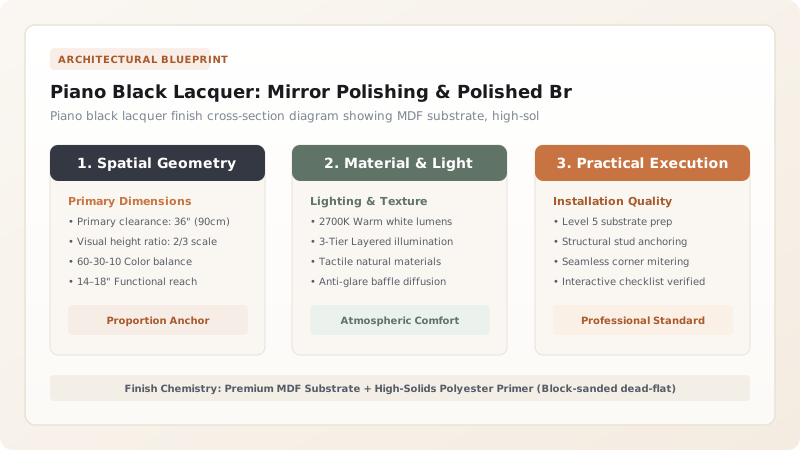
1. Polymer Chemistry: Polyester Primer & Deep Black Basecoats
True Piano Black Lacquer (*Noir Laque Piano*) is not just black paint—it is an Optically Flat Mirror that reflects room architecture with zero distortion or 'orange peel' texture.
The secret lies in the substrate preparation: applying two heavy coats of High-Solids Unsaturated Polyester Primer (ICA or Milesi). Unlike standard primers that shrink for months, polyester cures 100% by chemical reaction with zero shrinkage, creating a glass-smooth rock-hard foundation. Review millwork curves in stepped speed lines millwork.

2. Progressive Wet-Sanding & Polished Brass Metal Integration
After spraying 8 coats of clear 2K polyurethane lacquer and letting it cure for 7 days, the finisher begins Progressive Wet-Sanding.
Sand with a hard rubber block using 1,000-grit, 1,500-grit, 2,000-grit, and 3,000-grit micro-abrasives with soapy water lubricant. Machine-buff with rotary foam pads and fine compound. Pair with Art Deco Streamline Moderne styling and inlaid solid brass trims.
Lacquer Coating Formulations Comparison
Use this reference table to calculate exact physical dimensions, ratios, and specifications before purchasing:
| Coating Formulation | Solids by Volume | Shrinkage Over Time | Polishable Mirror Gloss |
|---|---|---|---|
| 2K Acrylic Polyurethane (Milesi / ICA) | 50% Solids (Rigid thermoset) | 0% (Does not shrink or check) | 100 Gloss Units (Optical Mirror) |
| Traditional Nitrocellulose Lacquer | 20% Solids (High solvent) | High (Checks and crazes with age) | 90 Gloss Units (Warm vintage patina) |
| Waterborne Acrylic Gloss Finish | 30% Solids | Low | 75 Gloss Units (Lacks depth & clarity) |
| Oil-Based Gloss Enamel (Hardware store) | 40% Solids | Moderate (Yellows severely) | FAILS: Cannot be wet-sanded & buffed |
Buffing Swirl Hologram Scratch Constraints
Every successful decoration project must account for physical and environmental constraints:
Rotary Buffing Leaving Microscopic Hologram Swirl Marks Visible Under Spotlights
High-speed rotary polishers leave faint buffer swirls on black lacquer; finish with a dual-action (DA) orbital polisher fitted with an ultra-soft black foam finishing pad and Menzerna micro-fine finishing polish (SF 3800) under LED inspection lamps.
How to Spray, Sand, and Buff Piano Black Lacquer
Execute this professional sequence to achieve flawless results without backtracking:
Prep Premium Moisture-Resistant MDF
Sand Medite MR-MDF substrate to 220-grit; bevel all sharp corners with 1/16" radius ease.
Spray High-Solids Polyester Primer
Apply two coats of 2K polyester primer; let cure 24 hours and block-sand dead-flat with 600-grit.
Spray Jet-Black Polyurethane Basecoat
Apply two wet coats of deep jet-black 2K polyurethane basecoat in a clean downdraft spray booth.
Spray 8 Coats of Clear High-Gloss Lacquer
Spray 8 coats of clear 2K acrylic polyurethane lacquer, building a 6-mil dry film thickness.
Wet-Sand from 1,000 to 3,000-Grit
Allow lacquer to cure 7 days; wet-sand with soapy water using hard sanding blocks through 3,000-grit.
Rotary Buff with Wool Pad and Fine Compound
Machine-buff at 1,500 RPM with wool pad and coarse compound, followed by foam pad fine polish.
Install Polished Solid Brass Accents
Inlay solid C36000 brass stringers and hardware buffed with jewelers rouge.
Common Mistakes & Countermeasures
Avoid these costly errors that compromise aesthetics, ergonomics, and budget:
Hand-Sanding Piano Lacquer with Bare Fingers Instead of a Hard Block
Project Execution Checklist
Track your physical progress. Checkboxes persist automatically on this device:
Frequently Asked Questions
How do you clean and maintain piano black lacquer furniture?
Never wipe dry lacquer with paper towels (which cause micro-scratches). Dust gently with an ultra-plush microfiber cloth misted with anti-static optical lens cleaner or distilled water.


