
Execute authentic chemical mirror foxing by stripping the rear protective grey enamel with paint stripper, then applying a dilute solution of 10% Muriatic (Hydrochloric) Acid mixed with hydrogen peroxide using a spray bottle and sea sponge. Once the silver oxidizes to desired opacity, neutralize with baking soda water and seal with black acrylic paint.
At a Glance: Key Takeaways
- Paint Stripping Stage: Citrus or solvent stripper removes the grey backing without scratching the ultra-thin silver layer.
- 10% Muriatic Acid Reaction: Hydrochloric acid reacts with the silver and copper flash, dissolving metal into cloudy clusters.
- Neutralization Bath (Baking Soda Water): Halts chemical acid reaction instantly to prevent over-stripping into clear glass.
- Back-Sealing Layer: Black, gold, or charcoal backing paint locks the patina and provides rich visual depth from the front.
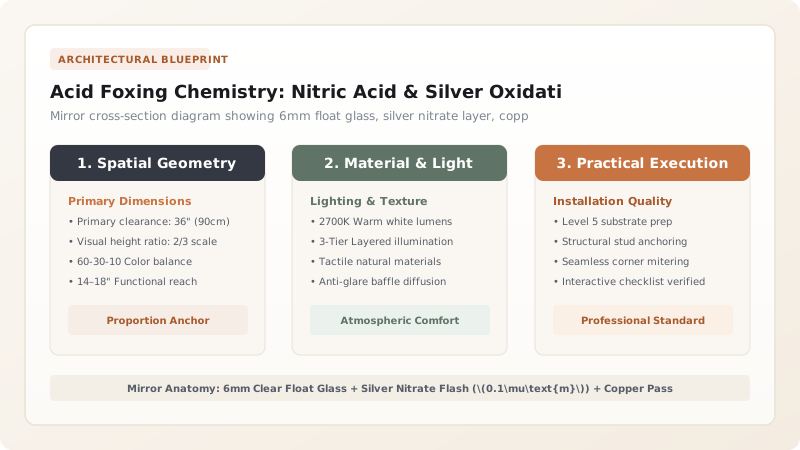
1. Chemical Physics: Oxidation-Reduction of Silver Nitrate
Modern mirrors are manufactured by depositing a microscopic layer of pure Silver Nitrate (\(\text{AgNO}_3\)) and Copper (\(0.1\mu\text{m}\text{ thick}\)) onto polished float glass via chemical precipitation, protected by a heat-cured grey alkyd enamel paint.
To create authentic vintage foxing, the protective paint is stripped in organic patterns. Applying an oxidizing acid mixture:
$$2\text{Ag} + 2\text{HCl} + \text{H}_2\text{O}_2 \longrightarrow 2\text{AgCl} + 2\text{H}_2\text{O}$$
The reaction converts reflective metallic silver into translucent Silver Chloride (\(\text{AgCl}\)), recreating the 100-year atmospheric degradation found in French châteaux. For framing details, see grid panel bevel spacing.

2. Toning Washes: Golden Amber vs Dark Mercury Shading
Once the acid reaction is neutralized, the exposed bare glass areas behind the oxidized silver can be customized with background toning coats:
- Warm Golden Amber Patina: Spraying a sheer coat of bleached shellac or gold mica dye gives reflections a warm, flattering candlelight tone.
- Deep Dramatic Mercury Patina: Backing with matte black or charcoal acrylic paint gives the cloudy veins rich, moody contrast.
Always seal the finished back with solvent-resistant polyurethane lacquer before mounting with safety-rated mirror mastic.
Chemical Distressing Agents & Resulting Patinas
Use this reference table to calculate exact physical dimensions, ratios, and specifications before purchasing:
| Chemical Distressing Agent | Oxidation Speed | Visual Patina Character | Safety Level |
|---|---|---|---|
| Dilute Muriatic Acid + Peroxide (Optimal) | Fast (2 - 5 Minutes) | Organic cloudy mercury halos & mottled spots | Wear respirator & nitrile gloves |
| Full-Strength Bleach (Sodium Hypochlorite) | Very Slow (1 - 2 Hours) | Faint yellow speckles (Lacks deep clouding) | Moderate ventilation required |
| Nitric Acid Wash (Professional) | Ultra-Fast (30 Seconds) | Dramatic antique gold & black crystal fractures | EXTREME CAUTION: Professional laboratory only |
| Steel Wool Mechanical Abrasion (DIY) | Manual scraping | FAILS: Visible linear scratch marks (Unnatural) | Low safety risk (Poor result) |
Over-Acidification Total Silver Loss Constraints
Every successful decoration project must account for physical and environmental constraints:
Acid Left on Mirror Too Long Turning 100% of Panel Transparent
Muriatic acid dissolves silver rapidly; leaving acid for 10 minutes strips all silver, leaving clear glass; mist acid in 60-second intervals, checking progress from the front face with a flashlight, and flood immediately with baking soda water when 20% foxing is reached.
How to Chemically Distress a Mirror Pane
Execute this professional sequence to achieve flawless results without backtracking:
Apply Chemical Paint Stripper
Brush heavy paste paint stripper over the grey backing enamel; let sit 30 minutes until paint wrinkles.
Scrape Paint Gently with Plastic Spatula
Remove softened paint without scratching the delicate silver layer underneath; rinse with water and dry.
Mist Dilute Muriatic Acid Solution
Mix 1 part muriatic acid with 3 parts water and 1 part hydrogen peroxide; mist lightly onto edges with spray bottle.
Dab Organic Texture with Sea Sponge
Dab acid puddles with a sea sponge to create irregular cloudy clustering along perimeter borders.
Neutralize in Baking Soda Bath
Flood panel with 10% sodium bicarbonate (baking soda) water to instantly halt the acid reaction.
Seal with Matte Black Protective Paint
Spray 2 coats of black acrylic enamel over the dried back to protect silver and create deep contrast.
Common Mistakes & Countermeasures
Avoid these costly errors that compromise aesthetics, ergonomics, and budget:
Using Metal Scrapers to Remove Grey Backing Paint
Project Execution Checklist
Track your physical progress. Checkboxes persist automatically on this device:
Frequently Asked Questions
Can you chemically distress a mirror that has safety backing film?
No. Safety-backed mirrors have a heavy woven vinyl film glued to the rear that cannot be chemically stripped. You must start with standard 4mm or 6mm raw silver-backed float glass.


