
Mount heavy decorative mirror feature walls (exceeding 50kg / 110 lbs) using a dual safety system: support 100% of the vertical dead load with a bottom mechanical J-channel or interlocking aluminum French cleats screwed into studs. Apply non-staining neutral-cure mirror mastic in vertical golf-ball sized mounds to lock the face flush to the wall.
At a Glance: Key Takeaways
- Dead Load vs Shear Force: Mechanical cleats carry 100% of vertical weight; mastic prevents outward peeling and wall vibration.
- Solvent-Free Neutral-Cure Chemistry: Prevents chemical black rot from attacking the mirror silvering over time.
- Vertical Mastic Column Pattern: Allows continuous airflow from floor to ceiling for rapid adhesive curing.
- Aluminum J-Channel Bottom Track: Continuous concealed metal ledge provides permanent earthquake-safe foundation.
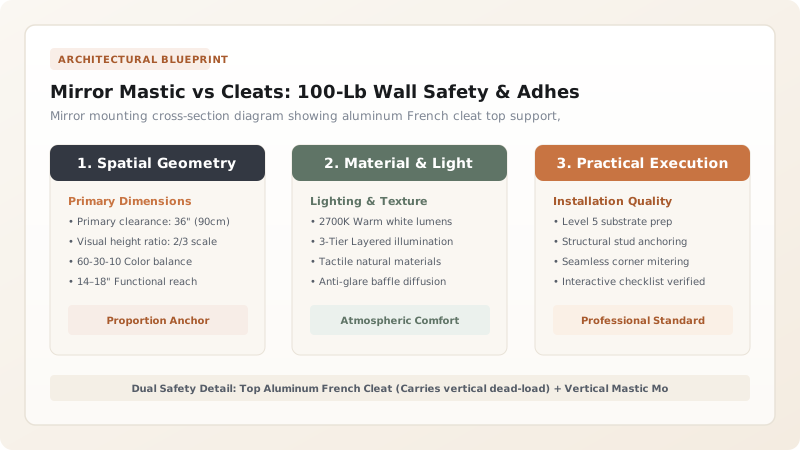
1. Adhesive Chemistry: Solvent-Based vs Neutral-Cure Polymer
Standard heavy-duty construction adhesives (such as Liquid Nails or polyurethane grab adhesives) contain harsh hydrocarbon solvents. When applied to the back of a mirror, the solvents penetrate the protective paint within 3 to 6 months, chemically dissolving the silver and leaving ugly black rotting stains across the glass.
Professional glaziers strictly use Neutral-Cure Polymer Mirror Mastic (such as Gunther Premier Plus or Franklin Mirror Adhesive). These adhesives contain zero solvents, cure by absorbing ambient air humidity, and remain permanently elastomeric to absorb building expansion. For acid distressing recipes, explore mirror acid oxidation chemistry.

2. Dead-Load Calculations & Mechanical Cleat Engineering
A full-height feature wall measuring \(3.0\text{m} \times 2.4\text{m}\) with 6mm glass weighs approximately 108kg (238 lbs). Relying on glue alone to hold this weight creates catastrophic liability if drywall paper ever delaminates.
Install a Continuous Bottom Aluminum J-Channel or Interlocking Extruded Aluminum French Cleats lag-screwed directly into 16-inch on-center wall studs. This ensures the vertical dead load is carried by structural framing, while the mastic prevents outward tilting. For panel alignment, see beveled grid spacing standards.
Mirror Mounting Systems & Safety Capacity
Use this reference table to calculate exact physical dimensions, ratios, and specifications before purchasing:
| Mounting Method | Dead-Load Capacity | Silver Coating Safety | Building Code Compliance |
|---|---|---|---|
| J-Channel + Neutral Mastic (Optimal) | 200+ kg (Supported by studs) | 100% Safe (Zero chemical attack) | Meets all commercial safety codes |
| Aluminum French Cleat System | 150 kg (Supported by studs) | 100% Safe (Mechanical bracket) | Meets commercial safety codes |
| Standard Construction Adhesive (DANGER) | 50 kg (Risks drywall tear-off) | FAILS: Destroys silvering with black rot | Violates glass safety standards |
| Adhesive Foam Tabs Only | 10 kg (Lightweight craft only) | Moderate | DANGEROUS on large architectural glass |
Drywall Paper Delamination Constraints
Every successful decoration project must account for physical and environmental constraints:
Heavy Mirror Pulling Drywall Paper Off Gypsum Core
Mirror mastic bonds to the top paper layer of drywall; if 100 lbs of glass is glued without bottom mechanical support, the paper shears off the gypsum core, causing the mirror to crash down; always install a bottom mechanical support ledge screwed into studs.
How to Mount Heavy Mirrors with Mastic and Cleats
Execute this professional sequence to achieve flawless results without backtracking:
Locate Wall Studs with Stud Finder
Mark exact stud centerlines across the wall using painter's tape.
Screw Aluminum J-Channel into Studs
Fasten bottom J-channel dead-level using 2.5" structural screws into every stud.
Apply Mastic in Vertical Golf-Ball Mounds
Apply Gunther mastic in 2-inch diameter mounds spaced 12 inches apart vertically on mirror back.
Set Mirror Bottom into J-Channel
Rest bottom edge in J-channel, tilting mirror upward against the wall.
Press Firmly with Suction Cups
Press mirror against wall until mastic mounds compress to approximately 3mm thickness.
Brace for 24 Hours
Use temporary wood braces or painter's tape to secure mirror while mastic cures fully.
Common Mistakes & Countermeasures
Avoid these costly errors that compromise aesthetics, ergonomics, and budget:
Applying Mastic in Horizontal Continuous Strips
Project Execution Checklist
Track your physical progress. Checkboxes persist automatically on this device:
Frequently Asked Questions
How much mirror mastic is required per square foot?
Apply approximately one 2-inch diameter golf-ball sized mound of mirror mastic for every 1.5 square feet of mirror area, keeping mounds at least 3 inches away from glass edges to prevent squeeze-out.


