
Bicolor River Pebble Geometric Mosaic Setting is the artisanal discipline that transforms ordinary river stones into monumental graphic floor tapestries. Master pavers sort alluvial pebbles by size, shape, and color into pure white quartzites and deep black basalts. Setting out intricate Moorish strapwork (lacería), stars, and heraldic emblems on a leveled sand-lime bed, the artisan places each stone on edge by hand, driving it to uniform height using specialized wooden beaters (pisones) to create a seamless, non-slip stone carpet.
At a Glance: Key Takeaways
- Calibrated Sizing Gauges: Sorting stones into 30mm, 45mm, and 60mm length bins using wire grading screens.
- Moorish Lacería Geometry: Drafting 8-pointed stars (ruedas) and interlaced borders directly onto the bedding ground.
- Vertical Tap Alignment: Bedding stones on edge, maintaining uniform 1.5mm to 2mm spacing between pebble flanks.
- Wooden Mallet Tamping (Pisonado): Compacting the pebble matrix with heavy olive-wood or holm-oak tamping rammers.
- Contrast Boundary Definition: Framing white pebble motifs with sharp single-stone black basalt outlines.
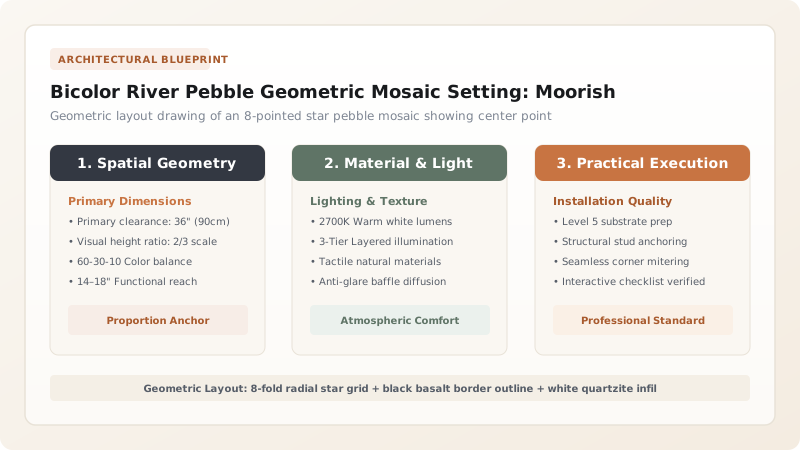
1. Sizing, Grading & Chromatic Sorting
A master empedrado cannot be achieved with random unsorted gravel. The first phase of craftsmanship occurs in sorting bins:
- Length & Thickness Calibration: Pebbles are passed through perforated metal screens to grade them into small (30mm to 45mm for delicate central medallions) and medium (50mm to 65mm for field pavements).
- Shape Selection: Master pavers select elliptical, flattened ovoids (cantos almendrados or almond stones). Spherical stones are rejected because they rotate underfoot, while flat ovoids lock tightly against neighboring stones.
- Chromatic Segregation: Stones are hand-picked for chromatic purity: snow-white quartzites and deep charcoal-black basalts. Mottled brown or red pebbles are set aside for utility borders.
2. Moorish Lacería Drafting & Centerline Scribing
The layout follows classical Islamic geometric principles. The paver establishes the room's central axis using taut chalk snap-lines. From the center point, a trammel compass scribes concentric circles to draft an 8-pointed star (rueda de ocho) or 16-pointed star with interlaced strapwork ribbons (lacería).
Artisans first lay the black basalt stones along the scribed lines, creating a crisp, dark outline like the inked border of an illuminated manuscript. Once the graphic skeleton is established, the interior fields are packed with dense white quartzite pebbles, arranged in radiating concentric fans or parallel chevron waves.
3. The Tamping Ritual: The Pisón & Surface Planarity
After a 1m² section is hand-set, the stones must be brought to an absolute planar datum. The paver places a thick, flat plank of seasoned holm-oak (encina) over the stones and strikes it firmly with a heavy, two-handled wooden rammer (el pisón, weighing 8 to 12 kg).
The impact drives any high stones down into the yielding sand-lime bed while forcing bedding sand upward into the gaps between pebbles. The resulting surface is smooth to walk on barefoot, yet retains sufficient aggregate texture to prevent slipping when wet.
Pebble Mosaic Design Rules & Stone Consumption Matrix
Use this reference table to calculate exact physical dimensions, ratios, and specifications before purchasing:
| Design Pattern | Pebble Size Class | Stones per m² (Approx.) | Pebble Bedding Depth | Visual Application |
|---|---|---|---|---|
| 8-Pointed Star (Rueda) | Small (30mm - 45mm) | 900 - 1,200 stones | 35mm - 40mm Embedded | Central courtyard focal medallion |
| Interlaced Border (Greca) | Medium (45mm - 60mm) | 750 - 950 stones | 45mm - 50mm Embedded | Framing bands along walkways |
| Herringbone Field (Espiga) | Standard (50mm - 70mm) | 650 - 800 stones | 50mm - 55mm Embedded | General patio floor paving |
| Wavy Wave Field (Ondas) | Large (60mm - 80mm) | 550 - 700 stones | 55mm - 65mm Embedded | Broad carriage entrances (Zaguanes) |
Physical & Craft Constraints
Every successful decoration project must account for physical and environmental constraints:
Ergonomic Physical Demands
Pavers work on their knees for 8 to 10 hours daily, setting up to 1,000 stones by hand per square meter.
Weather Limitations
High summer heat (> 42°C) dries bedding sand too rapidly, requiring work under shade awnings or during early morning hours.
Protocol for Setting a Geometric Pebble Medallion
Execute this professional sequence to achieve flawless results without backtracking:
Substrate Leveling & Moistening
Level sand-lime bed within timber screed rails; mist lightly with water to provide cohesive bedding suction.
Compass Centerline Layout
Locate center nail; scribe concentric radial rings and 45° intersecting axes into damp sand bed using trammeled rod.
Black Contour Outline Setting
Set black basalt pebbles on edge along drafted lines, tapping each stone 40mm deep with a small paver's hammer (maceta).
White Quartzite Infilling
Pack white pebbles into interior polygons on edge; maintain uniform orientation parallel to geometric design lines.
Plank Tamping (Pisonado)
Lay oak tamping board across completed medallion; strike with heavy wooden rammer to achieve uniform plane.
Dry Sand Joint Packing
Sweep dry silica sand and lime powder into joints; mist with fine spray; repeat sweeping until joints are filled to within 5mm of stone crowns.
Common Mistakes & Countermeasures
Avoid these costly errors that compromise aesthetics, ergonomics, and budget:
Mixing random round and spherical stones into flat almond pebble patterns
Washing newly set pebble mosaics with high-pressure hose water before sand has set
Project Execution Checklist
Track your physical progress. Checkboxes persist automatically on this device:
Frequently Asked Questions
How long does a traditional river pebble mosaic floor last?
When bedded vertically on edge in well-drained sand-lime beds, historic Andalusian pebble mosaics routinely last 150 to 300 years under pedestrian traffic with only occasional sweeping of replacement sand into joints.
Can pebble mosaic paving be installed indoors?
Yes. In traditional Andalusian houses, entrance halls (zaguanes) and ground-floor summer dining rooms frequently feature pebble mosaic floors, which remain cool underfoot throughout the summer.


