
Lime-Stabilized Curb Edging and Compression Locking are the essential structural boundary systems that keep unbonded cobblestone paving intact. Because river pebbles are bedded in flexible sand without cement mortar, traffic loads exert intense horizontal outward thrust (lateral creep). Master masons construct rigid perimeter bands using dressed Carmona calcarenite stone ashlars backed by slaked lime-pozzolan concrete haunching, locking the entire pebble pavement in perpetual three-dimensional compressive confinement.
At a Glance: Key Takeaways
- Perimeter Compression Locking: Rigid stone curbs containing lateral aggregate displacement under wheel loads.
- Piedra de Carmona Ashlars: Golden calcarenite blocks dressed with draft margins and bush-hammered treads.
- Hydraulic Lime Haunching: Triangular lime-concrete haunching supporting curb backs without brittle cracking.
- Internal Panel Subdivision: Dividing expansive plazas into 3m x 3m compressive modules to limit cumulative movement.
- Historic Lime Grouting: Non-hydraulic fat lime and crushed calcarenite dust pointing matching historic stone color.
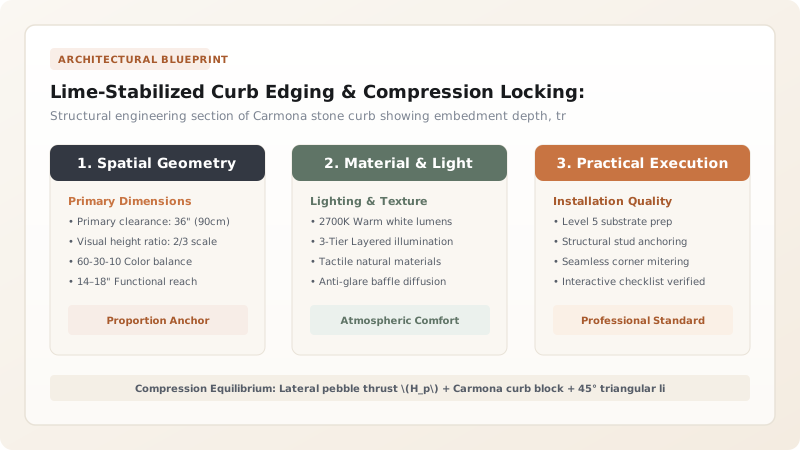
1. Mechanics of Lateral Spreading & Edge Confinement
Flexible pebble pavements behave according to the principles of granular soil mechanics. When a pedestrian foot or carriage wheel presses down on a river pebble, the downward vertical load is transformed into lateral horizontal thrust (\(H_p\)) through radial inter-particle contact angles:
Where \(\phi\) is the internal friction angle of the pebble-sand matrix (typically 35° to 42°). If the edge of the pavement is unrestrained, pebbles migrate outward, causing edge unraveling, subsidence, and total collapse of the mosaic pattern. Permanent stability requires an unyielding, rigid boundary.
2. Dressed Carmona Calcarenite Stone Headers (Encintados)
In western Andalusia, perimeter restraints were constructed from Piedra de Carmona—a porous, golden-yellow biocalcarenite extracted from the historic Los Alcores escarpment. Sawn and dressed into monumental rectangular blocks measuring 150mm to 200mm wide, 250mm to 300mm deep, and 600mm to 1,000mm long, these stones serve as edge headers (encintados).
Because Carmona stone is dense yet porous, it harmonizes aesthetically with the surrounding whitewashed palace walls while providing immense dead weight (bulk density \(\approx 1,850\text{ kg/m}^3\)) that resists outward shove.
3. Hydraulic Lime Haunching & Modular Compartmentalization
To support the Carmona curbs against lateral overturning moments, masons back them with a continuous triangular haunching of hydraulic lime concrete (NHL 5 natural hydraulic lime blended with gravel aggregate at a 45° angle).
Furthermore, master pavers never lay an uninterrupted pebble expanse larger than 4m x 4m. By introducing intersecting internal Carmona stone bands across the courtyard, the expansive pavement is compartmentalized into independent, self-contained compression modules. If ground settling occurs in one quadrant, the remaining mosaic panels remain perfectly locked and undisturbed.
Curb Header Dimensions & Structural Capacity Matrix
Use this reference table to calculate exact physical dimensions, ratios, and specifications before purchasing:
| Application Zone | Carmona Stone Dimensions (mm) | Embedment Depth (mm) | Haunching Specification | Load Rating |
|---|---|---|---|---|
| Private Patio Boundary | 120mm W × 200mm D | 120mm Embedded | NHL 3.5 Lime Mortar Bed | Pedestrian Traffic Only |
| Courtyard Central Panel | 150mm W × 250mm D | 160mm Embedded | Continuous Triangular Haunch | Light Carriage / Golf Cart |
| Palace Carriage Entry (Zaguan) | 200mm W × 300mm D | 200mm Embedded | NHL 5 Lime Concrete Base | Vehicular Delivery (3.5 Tonnes) |
| Public Plaza Perimeter | 250mm W × 350mm D | 240mm Embedded | Reinforced Lime-Pozzolan Haunch | Municipal Street Cleaning Trucks |
Geological & Conservation Constraints
Every successful decoration project must account for physical and environmental constraints:
Quarry Exhaustion & Protection
Historic Carmona quarries have restricted extraction; replacement stone must be sourced from certified active calcarenite beds.
Vehicle Turning Shear
Heavy delivery vehicles turning wheels while stationary can shear individual curb blocks unless curbs are anchored with internal stainless dowels.
Protocol for Installing Carmona Stone Curbs and Compression Haunching
Execute this professional sequence to achieve flawless results without backtracking:
Perimeter Trench Excavation
Excavate 300mm deep perimeter trench along design boundary lines; compact trench base to 95% Proctor density.
Hydraulic Lime Base Screed
Pour 75mm thick leveling bed of NHL 5 natural hydraulic lime concrete (1:2:3 lime, sand, gravel); screed level.
Carmona Stone Setting
Set Carmona ashlar curb blocks on wet mortar bed; align top edges to laser datum string lines with 2mm joint gaps.
Triangular Rear Haunching
Trowel a 45° triangular support wedge of NHL 5 lime concrete along the rear outer face of the curb, extending to within 50mm of top.
Joint Grouting with Lime Putty
Point curb joints with fat lime CL90 and crushed Carmona stone dust mortar; strike slightly recessed with an iron jointer.
Pebble Bed Infilling
Allow curb concrete 7 days to achieve structural strength before placing sand bed and compacting river pebbles against the curb face.
Common Mistakes & Countermeasures
Avoid these costly errors that compromise aesthetics, ergonomics, and budget:
Setting stone curbs without rear triangular concrete haunching
Using modern grey Portland cement to point golden Carmona stone joints
Project Execution Checklist
Track your physical progress. Checkboxes persist automatically on this device:
Frequently Asked Questions
Why is Piedra de Carmona preferred over granite or marble for curb edging in Andalusia?
Carmona stone possesses an incomparable warm golden-yellow color that harmonizes with the brilliant Andalusian sun, white lime walls, and dark river pebbles. Furthermore, its moderate hardness allows stonemasons to dress crisp margins and soft bullnose curves with traditional hand chisels on site.
How do you repair a cracked Carmona stone curb without replacing the whole block?
Conservators execute an in-situ repair by inserting horizontal 6mm threaded stainless-steel or titanium dowels across the fracture, bonding the split with conservation-grade epoxy (Araldite 2020), and repointing the surface hairline seam with natural slaked lime and pulverized Carmona stone dust.


