
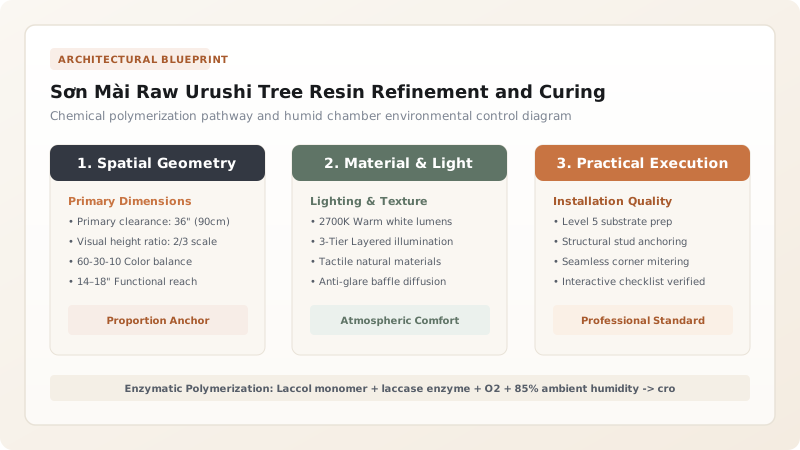
Sơn Mài Raw Urushi Tree Resin Refinement and Curing is the organic biochemical foundation of Vietnamese lacquer art. Sourced from the sap of Toxicodendron succedaneum trees in Phu Tho province, the milky raw sap (sơn sống) contains natural laccol, water, and the copper-bearing enzyme laccase. Rather than curing by solvent evaporation, the resin undergoes enzymatic polymerization strictly within high-humidity dark chambers (buồng ủ) at 85% RH and 28°C. Through hours of slow mechanical stirring (khuấy sơn) in wooden vats, moisture content is reduced to below 3%, transforming milky sap into amber clear lacquer (sơn cánh gián) with extraordinary mechanical resilience.
At a Glance: Key Takeaways
- Phu Tho Sap Tapping: Dawn harvesting of sap from bark incisions on native cây sơn trees.
- Laccase Catalytic Polymerization: Copper-glycoprotein enzyme driving aerobic cross-linking of laccol monomers.
- Buồng Ủ Humid Dark Chamber: Enclosed curing chambers maintaining 80%–90% RH and 25°C–30°C temperature.
- Moisture Content Reduction: Churning raw sap from 30% water down to < 3% to achieve optical transparency.
- Sơn Cánh Gián (Cockroach Wing Amber): Unpigmented translucent amber lacquer displaying deep golden optical refraction.
- Total Chemical Inertness: Cured polymer resisting concentrated hydrochloric acid, boiling water, and organic solvents.
1. Forestry & Harvesting: The Milky Blood of Phu Tho
The geographic cradle of Vietnamese lacquer is the rolling red hills of Tam Nong in Phu Tho province, where cây sơn (Toxicodendron succedaneum) has been cultivated for centuries. Farmers make diagonal cuts in the bark before sunrise, catching the milky white sap in clam shells or bamboo cups before the sun's heat can cause premature oxidation.
The raw sap (sơn sống) is a natural emulsion consisting of 60% laccol, 30% water, 7% water-soluble plant gums, and 1% laccase enzyme. When fresh, the sap is chalky white; upon contact with air, the surface rapidly oxidizes to a glossy chestnut skin.
2. Polymerization Mechanics: The Paradox of Humid Curing
Synthetic varnishes cure when volatile solvents evaporate into dry air. Natural lacquer behaves in the exact opposite manner: it cannot dry in dry air. The curing mechanism is driven by laccase, a complex copper-containing enzyme.
To cross-link the liquid laccol monomers into a dense three-dimensional polymer network, the enzyme requires both dissolved atmospheric oxygen and water vapor. Artisans place coated woodwork inside the buồng ủ—an airtight curing chamber lined with wet hemp sacks and damp earth floors, strictly maintained at 80% to 90% relative humidity and 25°C to 30°C. In this humid womb, the lacquer cures over 3 to 7 days into a diamond-hard, completely non-toxic resin that survives 1,000 years.
3. The Stirring Ritual: Transforming Raw Sap into Cánh Gián
Raw sap cannot be painted directly; its high water content (30%) causes it to cure into an opaque, milky, brittle film. It must undergo khuấy sơn (slow mechanical refinement).
Master refiners pour hundreds of liters of sap into shallow, hemispherical wooden vats carved from ancient jackfruit logs. Using long wooden paddles, artisans churn the sap continuously for 24 to 48 hours under gentle, indirect heat. As water slowly evaporates, the gums break down and the laccase distributes uniformly. The milky sap clarifies into a magnificent, viscous, translucent liquid with the exact color and transparency of a cockroach's wing: sơn cánh gián, the noble golden amber of imperial art.
Vietnamese Natural Lacquer Grade Classification
Use this reference table to calculate exact physical dimensions, ratios, and specifications before purchasing:
| Lacquer Grade | Vietnamese Name | Processing Method | Color / Translucency | Application Area |
|---|---|---|---|---|
| Raw Tree Sap | Sơn Sống | Unfiltered fresh dawn harvest | Milky beige emulsion | Substrate silk wrapping & primer putty |
| Refined Amber Lacquer | Sơn Cánh Gián | 48-hr slow paddle stirring in wood vat | Translucent golden-amber | Final clear glazes & mother-of-pearl burial |
| Black Iron Lacquer | Sơn Then | Stirred with iron filings in cast iron vat | Impenetrable jet black | Monolithic black grounds & pictorial shadows |
| Cinnabar Red Lacquer | Sơn Son | Blended with natural vermilion cinnabar | Rich imperial scarlet | Palace columns, thrones & ancestral shrines |
| Clay Putty Lacquer | Sơn Hom | Raw sap mixed with alluvial silt & sawdust | Thick structural paste | Leveling coats (5 passes) over timber |
Biological & Occupational Constraints
Every successful decoration project must account for physical and environmental constraints:
Severe Occupational Dermatitis
Unpolymerized laccol vaporizes during stirring; apprentices suffer severe face and throat swelling until biological tolerance develops.
Weather Dependency
In cold, dry northern Vietnamese winter months, curing chambers must be artificially humidified with steam boilers to prevent curing halts.
Protocol for Refining Raw Sap and Operating a Buồng Ủ Curing Chamber
Execute this professional sequence to achieve flawless results without backtracking:
Raw Sap Quality Inspection
Inspect fresh sap; verify absence of rainwater dilution; test specific gravity (standard 1.02 to 1.05 g/cm³).
Cotton Cloth Filtration
Strain raw sap through four layers of fine unbleached cotton cheesecloth to remove bark fragments, leaves, and insect debris.
Jackfruit Vat Churning
Pour filtered sap into jackfruit wood vat; churn with paddle at 30 RPM for 36 hours; maintain ambient temperature at 28°C until water < 3%.
Brush Coating Application
Apply refined lacquer onto seasoned wood panel in thin, uniform coats (approx. 0.1mm per pass) using fine human-hair brushes.
Buồng Ủ Chamber Loading
Transfer coated panels into humid chamber; mist chamber walls with clean well water; seal heavy insulated doors.
Hygrometric Monitoring & Curing
Monitor digital hygrometer; maintain 85% RH and 28°C for 72 hours until surface passes tack-free fingernail indentation test.
Common Mistakes & Countermeasures
Avoid these costly errors that compromise aesthetics, ergonomics, and budget:
Applying lacquer coats thicker than 0.2mm in a single pass
Allowing sunlight or direct daylight into the curing chamber
Project Execution Checklist
Track your physical progress. Checkboxes persist automatically on this device:
Frequently Asked Questions
Why are human hair brushes used to apply fine Vietnamese lacquer?
Human hair possesses natural microscopic cuticle scales that hold liquid lacquer with perfect capillary tension without releasing bubbles or brush strokes. Traditional makers collect long, virgin, untreated women's hair, bundling thousands of strands into flat wooden handles glued with raw lacquer. The hairs can be gently worn back with a knife over decades of use.
Is cured natural lacquer safe for contact with hot food and drinks?
Yes, 100%. While raw sap is toxic and allergenic, once fully polymerized in the buồng ủ, the resin converts into an inert, non-toxic, food-safe biopolymer. In fact, traditional Vietnamese lacquer bowls, chopsticks, and tea trays can hold boiling soups, hot tea, and alcoholic spirits without leaching chemicals or degrading.


