
Cẩn Xà Cừ Iridescent Abalone Shell Fret-Cutting represents the exquisite art of mother-of-pearl marquetry perfected in the thousand-year-old craft village of Chuyen My in northern Vietnam. Utilizing radiant shells from marine mollusks—primarily the precious green turban snail (ốc xà cừ / Turbo marmoratus), gold-lip pearl oysters, and abalone—artisans slice the curved shells into flat, paper-thin wafers measuring 0.5mm. Using miniature steel fret saws, artisans cut microscopic dragons, phoenixes, and botanical motifs, carving matching shallow mortises into seasoned ironwood to bed the iridescent jewels permanently flush.
At a Glance: Key Takeaways
- Ốc Xà Cừ (Green Turban Snail): The king of inlay shells, offering deep rainbow magenta, emerald, and sapphire iridescence.
- Thin Wafer Splitting & Flattening: Grinding curved shell humps and pressing in hot ash to produce flat 0.5mm sheets.
- Miniature Bow Sawing (Cưa Cẩn): Hair-thin jewelers' saws cutting intricate multi-piece narrative scenes.
- Negative Chisel Bedding (Đục Lõm): Hand-chiseling matching 0.6mm cavities into timber with razor-sharp micro-gouges.
- Shell Engraving (Tỉa Nét): Incising microscopic feather and scale details with diamond burins filled with black lacquer ink.
- Nguyen Imperial Heraldry: Assembling the Four Mythological Creatures (Tứ Linh: Dragon, Qilin, Turtle, Phoenix).
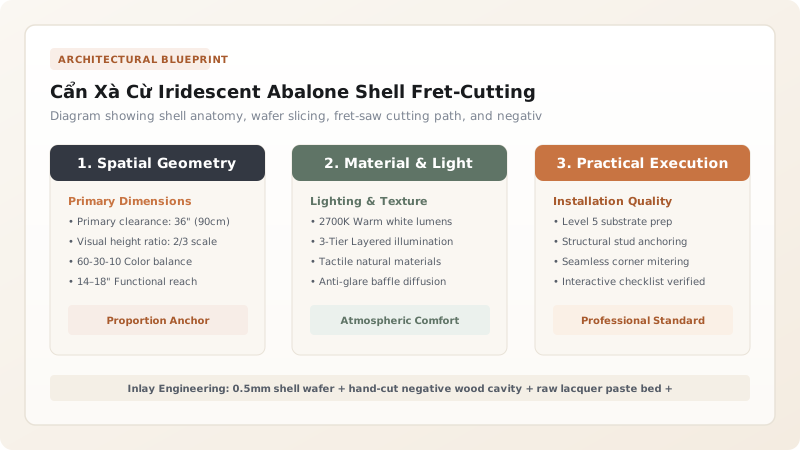
1. Conchology & Sourcing: The Rainbow Jewels of the South China Sea
The craft of cẩn xà cừ originated in the village of Chuyen My (Phu Xuyen, Hanoi), whose founding patron Truong Cong Thanh served under the Ly Dynasty in the 11th century. Master inlayers categorize marine shells according to their optical fire:
- Ốc Xà Cừ (Green Turban Snail / Turbo marmoratus): Harvested from deep coral reefs off Central Vietnam; the most prized shell in the world, displaying fiery rainbow magenta, violet, and electric green luster that changes with viewing angle.
- Trai Ngọc (Gold-Lip Pearl Oyster): Soft, warm champagne gold and silvery mother-of-pearl used for sky, clouds, and water.
- Bào Ngư (Abalone / Haliotis): Deep oceanic peacock blues and greens used for robes and foliage.
2. Lapidary Transformation: From Curved Shell to Flat Silhouette
A sea shell is naturally domed and curved; forcing a curved shell flat snaps it into useless dust. Craftsmen employ thermal annealing: the thick outer limestone shell is ground away on sandstone wheels, leaving only the thin nacreous layer.
The shell is placed inside a pan of hot sand or boiled in lime water to soften the conchiolin organic protein matrix. It is immediately pressed between two flat hardwood blocks in a vise, flattening the curved shell into a flawless, flat sheet 0.4mm to 0.6mm thick. The artisan glues a paper design onto the shell and cuts the delicate contours using a miniature bow saw strung with a hair-thin steel wire blade (lưỡi cưa chỉ), pivoting the shell with microscopic precision.
3. Joinery: Đục Lõm Bedding and Tỉa Nét Engraving
Unlike modern synthetic inlays glued onto flat wood and coated in polyester resin, authentic imperial cẩn xà cừ is true marquetry. The cut shell silhouette is traced directly onto the seasoned ironwood (gỗ lim) or rosewood (gỗ trắc).
With a set of tiny, razor-sharp micro-chisels (đục), the craftsman hand-excavates a negative pocket matching the exact contour to a depth of exactly 0.6mm. The pocket is buttered with a paste of thick raw lacquer and charred bone dust, and the shell is pressed firmly inside. Once cured, the artisan uses diamond scribes (dao tỉa) to engrave microscopic lines—facial expressions, dragon scales, and cloud swirls—rubbing black lacquer into the grooves so the lines pop with dramatic graphic clarity.
Mother-of-Pearl Shell Grades & Optical Characteristics
Use this reference table to calculate exact physical dimensions, ratios, and specifications before purchasing:
| Shell Species | Vietnamese Name | Primary Color Spectrum | Thickness / Flatness | Artisanal Application |
|---|---|---|---|---|
| Green Turban Snail | Ốc Xà Cừ | Electric magenta, violet, neon green | 0.4mm - 0.6mm (Flattened) | Royal imperial dragons, phoenixes, faces |
| Gold-Lip Pearl Oyster | Trai Tai Tượng | Silvery white, pale champagne, gold | 0.6mm - 1.0mm (Naturally flat) | Flowing rivers, moonlit skies, robes |
| Black-Lip Pearl Oyster | Trai Đen | Smoky charcoal, dark bronze, silver | 0.5mm - 0.8mm | Rocky mountains, tree bark, night skies |
| Paua / Abalone | Bào Ngư | Deep peacock blue, teal, emerald | 0.3mm - 0.5mm (Thin & pliable) | Peacock feathers, water lilies, textiles |
Ecological & Tooling Constraints
Every successful decoration project must account for physical and environmental constraints:
Endangered Marine Snail Scarcity
High-grade Turbo marmoratus snails from coral reefs are strictly regulated; master workshops maintain antique shell reserves.
Extreme Eye Strain
Hand-sawing and engraving 0.5mm shell figures requires high magnification loupes and exceptional hand stability.
Protocol for Slicing, Fretting, and Inlaying Mother-of-Pearl
Execute this professional sequence to achieve flawless results without backtracking:
Shell Outer Crust Grinding
Grind outer rough calcareous layer off Turbo shell on wet rotating sandstone wheel until pure iridescent nacre is exposed.
Thermal Sand Flattening
Submerge curved shell slices in 90°C hot sand; press between oak clamping blocks in a vise to flatten into flat 0.5mm wafers.
Paper Template Gluing
Paste paper cartoon figures onto shell wafers using rice-flour glue; organize shells to align color gradients with anatomy.
Jewelers' Bow Fret-Sawing
Saw contours using a 0.2mm steel wire blade in a jewelry bow saw; lubricate cut with beeswax; saw with vertical 90° strokes.
Wood Bed Chivelling (Đục Lõm)
Scribe shell contour onto timber with fine scriber; chisel 0.6mm deep pocket using flat-bottom micro-gouges; blow out all chips.
Lacquer Paste Bedding & Tỉa Nét
Bed shells in raw lacquer and bone-ash paste; clamp flat for 3 days; engrave surface details with burin; rub with black ink.
Common Mistakes & Countermeasures
Avoid these costly errors that compromise aesthetics, ergonomics, and budget:
Overheating shell wafers with dry electric rotary grinders
Using clear synthetic epoxy to bed the shells into wood pockets
Project Execution Checklist
Track your physical progress. Checkboxes persist automatically on this device:
Frequently Asked Questions
How does mother-of-pearl create rainbow colors without any pigment?
The iridescence of mother-of-pearl (nacre) is an optical phenomenon known as structural coloration. Nacre is composed of microscopic hexagonal platelets of aragonite (calcium carbonate) stacked in alternating layers with elastic biopolymers (conchiolin). The thickness of these crystalline layers matches the wavelengths of visible light, causing light waves to reflect, refract, and constructively interfere, creating shifting rainbow hues.
Can mother-of-pearl inlays withstand daily use on dining tables?
Yes. When embedded in solid hardwood and encased in multiple layers of polymerized Vietnamese natural lacquer, the shell is locked beneath an indestructible, waterproof shield. Historically, Vietnamese imperial banquet tables inlaid with mother-of-pearl have survived centuries of hot tea, soups, and heavy usage with zero shell delamination.


