Iznik tile bodies are engineered synthetic stone-pastes containing 80% crushed quartz, 10% lead-alkali glass frit, and 10% plastic clay. The glass frit acts as a flux that melts at 850°C, liquid-phase sintering the quartz grains into a dense, non-crazing body. A secondary micro-milled quartz slip is applied to the surface, creating an ultra-reflective white ground that prevents underglaze pigments from soaking into the porous body.
At a Glance: Key Takeaways
- Quartz Purity: ≥ 99.2% SiO2 (crushed hydrothermal vein quartz)
- Frit Glass Composition: Lead monosilicate (PbO·SiO2) or soda-lead borosilicate
- Plasticity Agent: White plastic bentonite / ball clay (10% by dry weight)
- Slip Thickness: 0.3 mm to 0.5 mm uniform colloidal quartz coating
- Thermal Expansion (COE): 6.8 to 7.2 × 10^-6 /°C (matched perfectly to glaze)
- Firing Atmosphere: Strictly oxidizing clean updraft kiln firing at 920°C
Hydrothermal Quartz Selection & Multi-Modal Particle Sizing
The foundation of authentic Iznik ceramic is pure quartz ($SiO_2$). In 16th-century Ottoman workshops, potters sourced high-purity hydrothermal vein quartz pebbles harvested from mountain streams around Uludağ (Mount Olympus of Mysia) near Bursa. Ordinary desert sands containing feldspar, iron, or mica were strictly rejected because metallic impurities cause yellowing and blistering during firing.
The quartz pebbles were calcined in wood kilns at 800°C and plunged into cold water. The sudden thermal shock shatters the crystalline quartz along micro-fractures, making the hard mineral easy to grind into fine flour. To achieve maximum packing density in the pressed tile body, quartz is ground into a multi-modal grain distribution: 60% coarse grains (100 to 200 mesh) that form a rigid, non-shrinking mineral skeleton, and 40% micro-fine flour (< 325 mesh) that packs into the interstitial voids, maximizing surface contact with the melting glass frit.
Glass Frit Smelting: Chemistry of Liquid-Phase Sintering
Because pure quartz has an extraordinarily high melting point of 1,713°C—far beyond the capabilities of traditional wood-fired kilns (max 1,050°C)—the quartz grains must be cemented together at lower temperatures through liquid-phase sintering. This is accomplished by adding 10% pre-melted glass frit.
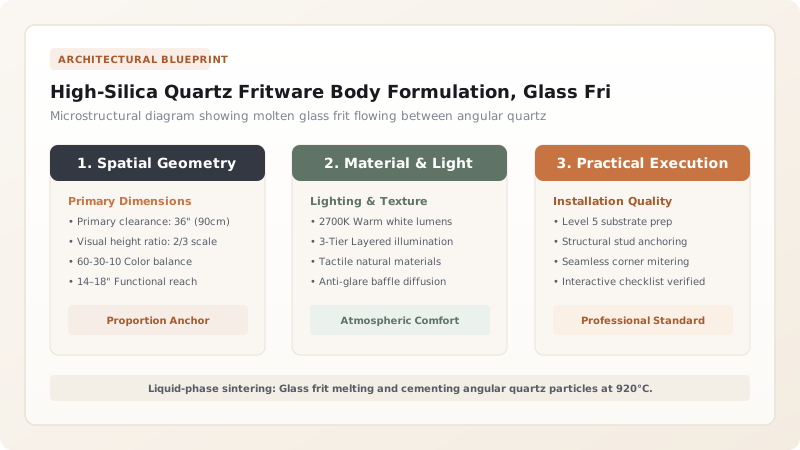
To manufacture the frit, artisans blend pure quartz sand with lead oxide (litharge, $PbO$) and soda ash ($Na_2CO_3$) or potash derived from the ashes of coastal halophyte plants (çöven). The mixture is smelted in a dedicated frit furnace at 1,000°C until an optical liquid glass forms. The molten glass is tapped directly into cold water; the explosive thermal quenching shatters the glass into millions of microscopic granules known as 'frit'. When compounded into the tile body and fired to 900°C–940°C, the frit dissolves and melts, forming a viscous liquid that wicks between the angular quartz particles via capillary suction. Upon cooling, this liquid freezes into a continuous borosilicate glass bridge that locks the quartz framework into a rock-hard artificial stone.
Colloidal White Slip Engineering & Underglaze Canvas Optimization
Although the fired quartz body is pale off-white, its surface is microscopic stone sandpaper—too coarse for fine underglaze brushwork. To create the immaculate, porcelain-smooth canvas required for imperial Nakkaşhane painters, tiles are coated with an ultra-fine astar (quartz slip).
The slip is formulated by ball-milling pure quartz flour with 10% highly plastic white bentonite clay and a tiny fraction of natural gum tragacanth (kitre) for 48 hours, reducing particle sizes below 5 microns. When poured over the dry tile, the water wicks into the porous body, depositing an even 0.4 mm lamination of dense, parallel quartz platelets. This slip layer serves two critical optical functions: it provides a dazzling, chalk-free white background that reflects 95% of incoming ambient light, and it acts as a micro-porous suction bed that holds underglaze pigment brushwork crisply without running, feathering, or sinking.
Raw Material Proportions for Iznik Stone-Paste Body (per 100 kg)
Use this reference table to calculate exact physical dimensions, ratios, and specifications before purchasing:
| Raw Material | Proportion by Weight | Particle Size Specification | Chemical Formula | Primary Function |
|---|---|---|---|---|
| Calcined River Quartz | 80 kg (80%) | 100 to 325 mesh graded | SiO2 (≥ 99.2% purity) | Structural skeleton; zero thermal shrinkage |
| Lead-Soda Glass Frit | 10 kg (10%) | < 200 mesh powder | PbO·Na2O·3SiO2 | Liquid-phase sintering flux; binds quartz at 920°C |
| White Bentonite Clay | 10 kg (10%) | Sub-micron colloidal platelets | Al2Si4O10(OH)2·nH2O | Provides green strength and plasticity for molding |
| Gum Tragacanth (Kitre) | 0.5 kg (Add-on) | Water-soluble organic polymer | Astragalus plant exudate | Temporary organic binder preventing green tile breakage |
Practical Constraints
Every successful decoration project must account for physical and environmental constraints:
Extreme Brittleness of Green (Unfired) Fritware Tiles
Unfired stone-paste has very low green strength; raw tiles can crumble if handled roughly before biscuit firing. Solution: Dry tiles on flat rigid plaster boards; transport exclusively on timber trays without flexing.
Silicosis Occupational Hazard from Fine Quartz Dust
Milling pure quartz creates airborne respirable silica dust that poses severe long-term lung disease risks. Solution: Enforce wet ball-milling protocols and equip mixing rooms with certified HEPA dust-extraction hoods.
Execution Blueprint & Craftsmanship Sequence
Execute this professional sequence to achieve flawless results without backtracking:
Quartz Thermal Shock Calcination
Heat translucent river quartz pebbles in a wood kiln to 850°C. Quench instantly in cold water vats to induce micro-fracturing throughout the mineral lattice.
Multi-Mesh Quartz Milling
Crush calcined quartz in heavy stone edge-runner mills. Sieve into 100-mesh coarse and 325-mesh fine fractions, blending in a 60:40 ratio.
Glass Frit Smelting and Water Quenching
Smelt 50% quartz, 35% lead oxide, and 15% soda ash at 1,000°C in a fireclay crucible. Tap molten glass into cold water to produce shatter-quenched frit granules.
Body Compounding and Hydration
Combine 80 kg quartz flour, 10 kg pulverized glass frit, and 10 kg white bentonite clay. Add 12% water mixed with dissolved gum tragacanth and knead into crumbly dough.
Compression Molding of Tile Slabs
Pack dough firmly into precision-machined hardwood molds (typically 245x245x18 mm). Compress with heavy wooden tampers and level top face with steel scrapers.
Slip Coating and Pre-Fire Inspection
Allow tiles to dry on plaster bats for 7 days. Pour micro-milled quartz slip over the face to achieve a 0.4 mm coating. Inspect for pinholes before biscuit firing.
Common Mistakes & Countermeasures
Avoid these costly errors that compromise aesthetics, ergonomics, and budget:
Using Uncalcined River Quartz Pebbles
Over-Compressing the Stone-Paste Dough in Metal Presses
Applying Slip to a Wet, Green Tile Body
Project Execution Checklist
Track your physical progress. Checkboxes persist automatically on this device:
Frequently Asked Questions
Why didn't Ottoman potters just use white porcelain clay like the Chinese?
True porcelain requires abundant deposits of kaolin and petuntse (porcelain stone), which are geologically absent in the Anatolian plateau. Instead of importing expensive Chinese raw materials, ingenious Ottoman potters invented an artificial stone-paste body made from local quartz pebbles and glass flux that brilliantly mimicked the pure white color and resonant ring of imperial Chinese porcelain.
What is the purpose of 'biscuit firing' the tile before painting?
Biscuit firing (at 850°C-900°C) melts the glass frit just enough to cement the quartz grains into a rigid, semi-porous stone slab. In this biscuit state, the tile is physically strong enough to be handled by court painters and has the ideal capillary suction to absorb underglaze water-based paints crisply without smudging.
Why doesn't the glaze craze on an 80% quartz tile?
Glaze crazing occurs when a glaze shrinks more than the ceramic body beneath it during cooling, causing tensile cracks. Because the Iznik body is 80% quartz and the transparent glaze is also formulated predominantly from silica, both layers have virtually identical thermal expansion coefficients (6.8-7.2 × 10^-6 /°C). They expand and contract in perfect harmony, resulting in a glass surface that remains crack-free for 500+ years.