Installing monumental Iznik tile revetments—such as the prayer niches (mihrabs) and wall panels designed by Mimar Sinan—requires advanced masonry engineering. Tiles are bedded in breathable, flexible Khorasan mortar (slaked lime, crushed brick dust, and sand) with razor-thin 1.0 mm butt joints. The high-lead silica glaze vitrifies at 920°C–940°C into an impervious, chemical-resistant glass shield that fuses molecularly with the quartz slip, ensuring permanent durability across centuries.
At a Glance: Key Takeaways
- Architectural Application: Mosque mihrabs, qibla walls, imperial royal pavilions (hünkâr mahfili)
- Installation Mortar: Khorasan mortar (slaked lime putty + crushed terracotta brick dust)
- Joint Spacing: 1.0 mm to 1.5 mm hairline joints bedded in pure lime putty
- Glaze Melting Point: 880°C (flows smoothly into glass sheet at 920°C - 940°C)
- Chemical Resistance: Impervious to water, atmospheric acids, and biological mold
- Famous Monumental Example: Rüstem Pasha Mosque (over 2,300 unique Iznik tiles)
Mimar Sinan & The Architectural Integration of the Mihrab
In Ottoman mosque architecture under the supreme court architect Mimar Sinan, Iznik tiles were never treated as superficial decorative wallpaper. Instead, they were conceived as integral optical components of the sacred architecture. The focal apex of this integration is the mihrab (the prayer niche indicating the direction of Mecca) and the surrounding qibla wall.
A monumental Iznik mihrab consists of a deep, semicircular or polygonal wall recess crowned by a tiered muqarnas (stalactite vault). The niche is flanked by monumental ceramic colonnettes and framed by an outer rectangular calligraphic border inscribed with the Throne Verse (Ayat al-Kursi) in magnificent cobalt-and-white thuluth script. Sinan orchestrated window placements so that natural morning sunlight raked across the tiled surfaces at low angles; the light penetrates the clear glaze, reflects off the white quartz slip, and illuminates the prayer hall with ethereal jewel-toned radiance.
Khorasan Mortar Physics: Avoiding Rigid Cement Failure
Installing massive, dense quartz tiles onto uneven brick masonry requires an adhesive matrix that can absorb structural building movements, seismic micro-tremors, and thermal expansion. Under no circumstances should modern Ordinary Portland Cement (OPC) or rigid polymer adhesives be introduced into historic mosques.
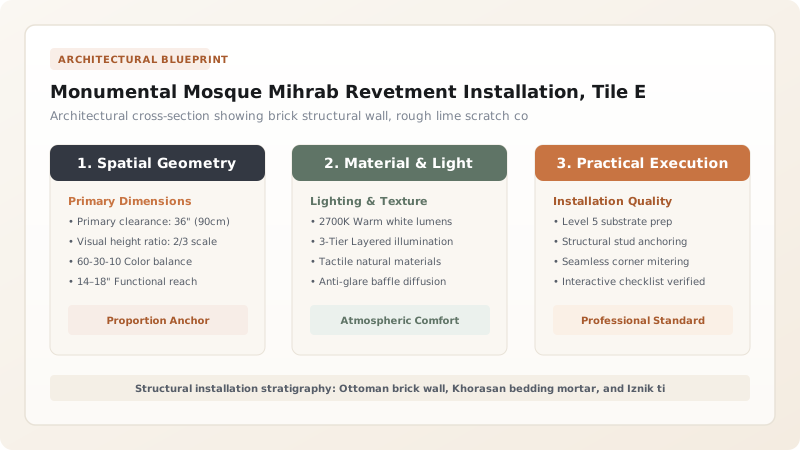
Ottoman master builders bedded tiles in Khorasan mortar (Horasan harcı). Khorasan is an engineered pozzolanic hydraulic mortar formulated from matured slaked non-hydraulic lime putty (CL90) mixed with finely crushed, low-fired terracotta brick dust and clean river sand in a 1:2 ratio. The reactive amorphous aluminosilicates in the brick dust react with calcium hydroxide to form calcium silicate hydrates ($C-S-H$), creating a resilient, flexible mortar that hardens even in thick beds behind non-porous tiles. Khorasan mortar matches the low elastic modulus of the quartz tiles, allowing the entire wall revetment to flex slightly without cracking individual tiles.
The Chemistry of Kiln Vitrification: Fusing Lead-Silica Glass
The optical brilliance and structural durability of an Iznik tile culminate in the kiln. The transparent glaze is a high-lead silicate glass formulated by blending roasted lead oxide with finely ground quartz sand in an approximately 2:1 molecular ratio:
$$2PbO + SiO_2 \xrightarrow{880^\circ\text{C}} Pb_2SiO_4\text{ (Liquid Lead Silicate Glass)}$$
As the kiln temperature passes 880°C, the lead silicate powder melts into a low-viscosity liquid glass. At peak temperature (930°C), this molten glass flows smoothly across the tile face, leveling surface brush striations via surface tension. Crucially, the liquid lead glass partially dissolves the uppermost micron of the quartz slip, forming a graded chemical interface where glaze and body fuse molecularly. When cooled slowly over 48 hours, the glaze vitrifies into an ultra-smooth, high-refractive-index ($n \approx 1.7$) glass shield that is completely impervious to water penetration, resisting environmental acids and preserving the vibrant underglaze colors for centuries.
Installation and Mortar Parameters for Iznik Tile Revetments
Use this reference table to calculate exact physical dimensions, ratios, and specifications before purchasing:
| Installation Layer | Material Formulation | Layer Thickness | Mechanical Role | Failure If Mis-Specified |
|---|---|---|---|---|
| Structural Wall | Ottoman brick or coursed limestone | Variable (structural) | Primary load-bearing substrate | Structural settlement causes wall cracking |
| Scratch Coat | Coarse lime-sand mortar (1:2.5) | 15 mm to 20 mm | Levels substrate; keyed with comb | Uneven bed causes tiles to teeter |
| Bedding Mortar | Khorasan mortar (lime + brick dust 1:2) | 10 mm to 15 mm | Flexible, pozzolanic adhesive bed | Rigid cement causes tiles to pop off |
| Hairline Joints | Pure CL90 lime putty slurry | 1.0 mm to 1.5 mm | Seals joints; accommodates micro-flex | Wide grout lines disrupt floral patterns |
| Vitrified Glaze | High-lead silica glass (PbO·SiO2) | 0.6 mm to 0.8 mm | Hermetic seal; color magnification | Crazing or cloudiness from underfiring |
Practical Constraints
Every successful decoration project must account for physical and environmental constraints:
Complex Modular Layout Across Uneven Curved Mihrab Niches
Slight deviations in tile sizing can compound across a 10-meter high mihrab, causing floral designs to misalign. Solution: Dry-lay all tile panels on the workshop floor, labeling each tile with alphanumeric grid coordinates before site delivery.
Seismic Ground Shaking in Active Anatolian Fault Zones
Earthquakes generate shear waves that can shear brittle tile revetments off exterior masonry walls. Solution: Ensure Khorasan mortar beds are thick and flexible, and incorporate concealed stainless-steel retaining clips at frieze levels.
Execution Blueprint & Craftsmanship Sequence
Execute this professional sequence to achieve flawless results without backtracking:
Substrate Deep Cleaning and Pre-Wetting
Rake out decayed mortar joints in the brick masonry wall. Wash stone with clean water to remove dust and saturate the masonry substrate.
Khorasan Scratch Coat Application
Apply a 15 mm leveling coat of coarse Khorasan mortar (lime and crushed brick dust). Key the surface with a notched trowel and allow to carbonate for 7 days.
Tile Soaking and Sorting
Soak biscuit-fired, glazed Iznik tiles in clean water for 30 minutes to satisfy internal capillary suction, preventing the tiles from de-watering the bedding mortar.
Butter-Backing and Wall Placement
Butter the back of each tile with a 10 mm bed of fresh Khorasan mortar. Press firmly against the wall, tapping with a rubber mallet to achieve absolute plumb alignment.
Hairline Butt Jointing
Align adjacent tiles with hairline 1.0 mm joints, ensuring that continuous floral vines, saz leaves, and Arabic calligraphic bands match seamlessly across tile boundaries.
Lime Putty Grouting and Surface Cleaning
Press pure slaked lime putty into the hairline joints using a rubber float. Meticulously clean all glaze surfaces with damp sponges before the lime hardens.
Common Mistakes & Countermeasures
Avoid these costly errors that compromise aesthetics, ergonomics, and budget:
Setting Iznik Tiles with Modern Cement-Based Thin-Set Mortars
Installing Tiles Dry Without Pre-Soaking in Water
Rapid Kiln Cooling of Glazed Tiles (< 24 Hours)
Project Execution Checklist
Track your physical progress. Checkboxes persist automatically on this device:
Frequently Asked Questions
What is 'Khorasan mortar' (Horasan harcı) in Ottoman architecture?
Khorasan mortar is a traditional pozzolanic hydraulic mortar used throughout the Ottoman Empire. Formulated by blending slaked lime putty with crushed terracotta brick and pottery dust, the amorphous silica and alumina in the baked clay react chemically with calcium hydroxide to form water-resistant calcium silicate hydrates. It is breathable, resilient, and slightly flexible, making it the supreme bedding mortar for ceramic tiles.
Why are Iznik tile joints so narrow compared to modern bathroom tiles?
Modern tiles typically use 3 mm to 6 mm wide grout lines to absorb dimensional inaccuracies in factory-made tiles. Iznik tiles were designed as continuous pictorial murals and architectural tapestries; wide grout lines would break the delicate lines of saz leaves, tulip stems, and calligraphic inscriptions. Ottoman masons achieved nearly invisible 1.0 mm hairline joints by precision-edging tiles and bedding them in pure lime.
Can damaged or missing historic Iznik tiles be replaced in conservation?
Yes. Modern heritage conservation institutes (such as the Iznik Foundation in Turkey) have scientifically revived the authentic 16th-century 80% quartz fritware formula, Armenian bole red, and lead glaze chemistry. Conservators commission bespoke hand-painted replica tiles matched to the original historic Nakkaşhane cartoons, bedding them in Khorasan mortar alongside original surviving tiles.