Zhu pillar capitals and multi-tier bow-brackets (boku) form the primary tectonic load-bearing bracket set of Tibetan monumental architecture. Interlocking the vertical timber column (ka) with the horizontal roof crossbeam (dung), the zhu capital features carved blooming lotus petals (padma) that expand the column's compressive bearing area. Above it, the winged boku bow-bracket cantilevers outward up to a meter in both directions, drastically reducing horizontal beam spans and safely carrying the massive dead loads of heavy earthen temple roofs.
At a Glance: Key Takeaways
- Structural System: Timber Bracket Set: Column (Ka), Capital (Zhu), Bow-Bracket (Boku)
- Primary Timber: Himalayan Deodar Cedar (Cedrus deodara) & Tibetan Cypress
- Bracket Cantilever Span: 600 mm to 1,000 mm projection on each side of column axis
- Effective Span Reduction: Reduces unsupported horizontal crossbeam span by 35% to 50%
- Iconographic Relief: Blooming Padma lotus, Makara water-monsters, jewel festoons
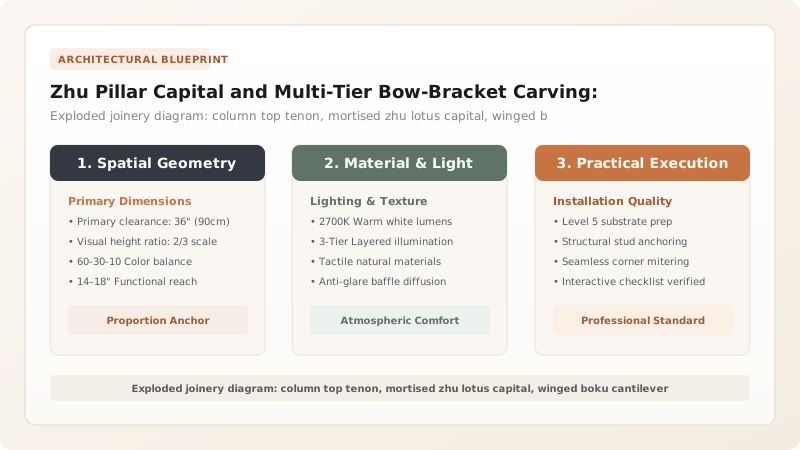
The Architectural Anatomy of the Tibetan Bracket Set
In the vast, column-filled assembly halls (dukhang) of Tibetan Buddhist monasteries, the eye is inevitably drawn upward to the monumental structural joinery supporting the ceiling. To create open spaces capable of accommodating hundreds of chanting monks beneath hundreds of tons of heavy earthen roofing, Tibetan builders developed an iconic timber bracket assembly: the ka-zhu-boku complex.
This structural set consists of three interdependent elements. At the base is the ka—a soaring column shaft typically shaped with an octagonal or faceted fluted profile that symbolizes the Eightfold Noble Path. At the top of the column sits the zhu—a massive, spreading capital carved with blooming lotus petals. Rested across the capital is the boku (or gachung)—a long, winged, cantilevered bow bracket. Together, this sculptural trinity forms one of the most effective mechanical load-transfer systems in traditional Asian timber engineering.
Load Dispersal Mechanics: Mitigating Shear and Bending Stress
The primary engineering function of the zhu and boku assembly is the redistribution of colossal compressive and flexural loads. Wood has immense compressive strength parallel to its grain (along the trunk), but its compressive strength perpendicular to the grain (across the fibers of a horizontal beam) is relatively weak. If a heavy, loaded crossbeam were placed directly on top of a slender wooden post, the hard end-grain of the post would crush the softer horizontal fibers of the beam, causing structural depression, fiber shearing, and eventual failure.
The zhu capital solves this by acting as a wide, load-spreading bearing pad. It expands the contact surface area by three to four times, reducing the compressive stress on the horizontal timbers to safe levels. Above the capital, the boku bow bracket performs an even more dramatic structural service: its winged arms cantilever outward up to a meter on either side of the column axis. This cantilever effectively shortens the clear, unsupported span of the horizontal crossbeam (dung). By reducing the beam's clear span by 30% to 50%, the maximum bending moments and central deflections are reduced exponentially, allowing relatively modest timber beams to carry immense roof loads without sagging.
The Lotus Capital (Zhu): Padma Symbolism and Carving
Beyond its structural utility, the zhu is an altar of sacred Buddhist iconography. In Tibetan Buddhist art, the lotus (padma) is the ultimate emblem of spiritual transcendence: rooting in the dark, muddy depths of worldly delusion, it ascends through the water to bloom unstained and pristine in the open air, symbolizing the potential of all sentient beings to attain enlightenment.
The master woodcarver sculpts the four sides of the capital with double-tiered lotus petals. The lower tier features downturned petals (chö-kyi padma), while the upper tier features upturned petals, creating a dynamic, flared chalice that appears to burst into flower under the weight of the temple roof. Above the lotus petals, the carver chisels relief bands of celestial jewels (norbu), pearl festoons, and sacred drapery swags, transforming a heavy structural bearing cushion into an offering of celestial beauty.
The Winged Cantilever (Boku): Aerodynamics and Earthquakes
The carving of the boku bow bracket showcases the fluid, dynamic sculptural vocabulary of Tibetan woodwork. Rather than leaving the cantilevered wings as blunt, utilitarian beams, the carver tapers the underside into elegant, parabolic curves that mimic the wings of a soaring eagle or the drawn curve of a golden bow.
The terminal ends of the bracket are sculpted into stylized cloud spirals (trin) or the gaping jaws of the makara (chu-srin)—a mythological aquatic sea monster symbolizing the inexhaustible life force of water and the protection of sacred thresholds. During earthquakes, the unfastened, mortised bracket set acts as a base-isolation mechanism: the joints slide and rock slightly against each other under friction, absorbing the ground's kinetic energy and damping the building's oscillation, ensuring that these centuries-old monastic sanctuaries remain standing on the roof of the world.
Tibetan Pillar-Capital-Bracket Assembly Components & Engineering Ratios
Use this reference table to calculate exact physical dimensions, ratios, and specifications before purchasing:
| Assembly Level | Component Name | Width-to-Height Ratio | Carved Motifs | Structural Mechanics |
|---|---|---|---|---|
| Vertical Shaft | Ka (Pillar) | 1:8 to 1:10 slender ratio | Octagonal fluting with lotus base | Carries pure vertical axial compression |
| Lower Capital | Zhu (Capital) | 1.5:1 to 2:1 broad saddle | Double-lotus (padma) & pearl drops | Expands bearing area 300%; prevents cross-grain fiber crushing |
| Single Bow Bracket | Boku (Gachung) | 3:1 to 4:1 wing cantilever | Cloud scrolls and makara heads | Reduces clear beam span by 35%–40% |
| Double-Tier Bracket | Zhu-Kham | Stacked dual cantilever | Layered jewel drops & cloud wings | Reduces beam span by 50%; used in monumental cathedral prayer halls |
| Primary Crossbeam | Dung (Lintel) | 1:1.5 deep rectangular beam | Floral friezes and geometric bands | Bridges pillars, carrying secondary joists and heavy roof |
Practical Constraints
Every successful decoration project must account for physical and environmental constraints:
Colossal weight of multi-story timber columns and beams during manual temple raising
Monolithic cedar beams can weigh several metric tons, requiring massive human hauling power. Mitigation: Design modular multi-piece capital assemblies hoisted sequentially using timber shear legs and block-and-tackles.
Unequal grain shrinkage between horizontal bracket timbers and vertical column posts
Wood shrinks up to 8% tangentially across grain but less than 0.1% longitudinally. Mitigation: Cut joinery with calculated expansion gaps and employ radial rift-sawn timbers for brackets.
Execution Blueprint & Craftsmanship Sequence
Execute this professional sequence to achieve flawless results without backtracking:
Timber Block Dressing and Layout
Square dense deodar cedar blocks to dimension (typically 400x400x350 mm for the zhu; 1,800x300x300 mm for the boku), scribing sacred thig-tse centerline grids.
Mortise and Tenon Socket Cutting
Chisel a central mortise pocket (typically 120x120 mm, 100 mm deep) into the base of the zhu capital to receive the top tenon of the structural column.
Sculpting the Zhu Lotus Petals (Padma)
Carve the flared sides of the capital into tiers of stylized Buddhist lotus petals, detailing the central petal ribs and curled tips with hollow gouges.
Shaping the Boku Winged Cantilever Wings
Chisel the tapering underside of the bow bracket wings, forming dynamic parabolic upward curves that terminate in stylized cloud scrolls or makara snouts.
Upper Saddle Routing for the Crossbeam
Rout a flat, recessed longitudinal channel along the top spine of the boku bracket, matching the exact width of the primary dung crossbeam.
Trial Dry Assembly on the Ground
Stack the column top, zhu capital, and boku bracket together horizontally, verifying seamless planar contact across all bearing surfaces.
Hoisting and Raising into Place
Hoist the column vertically onto its stone plinth, seating the zhu capital onto the column tenon and dropping the boku bracket squarely into place.
Seating the Dung Crossbeam
Lower the massive roof crossbeam onto the saddle of the bow bracket, locking the joint with vertical through-tenons and hardwood locking keys.
Common Mistakes & Countermeasures
Avoid these costly errors that compromise aesthetics, ergonomics, and budget:
Carving the boku bow-bracket wings with sharp, square 90-degree internal re-entrant corners
Relying on end-grain bearing contact without a transitional capital (zhu)
Project Execution Checklist
Track your physical progress. Checkboxes persist automatically on this device:
Frequently Asked Questions
Why is the bow-bracket named 'boku' or 'gachung'?
In Tibetan terminology, 'boku' refers to its bow-like curved profile, reminiscent of a drawn archer's bow. 'Gachung' refers to its avian, winged posture, resembling the outstretched wings of a mythical garuda bird carrying the heavens on its back.
What is the difference between a single-tier (zhu-boku) and multi-tier (zhu-kham) bracket?
A single-tier bracket consists of a single capital and one bow bracket, common in residential manors and smaller temple chapels. A multi-tier bracket (zhu-kham) stacks two or three progressively wider bow brackets separated by intermediate block cushions, extending the cantilever up to 1.5 meters. This allows colossal prayer halls to span vast areas with fewer interior columns.
How do Tibetan timber brackets withstand earthquakes?
The bracket set functions as an unbonded, friction-damped structural hinge. Because the joints are held together by mortises, tenons, and gravitational dead weight rather than rigid metal bolts or concrete, the assembly can micro-slip and rotate during seismic tremors, absorbing and dissipating ground shocks without fracturing.