Traditional Tibetan Shing-Tsa (sacred architectural woodcarving and carpentry) is the structural and spiritual backbone of monastic temples (gompas) and palace architecture (such as the Potala and Jokhang). Utilizing slow-grown Himalayan cedar (deodar), cypress, and spruce, master woodworkers (shing-zo) carve elaborate post-and-lintel timber assemblies. Characterized by multi-tiered, cantilevered bow brackets (boku), lotus-carved pillar capitals (zhu), and high-relief Ashtamangala (Eight Auspicious Symbols), these timber structures disperse heavy earthen roof loads across vast prayer halls before being consecrated with crushed mineral pigments and fine 24k gold contour lining.
At a Glance: Key Takeaways
- Sacred Craft: Tibetan Shing-Tsa / Shing-zo (Architectural Woodcarving & Carpentry)
- Iconic Monuments: Potala Palace, Jokhang Temple (Lhasa), Samye, Tashilhunpo Monastery
- Structural System: Post-and-lintel bracket set: Pillar (Ka), Capital (Zhu), Bow-bracket (Boku)
- Primary Tonewoods: Himalayan Cedar (Deodar / Shing-kar), Cypress (Tsug-shing), Blue Pine
- Surface Decoration: Yak-hide glue sizing, crushed mineral pigments, and 24k gold leaf lining
In-Depth Guides in this Directory
Explore specialized subtopic blueprints, technical dimensions, and execution checklists:
Zhu Pillar Capital and Multi-Tier Bow-Bracket Carving: Tibetan Tectonics
Technical analysis of Tibetan architectural joinery: zhu lotus pillar capitals, cantilever bow brackets (boku), mortise-and-tenon load dispersal, and deodar carving.
Ashtamangala Eight Auspicious Symbols Relief Chiseling: Tibetan Sacred Iconography
Artisan guide to carving the Tibetan Ashtamangala (Eight Auspicious Symbols): Tashi Tagye relief chiseling on temple doors, beams, and altar cabinets.
Mineral Pigment Glue-Sizing and Gilded Contour Lining: Tibetan Polychromy
Master guide to Tibetan architectural polychromy: yak-hide glue sizing (ser-ka), crushed mineral pigments (malachite, lapis, cinnabar), and 24k gold line work (tsalo).
The Sacred Vocation of the Shing-Zo
Across the vast, high-altitude plateau of Tibet—from the towering white-and-crimson bastions of the Potala Palace in Lhasa to the remote, cliffside monastic hermitages of Ladakh, Kham, and Amdo—the architectural identity of Tibetan Buddhism is defined by its monumental timber craft: Shing-Tsa. In Tibetan society, the master carpenter and woodcarver—the shing-zo—is not viewed merely as a manual laborer; they are regarded as sacred artisans who perform a ritual act of devotion, translating the celestial architecture of the Buddhist heavens into physical terrestrial form.
Building at elevations between 3,500 and 4,500 meters above sea level, Tibetan craftsmen faced immense structural and climatic obstacles. In an alpine desert where timber is confined to steep, subtropical southern river gorges (such as the Tsangpo and Kongpo valleys), every structural log had to be hauled over high mountain passes by yaks and human porters. The resulting architecture maximized every cubic inch of timber, developing an ingenious post-and-lintel structural system capable of supporting colossal multi-story temples without a single drop of mortar or steel.
The Tectonic Post-and-Lintel Bracket Anatomy
At the structural core of every Tibetan monumental interior is the column bracket assembly, an architectural masterpiece developed in parallel with ancient Indian and Chinese wooden traditions, but uniquely adapted to the colossal dead loads of Himalayan construction. Tibetan flat roofs are made of arka—a dense, highly compacted, water-impervious lime-rich clay up to 400 millimeters thick. This clay roof exerts crushing compressive forces that would snap ordinary horizontal wooden beams.
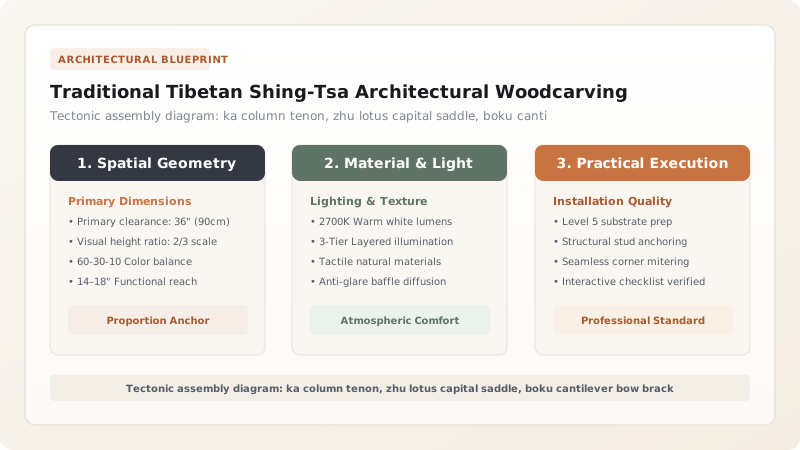
To carry these loads, the builders developed a four-part vertical assembly. The foundation is the ka (column), a massive trunk of Himalayan cedar or pine. Atop the column sits the zhu (capital), a carved block shaped like an inverted stepped pyramid or blooming lotus flower that broadens the bearing surface. Resting atop the capital is the boku (or gachung)—a long, cantilevered, bow-shaped bracket beam whose winged ends extend 600 to 1,000 millimeters on either side. Resting finally upon the boku is the primary crossbeam (dung). This bracket triangulation shortens the clear unsupported span of the crossbeam by up to 50%, transforming what would be dangerous bending moments into safe axial compression transferred directly down the column shaft.
The Sacred Canon of Proportions (Thig-Tse)
Tibetan woodcarving is never an arbitrary, whimsical decorative exercise; it is strictly governed by the sacred canon of iconometric proportions known as thig-tse. Rooted in the ancient Sanskrit Pratima Mana Laksana and codified by Tibetan polymaths like Buton Rinchen Drub, the canon establishes strict mathematical grids based on sacred units of measurement—primarily the sor-mo (finger-width) and the mtho (hand-span).
Every carved lotus petal, every stylized cloud swirl, and every wrathful monster face must conform to these geometric coordinates. If a carver miscalculates the proportion of a lotus petal or draws the curve of a bow-bracket out of canonical alignment, the wood is considered spiritually flawed and incapable of housing the divine presence of enlightened deities. Master carvers scribe these sacred grids onto raw timber using bone compasses, ink-soaked snapping lines (thig-le), and copper styluses before the first stroke of a chisel is struck.
Material Alchemy: Minerals, Yak Collagen, and Gold
The visual climax of Tibetan Shing-Tsa is its radiant, jewel-like surface polychromy. Raw timber exposed to the arid, high-UV mountain atmosphere of Tibet quickly checks, splits, and bleaches into a dull grey. To protect the wood and elevate it to celestial magnificence, craftsmen developed an organic-mineral coating system of extraordinary longevity.
The wood was first saturated with ser-ka, a warm collagen sizing broth boiled down from dried yak skins. Over this animal-glue primer, artisans troweled a smooth ground of fine mountain chalk, sealing the timber pores. The carvings were then painted using pure, unadulterated crushed mineral pigments mined across the Himalayas: vivid malachite green (pang-ma), azurite and lapis lazuli blue (ting), cinnabar vermilion (tsal), and orpiment yellow (ba-bla). The final touch was the application of tsalo: master painters dipped fine marten-hair brushes into liquid gold leaf ground with animal glue, executing razor-sharp gold contour lines along every carved petal rim, dragon claw, and jewel facet, causing the dim, butter-lamp-lit prayer halls to shimmer with divine celestial light.
Tibetan Monastic Timber Elements & Structural Roles
Use this reference table to calculate exact physical dimensions, ratios, and specifications before purchasing:
| Architectural Element | Tibetan Name | Timber Species | Carved Iconography | Engineering Function |
|---|---|---|---|---|
| Structural Column | Ka | Deodar Cedar / Cypress | Fluted octagonal shaft, lotus base | Carries multi-tier vertical roof compressive loads |
| Pillar Capital | Zhu | Himalayan Cedar | Double-lotus (padma) & jewel festoons | Expands bearing area; reduces shear stress on column head |
| Cantilever Bow Bracket | Boku / Gachung | Seasoned Deodar Heartwood | Stepped wings with makara/cloud scrolls | Cantilevers out 600–900 mm to reduce clear beam spans |
| Primary Crossbeam | Dung | Monolithic Spruce / Pine | Floral lotus friezes and cloud rosettes | Bridges pillars, carrying secondary joists and heavy roof |
| Upper Frieze Cornice | Shambu | Carved Pine / Poplar | Ashtamangala symbols & lion masks | Decorative cantilever cornice supporting roof eaves |
Practical Constraints
Every successful decoration project must account for physical and environmental constraints:
Colossal live and dead load of heavy compacted earthen roofs (arka clay, up to 400 mm thick)
Exerts immense bending stress and shear loads on wide-span timber lintels and beams. Mitigation: Install multi-tiered cantilever bow brackets (zhu-kham) that reduce effective clear spans by up to 50%.
Extremely arid high-altitude plateau climate (3,650 m to 4,500 m) with fierce winter cold and UV radiation
Dries out exposed exterior wood rapidly, inducing severe grain checking and paint flaking. Mitigation: Seal wood with dense yak-hide glue sizing and multiple layers of natural mineral pigment tempera.
Execution Blueprint & Craftsmanship Sequence
Execute this professional sequence to achieve flawless results without backtracking:
Sacred Tree Selection and Forest Offering (Sang-Sol)
Select mature, straight-grained Himalayan cedar (deodar) or cypress, conducting juniper smoke-cleansing rites to seek permission from local nagas (lu) and tree spirits.
Log Debarking and Multi-Year Shade Curing
Strip bark down to the heartwood, sealing cross-cut log ends with pine pitch and stacking in covered, well-ventilated sheds for two to three years of slow curing.
Pillar (Ka) Shaft Hewing and Octagonal Fluting
Hew cylindrical column logs into traditional octagonal or square shafts using broadaxes and adzes, carving stepped lotus blossoms around the base.
Lotus Capital (Zhu) Roughing and Joining
Chisel the expanding pillar capital from dense cedar blocks, carving upturned lotus petals (padma) and cutting the central bottom tenon to receive the column head.
Cantilever Bow-Bracket (Boku) Sculpting
Shape the winged cantilever bracket (boku), carving dynamic cloud spirals, makara water-monster snouts, and jewel motifs along the tapered wings.
Ashtamangala Relief Chiseling on Lintels
Transfer the eight auspicious symbols onto the primary crossbeams (dung), carving 30–50 mm high-relief outlines with curved gouges and V-tools.
Yak-Hide Glue Sizing & Chalk Ground (Gesso)
Boil shaved yak skins to extract collagen glue (ser-ka), mixing with fine mountain chalk to apply three sandable ground coats over all carved wood surfaces.
Mineral Pigment Painting & Pure Gold Contour Lining
Paint carvings with crushed natural mineral pigments (malachite green, lapis blue, cinnabar red), finishing all carved margins with fine 24k gold leaf line work (tsalo).
Common Mistakes & Countermeasures
Avoid these costly errors that compromise aesthetics, ergonomics, and budget:
Using unseasoned, green Himalayan conifer logs for structural temple brackets
Applying modern synthetic acrylic or enamel paints directly over raw carved timber
Carving sacred Buddhist iconographic symbols without strictly adhering to proportional canon (Thig-tse)
Project Execution Checklist
Track your physical progress. Checkboxes persist automatically on this device:
Frequently Asked Questions
What is the structural role of the 'Zhu' and 'Boku' bracket set in Tibetan architecture?
The pillar capital (Zhu) and bow-bracket (Boku) form a structural load-distribution bracket system. Heavy earthen roofs (arka) in Tibet exert massive downward weight. If crossbeams rested directly on slender column heads, the concentrated load would cause shear failure. The Zhu spreads the load across the column top, while the winged Boku cantilevers outward 600–900 mm on either side, effectively shortening the clear span of the horizontal beam and preventing deflection.
Why is yak-hide glue used instead of modern wood glue in traditional Tibetan carving?
Yak-hide glue (ser-ka) is a pure animal collagen binder extracted by boiling dried yak skins. It has exceptional flexibility, high tensile adhesion, and thermal expansion properties that match wood perfectly. Modern synthetic glues become brittle in the brutal sub-zero winter cold of the Tibetan plateau (-30°C), whereas collagen glue remains resilient and fully reversible for restoration.
What are the Ashtamangala symbols and why are they carved in temple woodwork?
The Ashtamangala (Tashi Tagye) are the Eight Auspicious Symbols of Mahayana and Vajrayana Buddhism: the Endless Knot, Lotus Flower, Victory Banner, Wheel of the Dharma, Treasure Vase, Golden Fish, Parasol, and Conch Shell. Carving them on door lintels, pillar capitals, and beams transforms structural timbers into protective spiritual mandalas that radiate blessings throughout the sanctuary.
What woods are traditionally harvested for Tibetan monastic architecture?
The most prized wood is Himalayan deodar cedar (Cedrus deodara, known as shing-kar), celebrated for its rot resistance and fine grain. Other essential woods include high-altitude Tibetan cypress (Cupressus torulosa / tsug-shing), Himalayan blue pine (Pinus wallichiana), and birch (tak-pa) for carved printing blocks and delicate cabinetry.