Raccards are constructed using high-altitude European larch logs squared with broadaxes and joined at corners with self-draining lap or saddle notches (tippet). Uniquely, horizontal log seams omit chinking, mortar, or moss, maintaining calibrated 4–8 mm open gaps. This passive aerodynamic design harnesses mountain Föhn winds to aerate harvested rye sheaves, preventing mold and condensation while deflecting wind-driven snow.
At a Glance: Key Takeaways
- Timber Selection: Old-Growth Alpine Larch (Larix decidua) harvested in winter
- Corner Notch Style: Stepped Half-Lap / Saddle Notch (Tippet / Kerve) with water drip
- Seam Spacing: 4 mm to 8 mm unchinked continuous horizontal air gaps
- Surface Finishing: Hand-adzed and broadaxe-hewn; unpainted, UV-oxidized
- Aerodynamic Driver: Föhn wind pressure differentials creating cross-draft currents
Silviculture and Chemical Excellence of Alpine Larch
The extraordinary longevity of Swiss Valais raccards—many of which have stood for over four centuries without chemical wood preservatives—is rooted in the silviculture of European larch (Larix decidua / mélèze). In the high Valais valleys, harsh alpine winters and short growing seasons force larch trees to grow at an exceptionally slow pace, producing tight, dense annual rings with up to 20 rings per centimeter.
The chemical profile of alpine larch heartwood is unique among softwoods. It contains massive concentrations of arabinogalactans (water-soluble polysaccharides) and natural oleoresins that permeate the cellular lumen. When exposed to ambient sunlight and mountain air, these resins undergo gradual polymerization and oxidation. Within decades, the pale reddish-gold timber deepens into a rich dark chocolate hue and eventually a lustrous, pitch-black surface crust that acts as an impermeable barrier against rot, moisture, and ultraviolet breakdown.
Corner Notching Geometry: The Tippet Joinery System
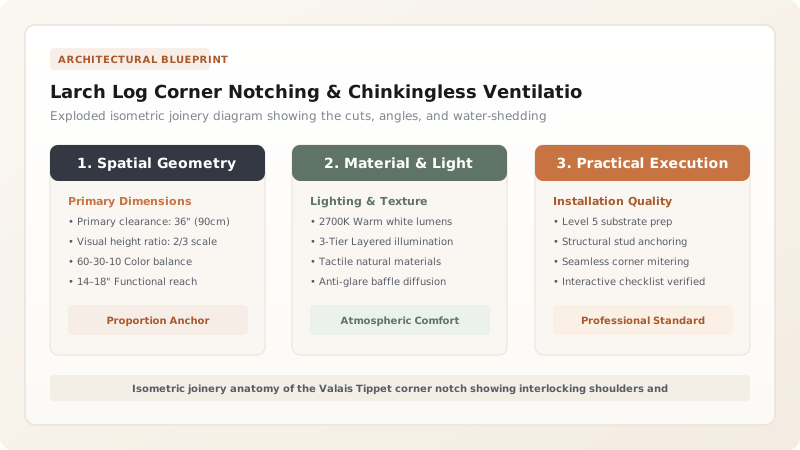
To construct a timber crib capable of withstanding the crushing weight of winter snow and the outward hydrostatic thrust of tons of stored grain, Valais carpenters perfected the Tippet corner notch (also known as the stepped saddle notch). Unlike simple rounded log notches that trap moisture, the Tippet is carved exclusively into squared beams using saws, mortise axes, and heavy paring gouges.
The joinery features a multi-tiered interlocking geometry. Each beam has a central stepped tongue and corresponding mortise recess. Crucially, the internal horizontal bearing shelves are cut with an outward bevel of 5° to 10°. When wind-driven alpine rains strike the corner of the building, water cannot enter the joint; gravity forces moisture to drain harmlessly outward toward the exterior face, preserving the critical end-grain of the timber from rot.
Thermodynamic Aerodynamics of Chinkingless Seams
The most counter-intuitive feature of the raccard to modern observers is its complete lack of chinking. In residential timber architecture (Blockbau), seams between logs are painstakingly caulked with moss, straw, and slaked lime mortar to seal out drafts. In a raccard, however, master builders deliberately maintained uniform, calibrated gaps of 4 to 8 millimeters along every horizontal log seam.
This design functions as a passive thermodynamic ventilation system powered by the alpine Föhn—a warm, dry, high-velocity katabatic wind that sweeps down the Valais valleys in spring and autumn. As the Föhn blows past the raccard, it creates a powerful aerodynamic pressure differential (Bernoulli’s principle) between the windward and leeward walls. Air is drawn through the unchinked seams, circulating continuously through the rye sheaves stacked inside. This steady draft strips moisture from the grain, preventing fungal fermentation without allowing blowing winter snow to cross the deep beam thresholds.
Structural Creep, Log Settling, and Long-Term Integrity
A major challenge in horizontal log construction is cumulative cross-grain shrinkage and settling. Over its first two decades, a newly erected log crib will settle by 3% to 5% of its total height as the timber loses bound moisture and compresses under its own deadweight.
Valais carpenters engineered every secondary element of the raccard to accommodate this dynamic settling. Door frames and vertical bin partitions were never nailed directly to horizontal wall logs. Instead, they were fitted into vertical sliding grooves (coulisses) with generous expansion gaps left above header timbers. As the horizontal log courses settled, the walls slid smoothly downward around the vertical framing without hanging up or creating wide, uncontrollable fissures, preserving the calibrated ventilation geometry indefinitely.
Alpine Log Notching Typologies and Mechanical Characteristics
Use this reference table to calculate exact physical dimensions, ratios, and specifications before purchasing:
| Corner Notch Style | Interlocking Strength | Water-Shedding Capacity | Assembly Complexity | Suitability for Raccards |
|---|---|---|---|---|
| Tippet (Stepped Saddle) | Extremely High (Multi-plane lock) | Superior; dual sloped drainage | High; requires hand chiseling | Ideal; standard in Valais raccards |
| Simple Half-Lap (Mi-Bois) | Moderate; prone to lateral slip | Moderate; needs sloped cuts | Low; rapid saw cutting | Acceptable on smaller bins |
| Full Dovetail (Queue d’aronde) | Maximum tensile interlocking | Excellent; slopes shed water | Very High; complex compound angles | Used in luxury residential chalets |
| Round Notch (Saddle Cope) | Moderate to High | Poor; traps water on round logs | Moderate | Rare in squared raccard timber |
Practical Constraints
Every successful decoration project must account for physical and environmental constraints:
Extreme Thermal Shocks and Solar Radiation at High Altitude
Rapid transitions between -20°C ambient temperatures and intense UV radiation cause deep surface checking in timber. Mitigation: Use slow-grown, high-density larch with fine growth rings that distribute stress without catastrophic through-splitting.
Differential Shrinkage Between Heartwood and Sapwood
Irregular drying induces beam warping that twists corner notches out of square alignment. Mitigation: Hew away all perishable sapwood, constructing the entire load-bearing crib from stable, quartersawn heartwood.
Execution Blueprint & Craftsmanship Sequence
Execute this professional sequence to achieve flawless results without backtracking:
Larch Log Sourcing and Bark Peeling
Harvest high-altitude larch logs during winter; peel the bark in spring before sap rises to accelerate initial air seasoning.
Broadaxe Squaring (Hewing)
Snap chalk lines along the log; score relief cuts with a felling axe and hew the log faces flat and true using a broad-bladed doloire axe.
Scribing Corner Notches (Tippet)
Position the hewn beam across the wall plate; scribe the interlocking notch profile using a carpenter’s compass to guarantee exact contact with the course below.
Notch Chiseling and Outward Beveling
Cut the notch shoulders with a hand crosscut saw; chop the central waste with a heavy framing chisel, ensuring the inner shoulder slopes outward for water drainage.
Wall Log Stacking and Gap Spacing
Set the notched log onto the wall course; insert temporary 6 mm wooden spacing gauges along the horizontal seam to establish the unchinked ventilation gap.
Corner Interlocking and Truing
Drive the log home with a heavy wooden mallet (mailloche); verify wall plumb using a plumb bob and spirit level along corner stanchions.
Tie-Beam and Plate Locking
Anchor top wall plates with through-tenoned tie beams that tie opposing walls together against the outward thrust of roof rafters.
Natural Weathering and Resin Crystallization
Allow natural alpine sunlight and dry winds to oxidize exterior wood fibers, converting natural larch resins into an impermeable protective bronze crust.
Common Mistakes & Countermeasures
Avoid these costly errors that compromise aesthetics, ergonomics, and budget:
Sealing horizontal log gaps with silicone, foam, or mortar during building renovation
Cutting flat, horizontal corner notch shelves without shedding angles
Applying synthetic wood stains or chemical sealers to exterior larch logs
Project Execution Checklist
Track your physical progress. Checkboxes persist automatically on this device:
Frequently Asked Questions
What is the "Tippet" corner notch in Valais carpentry?
The Tippet is a sophisticated stepped lap notch engineered specifically for squared alpine timber. It features multi-planar interlocking tongues and stepped shoulders cut with an outward bevel, locking logs against both horizontal racking and vertical twisting while shedding water.
Why doesn’t snow blow into the unchinked gaps of a raccard during winter storms?
The aerodynamic design takes advantage of boundary-layer pressure dynamics. Because the horizontal seams are narrow (4–8 mm) and deep (140–180 mm through the beam width), high-velocity alpine blizzard winds lose velocity as they hit the timber wall, causing blowing snow to drop out before penetrating the interior.
Why do Valais raccard walls turn black over time?
The black color is not paint, stain, or fire damage. It is the natural result of intense high-altitude ultraviolet radiation combined with the oxidation of oleoresins exuding from the larch heartwood, forming a protective, weather-impervious biological shield.