Knuttimring is the ancient Nordic art of building load-bearing structures with horizontal interlocking logs. Corner stability relies on precision-cut notches (knutar)—most notably the dubbelkattknut (double cat notch) and laxknut (dovetail notch)—that lock intersecting logs in multiple axes. Longitudinal joints are hand-scribed with a compass tool (dragjärn) and hollowed out with a curved gouge adze (rännyxa). The concave groove is packed with dried Sphagnum moss, forming an airtight, self-adjusting thermal barrier.
At a Glance: Key Takeaways
- Corner Notch Types: Dubbelkattknut (double beveled), Enkelkattknut, Laxknut (dovetail)
- Scribing Instrument: Dragjärn (forged iron double-point compass scriber)
- Longitudinal Groove: Långdrag (concave parabolic hollow carved on log underside)
- Carving Tools: Skrädobil (broadaxe), Rännyxa (gouge adze), Bandkniv (drawknife)
- Natural Chinking: Air-dried wild Sphagnum moss (Sphagnum palustre)
- Vertical Stabilization: Square birch dymling dowels inserted in round holes
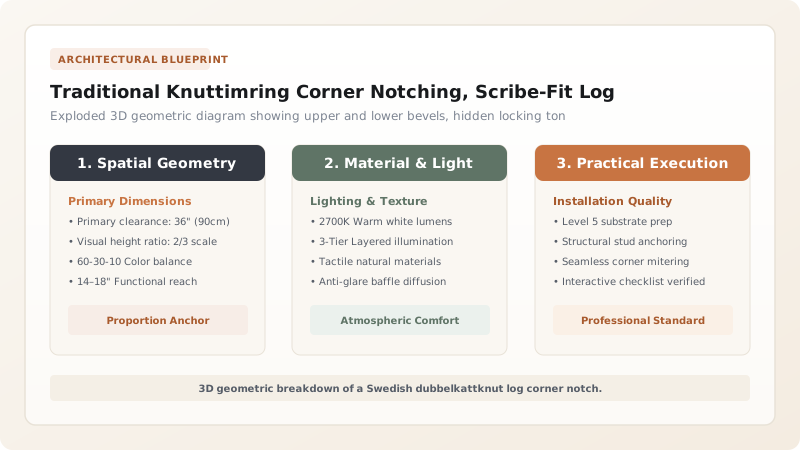
Corner Notch Typologies: Physics of the Dubbelkattknut and Laxknut
In horizontal log architecture, the structural integrity of the entire building depends on its corners. Without rigid footings or frame ties, the corners must resist lateral wind shear, roof live loads, and differential ground movement. Nordic carpenters solved this through sophisticated knut (notch) geometry.
The quintessential Swedish notch is the dubbelkattknut (double cat notch). Developed in Dalarna and Hälsingland, this joint features opposing 45-degree sloping bevels cut into both the top and bottom of each log. Within the heart of the notch, a concealed rectangular wooden tongue ('skjorta' or shirt) engages a matching mortise in the intersecting log. This three-dimensional interlock locks the two walls in all six degrees of freedom: logs cannot shift inward, outward, or rotate. An alternative refinement is the laxknut (dovetail notch), which cuts compound sloping trapezoidal angles that become tighter as the building settles, creating flush exterior wall corners ideal for cottages intended to be clad in protective weatherboarding.
The Art of the Scribe: Dragjärn Compass and Långdrag Adze Work
Logs in natural forests are never perfectly straight or uniform in diameter. To create an airtight wall, each log must be custom-contoured to match the unique curvature of the log resting beneath it. This is accomplished using a dragjärn—a forged iron scribe with two curved legs terminating in hardened scriber tips, often incorporating a bubble level.
The newly positioned log is dog-clamped temporarily in place above the wall. The carpenter adjusts the dragjärn to the maximum gap width between the two logs and pulls the compass smoothly along the entire length of the timber. The lower tip follows the contours of the bottom log, while the upper tip scribes an identical mirrored line into the bark of the upper log. The log is rolled over, and the craftsman uses a rännyxa (a curved adze with a gouge blade) or a specialized curved axe to carve out the wood between the scribed lines, creating the långdrag (a continuous concave parabolic trough). The outer edges of the långdrag are left razor-sharp; when set down, these knife-edges press tightly against the lower log, shedding water while concealing the internal insulation.
Natural Moss Chinking Dynamics & Wooden Dymling Doweling
Before the upper log is permanently dropped into place, the hollowed långdrag trough is packed with dry Sphagnum moss. Harvested in early autumn from unpolluted boreal peat bogs and air-dried in barns, Sphagnum moss contains hollow hyaline cells that act like millions of microscopic air cushions. When compressed under the immense dead weight of the upper log courses, the moss forms an elastic, airtight gasket that dynamically expands and contracts as timber swells in humid summers and shrinks in freezing winters.
To prevent tall log walls from bowing outward (buckling) under heavy snow loads, the logs are pinned vertically using dymlir (hardwood dowels). Carpenters drill vertical 30 mm diameter holes through two to three log tiers using long T-handle augers. Square dowels measuring 32x32 mm hewn from seasoned heartwood birch or oak are driven into the round holes. The square corners bite into the round hole walls, creating immense lateral shear resistance while allowing individual logs to slide downward vertically without hanging up as the green timber shrinks over its multi-year seasoning cycle.
Scandinavian Log Joinery Tools and Dimensional Tolerances
Use this reference table to calculate exact physical dimensions, ratios, and specifications before purchasing:
| Craft Operation | Traditional Tool | Dimensional Tolerance | Structural Objective | Failure / Defect Risk |
|---|---|---|---|---|
| Surface Hewing | Skrädobil (Broadaxe) | ± 2.0 mm across face | Flat vertical wall planes for furniture / linings | Axe chatter marks / grain tearout |
| Profile Scribing | Dragjärn (Scriber compass) | ± 0.5 mm line transfer | Exact replication of log irregularities | Incorrect gap setting causes open seams |
| Groove Hollowing | Rännyxa (Curved gouge adze) | 15-25 mm trough depth | Creates pocket for compressed Sphagnum moss | Carving through outer lips destroys water seal |
| Notch Beveling | Knutyxa & timber chisel | Tight friction fit (< 1 mm gap) | 3D mechanical interlock resisting all lateral loads | Loose notch leads to building racking |
| Dowel Pinning | T-Auger & birch dymling | 32 mm square pin in 30 mm hole | Prevents wall bowing while allowing settling | Round dowel binds and causes log hanging |
Practical Constraints
Every successful decoration project must account for physical and environmental constraints:
Substantial Green Timber Shrinkage Rates
A typical 3-meter tall knuttimring wall shrinks vertically by 100 to 150 mm as pine logs dry from green to 12% moisture. Solution: Incorporate sliding expansion slip-tongues (gåt) and screw jacks beneath all vertical posts, chimneys, and partition walls.
Physical Labor and Heavy Log Handling
Lifting and maneuvering green 6-meter pine logs weighing 300+ kg poses severe fatigue and safety hazards. Solution: Utilize traditional timber skids, block-and-tackle gin poles, or modern mini-cranes with non-marring web slings.
Execution Blueprint & Craftsmanship Sequence
Execute this professional sequence to achieve flawless results without backtracking:
Sill Log (Syll) Leveling and Plinth Squaring
Select massive, high-resin pine heartwood logs for the foundation sill (syll). Hew flat bottom faces and bed directly on dry-stone granite foundation piers over birch bark damp-proof strips.
Rough Positioning and Dog-Clamping
Hoist the next log into position above the wall. Secure with forged iron timber dogs (timmerhakar) to prevent rolling during layout.
Dragjärn Contour Scribing
Set the dragjärn compass gap to the widest offset. Guide the scriber along both sides of the log, scribing dual parallel lines from corner to corner.
Carving the Långdrag Concave Groove
Roll the log 180 degrees. Chop cross-relief cuts and scoop out the concave center with a rännyxa adze, preserving knife-sharp outer contact arrises.
Cutting the Dubbelkattknut Corner Notch
Lay out the double-bevel notch on the log ends. Saw vertical check cuts and chop the 45-degree upper and lower slopes with broadaxes and chisels, forming the hidden central tongue.
Packing Moss and Seating the Log
Spread a 40 mm thick mattress of dried Sphagnum moss along the carved långdrag. Drop the log onto the wall, strike with heavy wooden mauls until notches seat tight, and drive square birch dymlir.
Common Mistakes & Countermeasures
Avoid these costly errors that compromise aesthetics, ergonomics, and budget:
Carving the Långdrag Groove Flat Instead of Concave
Using Round Dowels Glued into Place
Using Damp or Decomposed Moss for Chinking
Project Execution Checklist
Track your physical progress. Checkboxes persist automatically on this device:
Frequently Asked Questions
Why are square dowels (dymlir) used in round holes instead of round dowels?
A round dowel in a round hole creates friction around 100% of its perimeter. When logs dry and shrink, they will bind on the dowel, preventing the wall from settling downward under gravity and leaving open horizontal cracks. A square dowel contacts the round hole at only its four sharp corners: this provides massive lateral resistance against wind and seismic forces while allowing the logs to slide smoothly down without hanging up.
What is a 'gåt' in Swedish log architecture?
A gåt is a vertical wooden guide tongue inserted into a vertical groove routed into the severed ends of logs flanking a window or door opening. The window frame is fastened to the vertical gåt, not to the logs themselves. As the log wall settles downward over years, the logs slide freely along the gåt track, preventing the immense weight of the wall from crushing the window frame.
How much does a Swedish log home settle over its lifetime?
In slow-grown Scots pine, logs shrink across their radial grain by approximately 3% to 5% as they dry from fresh-hewn moisture (~30%) to indoor equilibrium moisture (~10%). For a standard 2.5-meter high ceiling, the entire wall settles downward by approximately 75 to 125 millimeters (3 to 5 inches) over the first three to five years.