Traditional Swedish Falun red cottages (stugor) and knuttimring log architecture represent the pinnacle of Nordic timber engineering. Walls are erected from massive, slow-grown Scots pine (Pinus sylvestris) logs joined at the corners with precision interlocking notches (knutar) and chinked with dry sphagnum moss. The exterior timber is preserved using genuine Falu Rödfärg—a traditional mineral cook paint formulated from calcined copper mining tailings from the Great Copper Mountain in Falun, bound with boiled rye and wheat flour and iron vitriol. This completely breathable, non-film-forming paint protects wood cells against UV radiation, rot, and fungi while allowing the heavy timber core to breathe and season naturally for centuries.
At a Glance: Key Takeaways
- Structural Joinery: Knuttimring (corner-notched interlocking log carpentry)
- Primary Timber: Slow-grown northern Scots pine (Pinus sylvestris / fura)
- Exterior Protective Paint: Genuine Falu Rödfärg (cooked mineral flour paint)
- Pigment Source: Calcined copper mine tailings from Falun, Dalarna (Sweden)
- Natural Chinking Matrix: Wild dried peat moss (Sphagnum / vitmossa) and flax tow
- Vapor Permeability: 100% open-pore breathability (zero peeling or blistering)
In-Depth Guides in this Directory
Explore specialized subtopic blueprints, technical dimensions, and execution checklists:
Falu Rödfärg Mineral Slurry Chemistry: Iron Ochre, Copper Vitriol, Rye Flour Binders, and Silicate Wood Preservation
Scientific analysis of traditional Swedish Falu Rödfärg mineral paint. Learn iron vitriol fungicidal chemistry, gelatinized rye flour starch physics, copper tailing pigments, and open-pore wood breathing.
Traditional Knuttimring Corner Notching, Scribe-Fit Log Geometry, and Dried Sphagnum Moss Chinking
Comprehensive craftsman guide to Scandinavian knuttimring log building. Learn dubbelkattknut notch cutting, dragjärn compass scribing, rännyxa adze carving, and sphagnum moss chinking.
Traditional Scandinavian Birch Bark & Turf Sod Roofing: Multi-Layer Naver Membranes, Wooden Torvstok Logs, and Living Insulative Grass
Architectural and environmental engineering guide to Nordic turf sod roofs (torvtak). Learn birch bark (näver) harvesting, shingling physics, torvstock eave logs, and meadow turf thermal mass.
Falu Rödfärg Mineral Chemistry & Cook Paint Formulation
The characteristic deep, glowing red hue that defines rural Sweden originates in Dalarna at the Great Copper Mountain (Stora Kopparberget) in Falun, which operated continuously from the 10th century until 1992. Weathering over centuries produced massive slag deposits ('rödmull') rich in iron ochres, copper compounds, silica, zinc, and lead. When calcined in high-temperature wood kilns and pulverized, this mineral tailings rock yields a rich, warm, light-fast mineral pigment.
Genuine Falu Rödfärg is not a modern plastic emulsion; it is a slamfärg (mineral wash or cook paint). Its binder is purely organic: finely milled rye and wheat flour boiled in water with iron sulfate (iron vitriol, $FeSO_4$) and raw cold-pressed Swedish linseed oil. The starch in the grain flour gelatinizes into a viscous paste that holds the mineral particles in suspension, while the iron vitriol acts as a natural wood fungicide. When applied to rough-sawn pine or hand-hewn logs, the paint does not form an impermeable film on the surface; instead, the mineral slurry penetrates deep into the open tracheid pores of the wood. The copper and zinc residues poison wood-decay fungi, while the high iron oxide density blocks 99% of damaging ultraviolet solar rays.
Knuttimring Carpentry: Scribe-Fit Log Geometry & Corner Notches
Long before sawn lumber was standard, Scandinavian homes were constructed using knuttimring (horizontal log building). Rather than relying on nails or rigid mechanical fasteners, structural stability is achieved entirely through gravitational interlocking joinery at the wall intersections. Logs are felled in deep winter when moisture content is minimal, hand-debarked with drawknives (bandkniv), and hewn with broadaxes (skrädobil) to create flat interior and exterior faces while leaving the natural curved log crowns intact.
At the corners, the logs are interlocked using specialized notches known as knutar. Master timmermän deploy several historic notch profiles:
- Enkelkattknut (Single Cat Notch): Simple round or saddle notch with a single lateral lock.
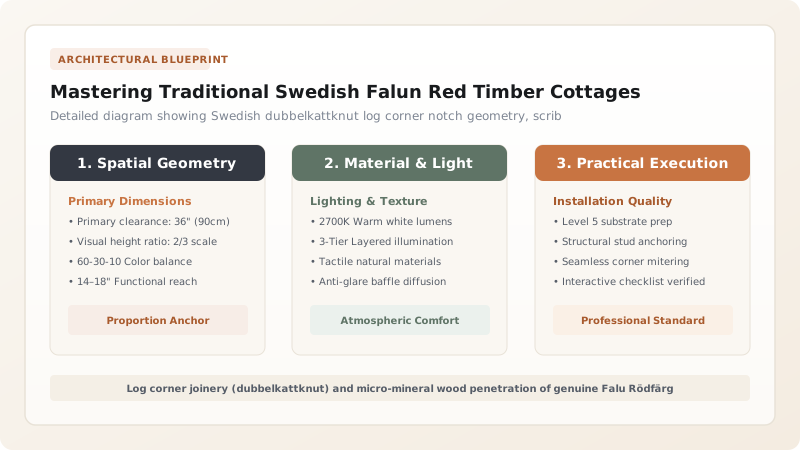
- Dubbelkattknut (Double Cat Notch): Symmetrical upper and lower bevels with an internal hidden timber dowel or wooden tongue ('skjorta') that locks the intersecting logs in both lateral axes, preventing horizontal log slippage under heavy snow loads.
- Laxknut (Dovetail Notch): Slanted compound angles creating a self-tightening joint that draws the logs tighter together as the timber shrinks.
Between horizontal log courses, carpenters scribe the contour of the lower log onto the underside of the upper log using an iron compass tool (dragjärn). The underside is then hollowed out with a curved gouge adze (rännyxa) to create a continuous concave groove (långdrag). When seated, the outer lips of the groove form an airtight, weather-shedding joint.
Sphagnum Moss Chinking & Internal Hardwood Dowel Alignment
To insulate the horizontal joints between logs against Arctic winds, traditional Swedish builders used vitmossa (wild dried Sphagnum peat moss). Sphagnum moss possesses extraordinary biological properties: its cellular structure can absorb up to 20 times its dry weight in moisture while remaining resilient, and it contains natural phenolic acids (sphagnan) that inhibit bacterial decay and mold growth. The dry moss is compressed tightly into the longdrag groove before the upper log is dropped into place. The moss expands and contracts with seasonal log movement, maintaining a continuous, non-perishable wind seal without the need for synthetic foams or sealants.
To prevent tall log walls from buckling outward under structural roof dead weight or during seasonal timber settling, carpenters drill vertical holes through consecutive log courses and drive square hardwood dowels (dymlir) cut from seasoned birch or oak. The square profile cuts slightly into the circular drill hole, maintaining vertical alignment while permitting individual logs to settle downward naturally as the green timber seasons over its first five years.
Turf Sod Roofs (Torvtak) & Classical White Linseed Fenestration
The traditional knuttimring cottage is crowned by a torvtak (sod roof). Underneath the living grass lies the true waterproof barrier: multiple overlapping layers of natural birch bark (näver) harvested in early summer. The birch bark is laid with the outer white side facing down and inner oily yellow side facing up, weighted down by continuous timber logs (torvstock) anchored by wrought-iron hooks. Two layers of dense turf sod (each 75 mm thick) are laid over the bark. The root systems of the grass knit the turf into a living structural mat, providing exceptional winter thermal insulation ($R$-value > 3.0), summer evaporative cooling, and heavy structural dead load that compresses the knuttimring wall logs into an airtight, solid mass.
Architecturally, the vibrant matte Falu Rödfärg of the log walls is punctuated by crisp white or pale-ochre window frames and corner boards (knutbrädor). Unlike the walls, window sashes and doors are painted with pure boiled linseed oil paint (linoljefärg) pigmented with titanium white or zinc oxide. Linseed oil cures into a durable, flexible, weather-resistant satin film that protects finely joined joinery components, completing the timeless Swedish pastoral aesthetic.
Swedish Log Notches and Protective Coating Specifications
Use this reference table to calculate exact physical dimensions, ratios, and specifications before purchasing:
| Architectural Element | Joinery / Coating Typology | Traditional Material | Mechanism / Physics | Maintenance Interval |
|---|---|---|---|---|
| Log Corner Joinery | Dubbelkattknut or Laxknut | Slow-grown Scots pine heartwood | Interlocking bevels + internal dowel locks | Inspect settling every 5 years; zero rot |
| Horizontal Log Seam | Långdrag concave groove | Compressed dry Sphagnum moss | Phenolic preservation; self-adjusting seal | Self-maintaining for 100+ years |
| Exterior Log Walls | Genuine Falu Rödfärg | Cooked mineral slurry (iron ochre/vitriol) | Deep pore penetration; 100% breathable | Re-coat every 8 to 12 years (no scraping) |
| Windows & Doors | Linoljefärg (Linseed oil paint) | Boiled linseed oil + zinc oxide pigment | Flexible elastic film; UV resistant | Nourish with boiled oil every 7 to 10 years |
| Roof Membrane | Torvtak (Turf Sod Roof) | 6-8 layers birch bark (näver) + 150mm sod | Natural betulin oil water barrier + soil mass | Bark lasts 50-80 years; mow turf annually |
Practical Constraints
Every successful decoration project must account for physical and environmental constraints:
Authentic Falun Mine Pigment Resource Scarcity
The Falun mine is closed; raw historical tailings deposits are strictly managed, driving up authentic pigment costs. Solution: Verify official 'Falu Rödfärg Original' seal on paint tubs; avoid cheap synthetic red oxide imitations.
Long Structural Log Settling Dimensions
Knuttimring walls settle vertically by 30 to 50 mm per meter of wall height during the first 3 to 5 years of drying. Solution: Incorporate sliding expansion slip-joints (gåt) above all window and door frames to prevent jamb crushing.
Execution Blueprint & Craftsmanship Sequence
Execute this professional sequence to achieve flawless results without backtracking:
Winter Timber Felling and Hewing
Fell dense Scots pine trees in January when sap is lowest. Debark immediately with drawknives and broadaxe-hew the inner and outer faces to uniform 150-200 mm thickness.
Scribing the Långdrag and Corner Notches
Position log over the wall. Scribe bottom contour with a dragjärn compass. Hollow out the longitudinal groove using a rännyxa gouge adze, and cut interlocking dubbelkattknut corner notches.
Sphagnum Moss Bedding and Dymling Pinning
Pack dry Sphagnum peat moss into the carved groove. Seat the log with wooden mauls. Drill vertical dowel holes and drive square birch dymling pins every 1.5 meters.
Roof Framing and Birch Bark Näver Laying
Erect heavy log rafters. Shingle 6 to 8 overlapping layers of birch bark over roof boarding, curling bark downward along eaves into gutter troughs.
Turf Sod Placement
Lay two staggered courses of dense meadow turf sod (grass face down for lower layer; grass face up for top layer) behind the timber torvstock eave retainer logs.
Cooking and Applying Falu Rödfärg
Boil water, rye flour, iron vitriol, linseed oil, and genuine Falun pigment for 2.5 hours. Apply the warm paint across rough log surfaces using wide horsehair block brushes.
Common Mistakes & Countermeasures
Avoid these costly errors that compromise aesthetics, ergonomics, and budget:
Applying Modern Acrylic or Alkyd Paints Over Falu Rödfärg
Applying Falu Rödfärg to Planed, Smooth-Sanded Timber
Using Synthetic Glass-Wool Insulation Between Logs
Project Execution Checklist
Track your physical progress. Checkboxes persist automatically on this device:
Frequently Asked Questions
Why does Falu Rödfärg paint never peel or flake off?
Falu Rödfärg is a non-film-forming mineral wash. Unlike modern acrylic paints that form a plastic skin over the wood, Falu Rödfärg's mineral grains and rye flour starch penetrate directly into the wood fiber tracheids. The surface remains completely porous and breathable. Over 8 to 10 years, the paint slowly weathers away by gentle chalking; when it is time to repaint, no scraping or burning is required—you simply brush off loose dust with a wire brush and apply a fresh coat.
How long does a traditional knuttimring timber house last?
When properly maintained with Falu Rödfärg and kept dry by a sound roof, knuttimring timber buildings can endure for 400 to 800+ years. Sweden contains intact log churches and storehouses dating back to the 13th and 14th centuries that remain structurally sound today.
Can I paint an existing house that has modern paint with Falu Rödfärg?
No. Falu Rödfärg can only bond to unpainted, rough-sawn, axe-hewn, or previously Falu-painted wood. If a building has been coated with acrylic, oil, or latex paint, those impermeable layers will prevent the mineral wash from absorbing into the wood. All previous film-forming paints must be completely stripped, or the timber re-clad in rough-sawn pine battens.