In Classical Suzhou garden architecture, louchuang openwork screens are not static decorative grilles; they are active optical instruments engineered to manipulate human visual perception, borrowed scenery (jièjǐng), and dynamic shadow projection. Operating according to the landscape theory of Ji Cheng's 1631 treatise Yuanye, louchuang windows frame carefully staged focal points (Taihu rockeries, weeping willows, distant pagodas) as living landscape paintings that evolve with every step along covered corridors. Simultaneously, the pierced terracotta lattices harness southern solar angles to project intricate, shifting geometric lace shadows across opposing whitewashed lime plaster walls (fěnqiáng), transforming blank architectural surfaces into kinetic calligraphic canvases.
At a Glance: Key Takeaways
- Landscape Theory: Ji Cheng's Yuanye (1631): Jièjǐng (borrowed scenery) and Yíbù huànjǐng (changing views with every step)
- Optical Canvas: Fěnqiáng (powder-white slaked lime plaster wall) functioning as blank rice paper (xuānzhǐ)
- Projection Light Source: Direct southern solar radiation and twilight lunar illumination
- Shadow Typology: Guāngyǐng (geometric lace shadows cast by tile lattices and overlapping plant foliage)
- Perceptual Mechanism: Visual parallax and spatial layering (yǐnjǐng / concealed-and-revealed scenery)
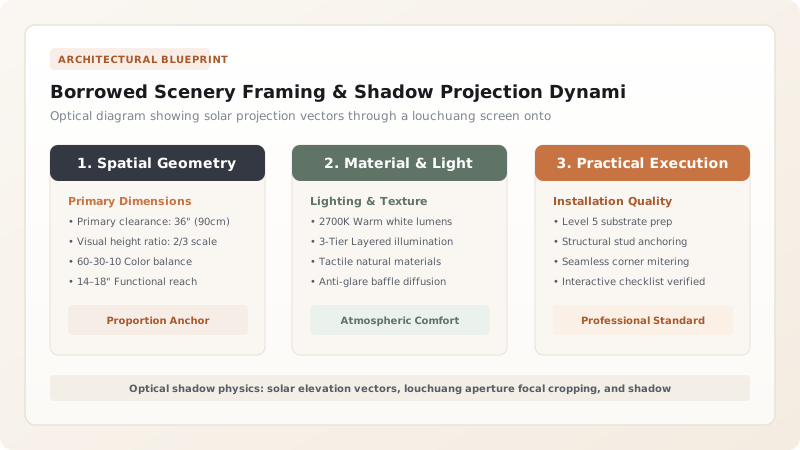
The Wall as Canvas: Fěnqiáng as Rice Paper
In Western architectural tradition, walls are predominantly understood as load-bearing enclosures, thermal barriers, or structural partitions. In the Classical Scholar Gardens of Suzhou, the wall is conceptualized through an entirely different artistic metaphor: it is a monumental sheet of unrolled, white calligraphic rice paper (xuānzhǐ).
Known as the fěnqiáng (粉墙 / powdered wall), these high masonry walls are rendered with multiple coats of pure slaked lime plaster and finished without paint, resulting in an immaculate, dead-flat matte white surface. Because scholars spent their lives practicing brush calligraphy and ink-wash landscape painting (guóhuà), they designed their architecture to replicate the aesthetic of ink on paper. Against this pure white ground, the dark grey terracotta openwork screens and the crooked branches of pine and plum are framed like bold strokes of wet black ink, transforming every corridor partition into an architectural painting.
Optical Choreography: Jièjǐng (The Art of Borrowing)
The placement of a louchuang is an exercise in rigorous optical alignment. Codified by Ji Cheng in his 1631 garden design treatise Yuanye, the master principle of jièjǐng (借景 / borrowed scenery) dictated that the garden must visually capture the outside world without letting secular noise inside. A garden master did not cut a window randomly; the opening was sited based on precise standing and walking sightline trajectories.
Walking along a covered gallery (yóuláng), the visitor's eye is framed by the louchuang opening. The solid portions of the screen crop away chaotic foregrounds, telephone lines, or adjacent servant quarters, isolating only the pure poetic essence: a solitary crag of weathered Taihu limestone, a cascading spring, or the distant spire of the North Temple Pagoda miles outside the city walls. This selective framing exploits human cognitive focus: by framing nature within an architectural border, the mind perceives the garden not as a confined urban enclosure, but as an infinite cosmic landscape.
Kinetic Shadow Dynamics: Guāngyǐng & Solar Vectors
The crowning glory of louchuang fenestration occurs when direct sunlight interacts with the pierced ceramic screen. In Jiangnan garden architecture, covered corridors are designed with specific solar orientations, typically running along the northern or western perimeters of courtyards to capture southern solar radiation.
As sunlight streams through the openwork terracotta lattice, the physical screen acts as an optical shadow mask. Complex geometric patterns—cracked-ice fractures, double coins, plum blossom petals—are projected across the opposing white wall in sharp, high-contrast silhouette (guāngyǐng). This shadow projection is not static; it is kinetic. As the sun sweeps across the southern sky from dawn to dusk, the geometric shadows stretch, compress, and crawl across the white plaster wall like living calligraphy. When wind rustles the leaves of bamboo planted outside the window, the soft organic fluttering of foliage shadows merges with the crisp, stationary geometry of the terracotta lattice, creating a mesmerizing optical symphony of light and shadow.
Visual Parallax, Mystery & The Chan Aesthetic of Emptiness
The psychological impact of walking past a sequence of louchuang windows relies on the optical phenomenon of visual parallax. As a spectator walks down a covered corridor, the foreground terracotta screen moves rapidly past the visual field, while the distant garden elements framed through the screen move much more slowly. This relative motion creates immense stereoscopic depth perception, tricking the brain into experiencing the adjacent courtyard as exponentially larger and deeper than its true physical boundaries.
This aesthetic embodies the Chan (Zen) Buddhist doctrine of 'emptiness and form' (kōng jí shì sè). A completely solid wall is closed and lifeless; a completely open archway reveals everything instantly, destroying mystery. The louchuang provides partial concealment (yǐnjǐng)—it conceals half the garden while revealing the other half, inviting the visitor to imagine what lies hidden beyond. Through this masterly fusion of ceramic craftsmanship, solar optics, and psychological suggestion, the Suzhou louchuang remains one of the most sophisticated architectural devices ever invented for elevating human contemplation within the natural world.
Optical & Temporal Dynamics of Louchuang Shadow Projections
Use this reference table to calculate exact physical dimensions, ratios, and specifications before purchasing:
| Time of Day / Season | Solar Angle & Quality | Projected Shadow Effect | Botanical Interaction | Atmospheric / Psychological Mood |
|---|---|---|---|---|
| Early Morning | Low eastern sun (15–30°) | Elongated, dramatic diagonal shadow lace stretching across the floor | Dew drops on plum petals project shimmering points of light | Awakening clarity, freshness, and quiet contemplative study |
| Midday Noon | High southern sun (60–75°) | Compact, high-contrast, razor-sharp geometric fret shadows on base sill | Overhead bamboo leaves cast kinetic fluttering dappled shadows | Dynamic energy; dramatic contrast between brilliant white and dark grey |
| Late Afternoon | Low western sun (20–35°) | Warm amber shadows climbing up the opposite white plaster wall | Maple leaves cast ruby-tinted glowing silhouettes through the screen | Poetic nostalgia, tranquility, and evening tea preparation |
| Moonlit Night (Yèlǐ) | Full moon overhead | Ethereal, faint silvery shadow lace visible in still darkness | Wind-blown bamboo creates rustling acoustic and visual silhouettes | Mystical Chan / Daoist detachment; dissolution of boundaries |
Practical Constraints
Every successful decoration project must account for physical and environmental constraints:
Rapid growth of exterior garden foliage encroaching on designed optical sightlines
Overgrown tree branches block designed views of distant pagodas or rockeries within three seasons. Mitigation: Institute rigorous seasonal bonsai pruning (shùshí xiūjiǎn) to maintain the precise framed opening.
Seasonal solar altitude shifts changing shadow projection angles across summer and winter
Summer sun projects shadows near the floor while winter sun casts shadows high on the opposite wall. Mitigation: Design the opposite wall height and corridor width to accommodate the full 45-degree seasonal solar sweep.
Execution Blueprint & Craftsmanship Sequence
Execute this professional sequence to achieve flawless results without backtracking:
Sightline Trajectory & Focal Point Alignment
Stand at the predetermined viewing station along the covered gallery, aligning a wooden targeting frame toward the chosen landscape element (e.g., a contorted Taihu rockery peak).
Solar Angle Mapping & Projection Distance Calculation
Calculate the solar trajectory across both solstices, ensuring the opposing corridor wall is positioned at a distance (2–3 m) that catches sharp, in-focus shadows.
Wall Opening Masonry & Elevation Setting
Build the rectangular or shaped louchuang opening at eye level (centerline 1.45–1.55 m above floor level), ensuring the bottom sill does not cut off foreground water views.
Pierced Terracotta Lattice Insetting
Install the cracked-ice, curved-tile, or floral terracotta screen within the opening, bedding perimeter frames in sticky-rice mortar flush with the wall face.
Opposing Projection Wall Whitewashing (Fěnqiáng)
Plaster the opposing corridor wall with three coats of pure slaked lime putty and fine marble dust, troweling to an optically flat, non-reflective matte finish.
Exterior Foreground Landscape Staging
Plant slender Nandina bamboo, Japanese maple, or winter plum directly outside the window, placing a moss-covered river stone in the intermediate foreground.
Shadow Projection Verification under Raking Sun
Observe shadow dynamics throughout a clear day, adjusting tree branch density to achieve a balanced interplay of sharp tile geometry and soft foliage silhouettes.
Nocturnal Lantern Placement & Tuning
Conceal a low-wattage warm light or paper lantern outside the window beneath eaves, tuning the lamp position to project delicate night shadows across the corridor wall.
Common Mistakes & Countermeasures
Avoid these costly errors that compromise aesthetics, ergonomics, and budget:
Positioning an openwork screen facing a cluttered, disorganized background (such as utility sheds or blank fences)
Painting the interior corridor wall with glossy modern enamel paint
Placing tall, dense evergreen shrubs directly against the louchuang screen
Project Execution Checklist
Track your physical progress. Checkboxes persist automatically on this device:
Frequently Asked Questions
What is the role of the white wall (fěnqiáng) in Suzhou garden shadow dynamics?
In Chinese garden aesthetics, the whitewashed wall (fěnqiáng) is conceived not as a barrier, but as a vast sheet of white rice paper (xuānzhǐ). The terracotta louchuang and adjacent trees function as the brush and ink. When sunlight strikes the pierced window, the black shadows cast across the stark white plaster create a living, ever-changing ink-wash painting (guóhuà) that moves with the sun and wind.
How does 'visual parallax' enhance the experience of walking past a series of louchuang?
Visual parallax occurs when near objects move faster across the field of view than distant objects. As a visitor walks along a covered corridor, the close-up geometric terracotta lattice slides rapidly across the vision, while the distant rockery or pavilion framed through the screen moves slowly. This relative motion creates immense optical depth, making small courtyards feel like vast mountain landscapes.
Can borrowed scenery (jièjǐng) borrow elements located miles outside the garden?
Yes. Master Ji Cheng categorized borrowed scenery into four spatial realms: distant borrowing (yuǎnjiè, such as borrowing the distant North Temple Pagoda or Tiger Hill Pagoda miles away), adjacent borrowing (línjiè, borrowing a neighbor's flowering tree), upward borrowing (yǎngjiè, framing soaring clouds and flying cranes), and downward borrowing (fǔjiè, framing swimming carp in pond water).