The traditional Russian pechka (русская печь) is an iconic multipurpose masonry heater, bake oven, and residential thermal battery developed across centuries of severe Eurasian continental winters. Weighing between 1.5 and 3 metric tons, the pechka is constructed from dense clay bricks laid in non-cementitious refractory earthen mortars. Unlike open fireplaces that lose 80% of their heat up the chimney, or metal woodstoves that produce sharp temperature spikes, the pechka operates on the principle of extreme thermal mass accumulation. A hot, clean fire burning at 800°C to 1,000°C transfers its heat into thick vaulted brick chambers and tortuous multi-turn internal smoke channels (oboroty). Over 24 to 36 hours, this stored thermal mass radiates gentle, far-infrared warmth (wavelength 8-14 microns) into the timber log izba, while the integrated top platform—the lezhanka—serves as a heated sleeping bench that maintains a therapeutic 40°C to 45°C surface temperature.
At a Glance: Key Takeaways
- Structural Weight: 1,500 to 3,500 kg of solid refractory clay brick mass
- Thermal Storage Cycle: 24 to 36 hours of steady radiant heat from a single 2-hour burn
- Internal Firebox Vault: Deep parabolic barrel vault (pod and svod) angled forward
- Sleeping Bench: Top horizontal masonry terrace (lezhanka) at 40-45°C
- Masonry Mortar: Screened refractory fat clay and quartz sand (zero Portland cement)
- Flue Regulation: Dual sliding iron damper valves (zadvizhki) with summer bypass
In-Depth Guides in this Directory
Explore specialized subtopic blueprints, technical dimensions, and execution checklists:
Thermal Mass Firebrick Chambers and Lezhanka Sleeping Bench Engineering: Ergonomics, Refractory Vaults, and Heat Conduction
Technical guide to engineering firebrick combustion chambers and heated lezhanka sleeping benches in traditional Russian pechka masonry stoves.
Smoke Channel Dynamics and Multi-Flue Damper Systems: Summer Bypasses, Vertical Chimneys, and Draft Control
Master internal smoke channel dynamics (oboroty), cast-iron sliding dampers (zadvizhki), summer bypass valves, and draft regulation in Russian masonry stoves.
Refractory Clay Mortars, Traditional Lime Whitewash, and Seasonal Curing Protocols for Masonry Heaters
Master the preparation of authentic refractory clay mortars, non-smudging salt-lime whitewash, and strict seasonal curing protocols for Russian masonry stoves.
The Pechka as the Heart of the Northern Izba
In traditional Russian wooden architecture (the izba), the house was literally built around the stove. Known culturally as the 'mother of the home' (matushka-pech), this massive masonry structure was situated at the center of the living quarters, positioned so that its four radiating brick faces warmed the main living room, sleeping quarters, and kitchen simultaneously.
The engineering genius of the pechka lies in its thermal storage capacity. In sub-zero Siberian and northern European winters, continuous heating with low-efficiency metal stoves consumes unsustainable quantities of cordwood and creates dry, soot-choked air. The pechka, by contrast, operates in batch-firing mode: a short, intense fire of dry birch or pine burns at peak thermodynamic efficiency (over 800°C) for 90 to 120 minutes with abundant oxygen, ensuring near-total combustion of volatiles and minimal creosote. The tremendous mass of 1,500 to 3,500 kg of solid clay brick absorbs this massive heat pulse and gently diffuses it into the surrounding rooms over the next 24 to 36 hours as healthy radiant far-infrared warmth.
Internal Vault Architecture: The Svod, Pod, & Uste
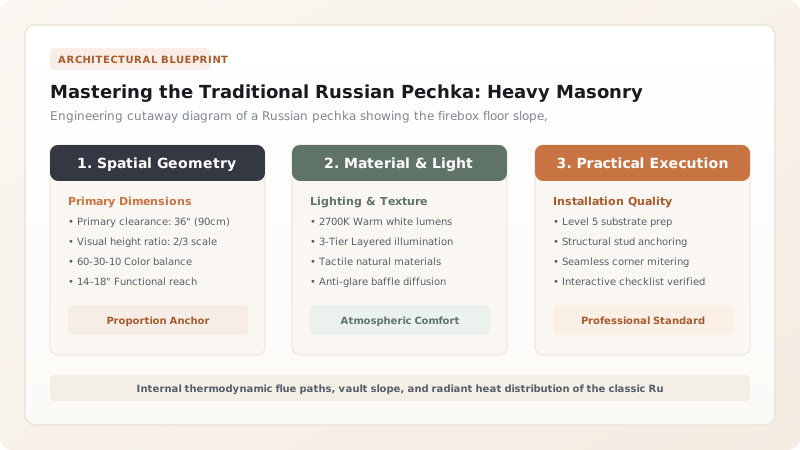
At the mechanical core of the pechka is the primary combustion chamber, known as the gornilo or pechische. The chamber floor—the pod—is constructed from ultra-dense, glass-smooth firebricks laid flat without mortar, gently pitched upward toward the rear wall at an angle of 3 to 5 degrees. This subtle upward slope ensures that cool incoming combustion air slides smoothly beneath the burning logs, while hot combustion gases roll along the ceiling.
Spanning over the hearth floor is the svod—a heavy, self-supporting parabolic barrel vault laid from wedge-shaped arch bricks. The height of the vault and the dimensions of the front opening (the uste) are calculated with extreme precision. The ceiling of the svod reflects radiant heat directly down onto bread baking on the pod floor, while forcing escaping gases to curl downward before entering the smoke collector (sheshtok). This gas-roll vortex traps heat within the vault long after combustion ceases, allowing the oven to bake rye sourdough bread, simmer restorative stews (kasha), and dry wild forest mushrooms over a 12-hour temperature descent.
The Lezhanka: Heated Sleeping Bench Ergonomics & Physics
Arguably the most unique architectural feature of the Russian pechka is the lezhanka (or polati)—a spacious horizontal brick terrace situated atop the stove body, typically 1.5 to 2.2 meters long and 1.2 to 1.5 meters wide, elevated 1.5 meters above the room floor. Accessible via a wooden ladder or stepped brick side-chests, the lezhanka provides a warm sleeping surface for two to three adults.
Heating of the lezhanka is controlled by routing internal horizontal and vertical smoke passages directly beneath the upper brick cap. By adjusting the thickness of the top masonry deck (typically 2 to 3 courses of brick overlaid with sand and ceramic tiles), the surface temperature of the sleeping bench is engineered to remain between a therapeutic 40°C and 45°C. For centuries, this constant, deep conductive heat served as the primary folk medicine remedy for rheumatism, arthritis, back pain, and hypothermia during long Arctic nights.
Multi-Flue Oboroty Channels & Dual-Damper Control
To maximize thermal extraction before exhaust gases exit into the atmosphere, the pechka incorporates an intricate labyrinth of internal smoke channels, historically termed oboroty. These channels can be configured in horizontal serpentine (gorizontal'nye), vertical multi-pass (vertikal'nye), or bell-type (kolpakovye) airflow circuits.
As hot exhaust gases travel through these winding masonry ducts, they transfer over 80% of their heat energy into the surrounding brickwork, exiting the chimney top at a safe 120°C to 150°C. Gas flow is regulated by heavy cast-iron sliding damper plates (zadvizhki or vyushki). A dedicated direct-draft 'summer damper' allows the stove to be used for cooking during warm months by directing exhaust gases straight up the chimney without charging the thermal mass. In winter, closing the bypass forces gases through the entire thermal labyrinth, heating the entire stove body.
Russian Pechka Masonry Stove vs Other Residential Heating Systems
Use this reference table to calculate exact physical dimensions, ratios, and specifications before purchasing:
| Heating System | Thermal Efficiency | Heat Retention Duration | Indoor Air Quality | Multi-Utility Functions |
|---|---|---|---|---|
| Russian Pechka Masonry Stove | 80% - 88% (hot batch firing) | 24 to 36 hours steady radiant heat | Exceptional; zero soot or scorched dust | Heater, bake oven, heated bed (lezhanka), food drier |
| Open Fireplace (Hearth) | 10% - 15% (most heat lost in flue) | 0 to 2 hours (cools as soon as fire dies) | Poor; draws cold drafts across room | Aesthetic and basic radiant warmth only |
| Cast-Iron Woodstove (Modern) | 65% - 75% (choked combustion) | 4 to 8 hours (rapid cooling when unbanked) | Moderate; scorches airborne dust on hot metal | Room heating and basic stovetop cooking |
| Central Forced-Air Gas Furnace | 80% - 95% (combustion efficiency) | 0 hours (instantaneous air cooling) | Dry air, circulates allergens and drafts | Air heating only |
Practical Constraints
Every successful decoration project must account for physical and environmental constraints:
Immense Structural Dead Load (1,500 - 3,500 kg)
Standard domestic timber floor joists cannot bear the concentrated mass of a Russian pechka. Mitigation: Always engineer an independent ground-supported masonry or concrete footing with adequate soil bearing capacity, completely isolated from timber subflooring.
Rigid Clearances to Combustible Timber Framing (Fire Code Standards)
Historic log cabins require strict safety separations (otstupka) between hot masonry surfaces and wooden walls. Mitigation: Maintain a minimum 380 mm brick-to-timber clearance, or 250 mm when protected by mineral wool and sheet metal heat shields per fire protection standards.
Extended Thermal Lag and Inflexibility
A cold pechka takes 4 to 6 hours to begin radiating noticeable room heat, making it unsuitable for intermittent weekend cabin heating. Mitigation: Install a secondary cast-iron quick-heating cooktop or direct-convective firebox alongside the masonry core to provide immediate warm air while the mass charges.
Execution Blueprint & Craftsmanship Sequence
Execute this professional sequence to achieve flawless results without backtracking:
Excavating and Pouring Non-Settling Base
Excavate an independent foundation separated from the house perimeter footings by a 50 mm expansion gap. Cast a 300 mm reinforced concrete pad or bed heavy granite boulders to support the 3-ton stove load.
Laying the Podpechye Brick Structure
Construct the lower rectangular base (podpechye), leaving an arched lower alcove for drying firewood. Lay solid red clay bricks using 5 mm refractory clay-sand mortar joints.
Installing the Sloped Firebrick Hearth
Lay dense, smooth firebricks flat without mortar to form the pod hearth floor, pitching the floor upward 3 to 5 degrees toward the rear wall. Fill underside voids with fine washed sand for thermal insulation.
Erecting Wooden Centering and Keystone Vault
Install temporary curved wooden formwork (kruzhalo). Lay wedge-shaped refractory firebricks in radial courses from both springlines, locking the vault firmly with tightly driven keystone bricks.
Forming Oboroty Flues and Sleeping Platform
Build the labyrinth of vertical or horizontal smoke channels above and behind the combustion chamber. Lay 3 solid brick courses over the top to form the lezhanka sleeping bench, smoothing with sand and terra-cotta.
Mounting Zadvizhki and Flue Collector
Bed cast-iron frame damper gates in refractory mortar with ceramic rope expansion joints. Connect to the brick chimney stack, ensuring strict 380 mm clearances from combustible timber roof framing.
Multi-Week Drying Fires and Pure Limewash
Allow mortar to dry naturally for 14 days. Burn small daily kindling fires (1-2 kg) over 10 days to gently drive out tons of moisture. Apply 3 coats of traditional slaked lime whitewash blended with salt.
Common Mistakes & Countermeasures
Avoid these costly errors that compromise aesthetics, ergonomics, and budget:
Using Standard Portland Cement Mortar for Firebox Masonry
Connecting Stove Foundation Directly to Timber House Joists
Lighting a Full Hot Fire Immediately After Bricklaying
Closing the Chimney Damper (Zadvizhka) While Blue Flames Remain
Project Execution Checklist
Track your physical progress. Checkboxes persist automatically on this device:
Frequently Asked Questions
How long does a Russian pechka stay warm after the fire burns out?
A properly sized Russian pechka containing 2 to 3 tons of masonry retains and emits comfortable radiant heat for 24 to 36 hours following a single two-hour burn of dry hardwood. In well-insulated timber log homes, firing once a day in winter is sufficient to maintain steady 20°C to 22°C indoor temperatures.
Can you bake real sourdough bread in a Russian pechka?
Yes. The pechka is widely considered the ultimate bread-baking oven. Once the fire burns down to coals and the ash is swept clean with a wet pine broom (pomelo), the massive refractory vault radiates intensely even, non-convective falling heat (dropping from 260°C to 180°C over two hours), producing deep, crispy caramelized crusts and open, moist crumbs.
What is the primary function of the lezhanka sleeping bench?
The lezhanka combines furniture with thermal therapy. By routing flue channels beneath the top brick terrace, the surface maintains a comfortable 40°C to 45°C. In harsh sub-zero continental winters, it provided a warm, draft-free sleeping zone for elders and children while using radiant far-infrared energy to relieve joint and muscle ailments.