
Nalichniki are the celebrated pierced fretwork window surrounds of traditional Russian timber architecture. Combining delicate multi-tiered saw-pierced linden or pine boards with deep Slavic mythological iconography, nalichniki served both practical and spiritual roles: they shielded vulnerable window-wall settlement gaps from driving snow while creating an apotropaic amuletic barrier that protected the household from evil spirits through carved solar rosettes, celestial birds, and water waves.
At a Glance: Key Takeaways
- Timber Species: Aged, knot-free linden (lipa), Scots pine, or aspen heartwood
- Decorative Technique: Glukhaya rezba (blind relief carving) and propilnaya rezba (pierced fretwork)
- Upper Pediment: Ochelye or kokoshnik arch crowned with radiant solar wheels (solntse)
- Lower Apron: Podokonnoe polotentse (under-sill towel apron) depicting fertile earth and water
Cosmological Zoning: The Three Worlds of the Window Frame
In traditional Slavic architecture, a window was not merely an aperture for daylight; it was an 'eye' into the home (the word okno shares roots with oko, meaning eye). Because openings breach the protective envelope of the log wall, they required specialized spiritual defenses.
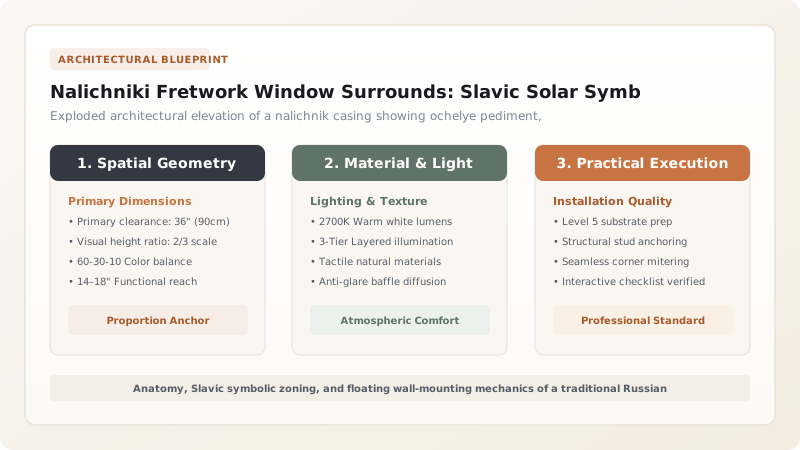
A nalichnik is divided into three vertical zones mirroring ancient Slavic cosmology: the upper pediment (ochelye) represents the celestial heavens, dominated by the supreme solar god Dazhbog and celestial birds (sirin); the side jambs represent the earthly air and life-giving rain, carved with zigzag water cascades; and the lower apron beneath the sill represents the fertile black earth (Mat Syra Zemlya) inscribed with diamond rhombuses symbolizing planted seeds.
The Evolution from Blind Relief to Pierced Lace Fretwork
Historically, early Russian platbands were executed in glukhaya rezba (blind or ship-carving relief), where motifs were chiseled in deep, tactile bas-relief into heavy solid timber planks. This technique was practiced by naval shipwrights working along the Volga River basin during winter freeze-ups.
During the mid-19th century, the widespread availability of thin European steel fret-saws (lobzik) sparked a design revolution: propilnaya rezba (through-cut or pierced fretwork). Carpenters began piercing delicate, lace-like openwork patterns through 25 to 35 mm boards, layering multiple cutout panels on top of one another to create multi-dimensional shadow depths that glowed against the dark log facades.
The Ochelye Pediment: Kokoshnik Profiles and Solar Rosettes
The crown of the nalichnik is the ochelye, named after the traditional Russian woman's headdress (kokoshnik). This arched or gabled pediment is dominated by the radiant solar rosette (solntsevorot or gromovoy znak), a multi-spoke wheel representing the path of the sun through the heavens.
In northern climates where winter sunlight was scarce for months, these carved suns served as visual affirmations of warmth and rebirth. The pediment frequently features flanking stylized horses' heads (konyki)—the mythological beasts that pull the solar chariot across the sky—or twin birds perched on the Tree of Life.
Floating Installation Mechanics over Settlement Gaps
Beyond its symbolic artistry, the nalichnik is an indispensable building envelope component. When an izba settles, the logs shrink vertically while the vertical window frame remains rigid. To accommodate this, builders leave a 60 to 90 mm void above the window frame.
The nalichnik is designed with deep return flanges that lap over this settlement gap, concealing the compressed moss insulation while remaining fastened exclusively to the window frame—never directly into the settling log wall. As the logs slowly descend over several years, the nalichnik moves smoothly with the window box, maintaining a weather-tight, draft-free seal without crushing the delicate fretwork.
Nalichniki Carving Traditions: Glukhaya (Blind) vs Propilnaya (Pierced)
Use this reference table to calculate exact physical dimensions, ratios, and specifications before purchasing:
| Technical Feature | Glukhaya Rezba (Blind Relief Carving) | Propilnaya Rezba (Pierced Fretwork Lace) |
|---|---|---|
| Historical Era | 17th to early 19th century (shipwright origins) | Mid-19th to early 20th century (Victorian saw era) |
| Primary Tooling | Hand gouges, flat chisels, and woodcarving adzes | Piercing drill bits, handheld fret saws, and coping saws |
| Visual Character | Sculptural, heavy, bas-relief figures on solid timber ground | Airy, multi-tiered white lacework with intense cast shadows |
| Timber Thickness | Requires thick 50–70 mm defect-free hardwood planks | Standard 25–35 mm softwood boards layered in relief |
| Weathering Resilience | High; solid wood has fewer fragile thin projections | Moderate; delicate pierced filigree can snap under heavy ice accumulation |
Practical Constraints
Every successful decoration project must account for physical and environmental constraints:
Heavy icicle accumulation and snow loads on wide ochelye pediments
Winter thaw-refreeze cycles create massive ice dams on projecting horizontal moldings, breaking fragile pierced filigree pendants. Mitigation: Install a beveled sheet copper or galvanized steel drip cap (otliv) over the top pediment molding sloped at 30 degrees to shed melting snow clear of the woodwork.
Sun-bleaching and peeling of exterior oil paint on south-facing facades
Intense solar exposure combined with sub-zero winter temperatures causes traditional oil paints on exposed fretwork edges to check and flake within 4 to 6 years. Mitigation: Formulate paints with pure zinc oxide and titanium dioxide pigments in raw cold-pressed linseed oil, which remains micro-flexible and does not peel.
Execution Blueprint & Craftsmanship Sequence
Execute this professional sequence to achieve flawless results without backtracking:
Selecting and Planing Softwood Lumber
Select slow-grown, knot-free boards of seasoned northern pine, linden, or aspen with an equilibrium moisture content below 12%. Plane all faces smooth to a uniform 28 mm thickness.
Drafting Symmetrical Patterns with Zinc Stencils
Transfer traditional regional fretwork patterns onto the wood face using heavy zinc or pasteboard stencils and fine graphite pencils, ensuring precise left-to-right symmetry.
Drilling Starter Holes for Internal Filigree
Bore pilot holes in the waste centers of all internal fretwork voids using an 8 mm brad-point drill bit, avoiding tearout on the back face of the timber board.
Piercing the Intricate Lace Cutouts
Thread a fine-toothed fret-saw blade through each pilot hole. Carefully cut out the internal negative spaces along drafted lines, maintaining perpendicular 90-degree edge cuts.
Carving Chamfers and Surface Modeling Details
Using small palm gouges, bevel the face edges of the pierced fretwork (falts) to soften hard contours and carve delicate feathers, flower petals, and solar wheel spokes.
Multi-Tiered Sub-Panel Assembly and Doweling
Stack and join the pierced fretwork panels onto the solid backer frame using waterproof hide glue and concealed wooden birch dowels, creating a 3-dimensional stepped relief profile.
Priming and Multi-Coat Breathable Painting
Apply two coats of boiled cold-pressed linseed oil primer to saturate wood pores. Paint with high-opacity white or cream breathable linseed oil paint, allowing 48 hours between coats.
Mounting Over the Window Settlement Gap
Screw the assembled nalichnik casing securely into the floating timber window box (okosyachka), verifying that the top pediment overlaps the moss-packed settlement gap without binding against descending wall logs.
Common Mistakes & Countermeasures
Avoid these costly errors that compromise aesthetics, ergonomics, and budget:
Nailing the top pediment of the nalichnik into the log wall above the window
Using open-grained fast-grown spruce or knotty lumber for fine fretwork
Project Execution Checklist
Track your physical progress. Checkboxes persist automatically on this device:
Frequently Asked Questions
What is the meaning of the two birds flanking the sun on the top pediment?
The twin birds represent mythological heralds of dawn (often identified with swans, ducks, or the mythical Sirin bird). In ancient Slavic folklore, birds carry the sun out of the underworld each morning, heralding light, spring, and the renewal of life.
Why are nalichniki almost always painted bright white in Russian villages?
White paint was traditionally formulated from slaked lime and chalk, which were cheap and widely available. Visually, pure white filigree created maximum optical contrast against the dark, weather-silvered pine logs, highlighting the intricate pierced lacework even through heavy winter blizzards and dim northern twilights.
Did different regions in Russia have distinct nalichniki carving styles?
Yes. Each region developed unique schools: the Volga region (Gorodets, Nizhny Novgorod) was famous for deep nautical blind carving with lions and sirens; Tomsk and Irkutsk in Siberia developed flamboyant multi-layered pierced Baroque fretwork; while the Russian North (Karelia, Arkhangelsk) favored austere, monumental geometric solar rosettes.
Can nalichniki be removed and preserved when a historic log house is demolished?
Yes. Preservation activists and museum collections across Russia (such as the Virtual Museum of Russian Nalichniki) actively rescue and restore antique window platbands. Because they are fastened to the window casing rather than embedded in structural logs, they can be carefully unfastened, cleaned, conserved, and displayed as historical artworks.


