Shish Mahal faceted mirror mosaic dome reflection engineering represents the pinnacle of optical and spatial design in Mughal and Rajput architecture. By setting thousands of hand-cut convex and flat mirror facets (thikri) across three-dimensional vaulted ceilings, pendentive arches, and shallow domes, historic royal architects created dynamic catadioptric environments. The angular inclination of every mirror shard was mathematically calibrated to the focal points of ground-level oil lamps and candles, allowing a single open flame to scatter into a scintillating galaxy of thousands of moving, star-like reflections that illuminated massive palatial halls without generating excessive heat or smoke.
At a Glance: Key Takeaways
- Architectural Typology: Shish Mahal (Palace of Mirrors / Mirror Pavilion)
- Ceiling Morphology: Shallow Hemispherical Domes, Bangaldar Vaults, & Cusped Arches
- Optical Physics: Convex Specular Diffusion & Wide-Angle Ray Scattering
- Illumination Source: Single Candle or Sesame-Oil Brass Diya Placed on Chamber Floor
- Atmospheric Thermal Lag: Thick Stone Vaulting Buffers Exterior Heat up to 14 Hours
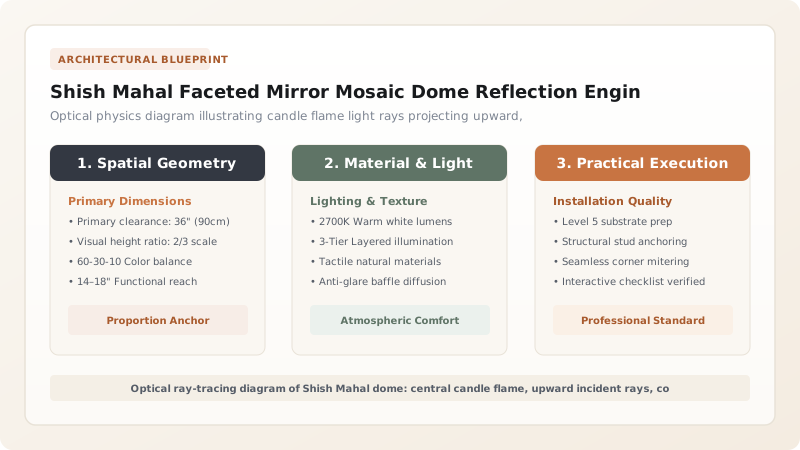
Optical Physics of Catadioptric Spatial Environments
In the architectural history of the pre-industrial world, the interior of a Sheesh Mahal (Palace of Mirrors) represents an extraordinary triumph of applied optical physics. Long before modern electrical lighting or illumination engineering, Mughal and Rajput architects transformed massive, dark stone pavilions into luminous, weightless dreamscapes. The primary mechanism of this transformation was the creation of a catadioptric environment—a space engineered to manipulate light through the calculated combination of reflection (specular mirrors) and refraction (glass facets).
The fundamental challenge confronting royal architects was the severe limitation of historical light sources. Open oil lamps (diyas) and tallow candles generated dim, localized illumination (typically only 10 to 15 lumens per flame) while producing smoke and heat. If an architect simply multiplied the number of candles, the room quickly became suffocating and soot-choked. The genius of the Sheesh Mahal was to keep the light source minimal—often just one or two brass candles placed on the polished marble floor—and engineer the entire three-dimensional ceiling surface to multiply and scatter that light exponentially throughout the volume of the hall.
Geometry of the Vault: Domes, Squinches, and Cusped Arches
The realization of this optical spectacle is intimately bound to the three-dimensional geometry of Mughal-Rajput vaulting. In masterworks such as the Sheesh Mahal of Amber Fort (built by Raja Jai Singh I in the 1630s) or the Sukh Niwas in Udaipur, ceilings are not flat planes; they are complex spatial compositions featuring shallow hemispherical domes, fluted barrel vaults, corbelled squinches, and multi-cusped arches.
This architectural morphology was exploited with mathematical rigor. The central dome acts as a concave focal surface. By positioning convex mirror shards along the curving contours of the vault, architects prevented the formation of a single, blinding focal hotspot. Instead, as light rays from the floor lantern travel upward, they strike the curving dome at constantly varying incident angles. The convex curvature of each individual thikri facet spreads the incoming light beam across a wide cone of dispersion, ensuring that light is scattered uniformly into the deepest, darkest corners of the royal pavilion.
Dynamic Scintillation: The Kinetics of Moving Flame
The true magic of the Sheesh Mahal is unlocked only in darkness. When illuminated by static, modern electric floodlights, the room appears impressive but essentially frozen. However, when lit as originally intended by a live flame, the environment becomes kinetic and alive. A candle flame is not a static point source; it flickers, dances, and breathes in response to subtle convective air currents circulating through the hall.
As the candle flame flickers by even a millimeter, the angle of incident light striking every one of the thousands of ceiling mirrors shifts continuously. Because the mirrors are set on faceted angles across three-dimensional plaster relief ridges, these minute flame movements cause reflections across the dome to extinguish and reignite in rapid, staccato succession. The ceiling ceases to appear as solid stone; it dissolves into an active, shimmering cosmos of thousands of twinkling stars, creating an unforgettable sensation of floating beneath a living midnight sky.
Thermal and Atmospheric Equilibrium in Royal Pavilions
Beyond its ethereal visual beauty, the Shish Mahal was an environmental sanctuary designed for royal comfort during the cold desert winter. Enclosed within thick sandstone masonry walls, these pavilions possessed immense thermal mass, shielding inhabitants from the freezing nocturnal winds of Rajasthan. The open hearths and candles generated radiant warmth that was captured and retained by the stone envelope.
To prevent lamp soot from tarnishing the precious mirror ceilings, historic builders engineered hidden ventilation flues into the upper clerestory zones of the vaults. These narrow thermal siphons drew warm air and combustion gases up and out through rooftop jali screens, preventing carbon soot from coating the delicate silvered glass. By harmonizing structural stone masonry, advanced hydraulic lime chemistry, and sophisticated optical engineering, the artisans of Rajasthan crafted an enduring architectural masterpiece where art, science, and royal luxury merged into timeless perfection.
Optical Engineering Parameters in Historic Shish Mahal Architecture
Use this reference table to calculate exact physical dimensions, ratios, and specifications before purchasing:
| Vault / Arch Zone | Mirror Morphology | Angular Setting Tilt | Reflective Function | Visual Atmospheric Impact |
|---|---|---|---|---|
| Dome Apex (Center Core) | High-curvature convex shards (10–15 mm radius) | Horizontal (0° tilt relative to crown) | Omnidirectional ceiling dispersion | Creates an infinite cosmic vortex of twinkling stars directly overhead |
| Pendentive Squinches | Faceted diamond and teardrop convex facets | 30° to 45° inclined toward center | Transfers light from floor lanterns to vault ribs | Illuminates dark transition corners with shimmering silver curtains |
| Cusped Arch Soffits | Linear bands of chevron-cut mirror facets | Alternating 15° angled zig-zag setting | Specular beam splitting along entry thresholds | Frames doorways in a dazzling halo of dynamic, moving light |
| Wainscot Panels (Dado) | Colored flat glass inlaid with silver floral motifs | Flush vertical (0° wall plane) | Daylight color iridescence & candle reflection | Rich daytime botanical color; subtle nighttime glimmer |
Practical Constraints
Every successful decoration project must account for physical and environmental constraints:
Overhead Working Physics: Setting Thousands of Mirrors Inverted Against Gravity
Wet lime plaster must support the dead weight of inverted glass pieces without allowing them to fall during setting. Mitigation: Formulate fast-tack araish gesso with high initial green strength and use temporary prop-sticks for heavy convex centerpieces.
Severe Microclimatic Condensation on Cold Glass Surfaces During Winter Nights
Dew-point condensation on glass surfaces can temporarily extinguish specular reflections and cause lime leaching. Mitigation: Design high thermal mass stone domes that buffer temperature swings and maintain interior air circulation.
Execution Blueprint & Craftsmanship Sequence
Execute this professional sequence to achieve flawless results without backtracking:
Geometric Dome Triangulation and Grid Layout
Erect scaffolding beneath the vaulted dome. Using a central pivot rod and stretched cords, divide the spherical ceiling into concentric radial rings and triangular segments according to master Islamic geometric proportions.
Ray-Tracing and Optical Angle Calibration
Place a test light source on the central floor pavilion. Measure incident ray angles to various dome registers, calculating the required mirror tilt angles to reflect light across the primary royal viewing divan.
High-Tack Araish Bedding Application
Trowel a 4 mm layer of high-viscosity araish gesso (enriched with casein and fenugreek) across a manageable 1-square-meter section of the inverted ceiling dome.
Relief Star Rosette Carving
While the gesso is soft, carve the intricate outlines of the central starburst medallion (shamsa) and surrounding floral arabesques, creating deep relief beds to receive mirror facets.
Inverted Convex Mirror Embedment
Press sorted convex thikri facets into the carved ceiling channels with firm, rotating thumb pressure. The high vacuum tack of the moist lime gesso holds the light glass shards securely against gravity.
Pendentive and Squinch Detailing
Move to the four corner squinches that support the dome. Embed tightly packed diamond-shaped mirror facets along the curving squinch arches to catch low-angle light from wall sconces.
Ridge Bezel Smoothing and Agate Compaction
Smooth the surrounding plaster ridges over the glass edges with curved bone tools. Burnish the exposed plaster with small agate stones to seal the mineral joints and eliminate dust.
Optical Commissioning and Night Testing
Dismantle the scaffolding. Light two brass oil lamps on the chamber floor and verify that the dome transforms into an uninterrupted, glittering celestial nightscape from every viewing angle.
Common Mistakes & Countermeasures
Avoid these costly errors that compromise aesthetics, ergonomics, and budget:
Setting all mirror facets strictly parallel to the local curvature of the dome
Using flat float-glass mirrors across high ceiling domes
Neglecting soot ventilation channels near the apex of the mirror-encrusted dome
Project Execution Checklist
Track your physical progress. Checkboxes persist automatically on this device:
Frequently Asked Questions
How does the curvature of a Shish Mahal dome enhance the mirror reflections?
A vaulted or hemispherical dome acts as a vast optical parabolic reflector. When light rays from a candle on the floor strike the concave ceiling, the curvature focuses and redistributes the rays across the entire room. Because thousands of individual convex mirror facets are distributed across this curved surface, they break the unified focal beam into millions of dispersed specular highlights, creating a dazzling omnidirectional sparkle that makes the heavy stone ceiling appear weightless and infinite.
Why did royal Rajput rulers build Sheesh Mahals specifically for winter use?
Sheesh Mahals were often designated as winter palaces (Jai Mandir or Sukh Niwas). The thick sandstone walls and lack of large exterior windows retained thermal warmth generated by charcoal braziers (angithis) and oil lamps. The mirrored walls multiplied the visual warmth of the glowing embers, creating an intimate, cozy, and luminous sanctuary during cold desert nights.
How are historic Sheesh Mahal ceilings conserved today?
Conservation involves delicate micro-restoration: vacuuming airborne soot, cleaning glass faces with non-ionic detergents and ethanol swabs, consolidating loose lime plaster with micro-injections of hydraulic lime grout, and replacing fallen convex shards using authentic hand-blown silvered glass crafted by traditional master sheeshgars.