Lime plaster gesso relief bedding and channelling represent the sculptural and adhesive foundation of authentic Rajasthani Thikri work. Utilizing traditional Araish lime plaster—formulated from long-slaked Makrana marble lime, marble flour, curd, jaggery, and fenugreek water—master artisans model intricate bas-relief floral arabesques and geometric cartouches directly onto masonry walls. While the gesso remains leather-hard, artisans carve recessed bedding channels into the plaster. Hand-cut convex mirror facets (thikri) are pressed into these channels, where the wet lime cures into an insoluble calcium carbonate frame that locks the mirrors immovably without synthetic glues.
At a Glance: Key Takeaways
- Plaster Matrix: Aged High-Calcium Slaked Lime (Chuna) & Micronized Makrana Marble Dust
- Organic Fermentation: Curd (Dahi), Cane Jaggery (Gur), & Fenugreek (Methi) Infusion
- Channel Execution: Carved Bas-Relief Grooves (1.5–2.5 mm Deep) with Boxwood Tools
- Adhesion Mechanism: Mechanical Encasement via Carbonated Calcite Mineralization
- Surface Finish: High-Gloss Araish Burnished with Agate Stones & Coconut Soap
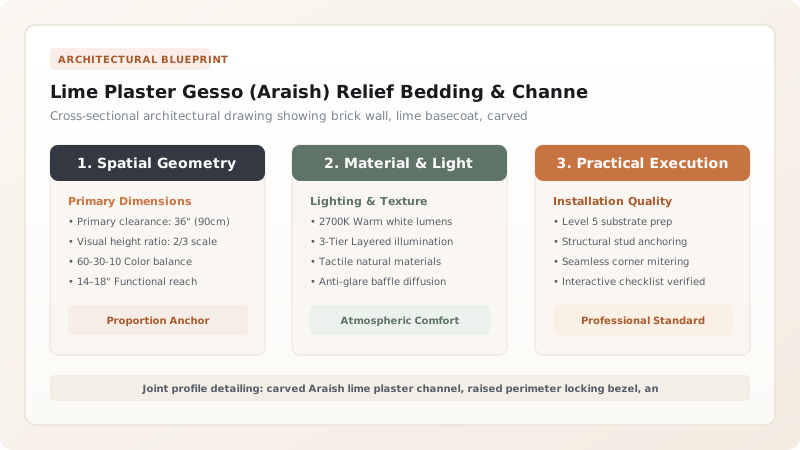
The Chemistry of Araish: Rajasthan's Living Marble Plaster
In the architectural traditions of northern India, the mastery of lime plaster reached its zenith in the historic technique known as araish (also known as chuna gesso). Celebrated in the royal palaces of Jaipur, Udaipur, and Amber, araish is not merely a wall render; it is a synthetic marble. Developed by palace plasterers (chezyas) seeking a material that combined the compressive hardness and cool luster of solid Makrana marble with the fluid sculptural plasticity of clay, araish served as the indispensable bedding medium for royal thikri mirror mosaics.
The chemical foundation of araish begins with high-calcium quicklime (calcium oxide, CaO) calcined from pure limestone boulders. This lime is slaked in deep water vats and aged underwater for a minimum of six months to two years. Over this extended aging period, the calcium hydroxide crystal platelets diminish in size to sub-micron scales, forming a silky, ultra-cohesive putty. When blended with micronized white marble flour (sang-e-marmar) derived from the quarries of Makrana, the lime forms an ultra-dense mineral slurry that cures entirely through atmospheric carbonation, transforming back into solid, crystalline calcium carbonate.
Organic Bio-Additives: Casein, Sucrose, and Mucilage Synergy
The extraordinary performance of araish as an adhesive bedding medium is made possible by centuries of empirical organic chemistry. To transform brittle lime into an elastic, non-cracking sculpting gesso, master artisans introduced a specific suite of organic modifiers during grinding: fresh curd (dahi), unrefined cane sugar jaggery (gur), and the mucilaginous water extracted from boiled fenugreek seeds (methi).
Each biological ingredient performs a precise thermodynamic role. The casein proteins and lipids in curd react chemically with calcium hydroxide to form calcium caseinate, a natural bio-adhesive that is completely insoluble in water once cured. The sucrose molecules in jaggery act as a natural retarder, slowing the rapid evaporation of water in the arid desert heat and allowing the lime to hydrate fully without cracking. Finally, the polysaccharide galactomannans in fenugreek mucilage impart immense pseudoplastic viscosity, allowing the plaster to hold sharp, vertical sculptural relief ridges without slumping.
The Relief Channelling Technique: Carving the Stone Bezel
Unlike Western mosaic work where glass tesserae are glued onto a flat substrate and grouted from above, thikri is an intaglio relief craft. The artisan trowels a 3-millimeter topcoat of pure araish gesso across the wall and transfers the master floral cartoon using a perforated parchment pounce bag filled with fine willow charcoal dust. While the gesso is in its leather-hard plastic state, the artisan uses curved boxwood modeling tools and steel scrapers to excavate recessed channels (1.5 to 2.5 mm deep) corresponding exactly to the design motifs.
This carving leaves behind raised plaster ridges that outline every leaf, petal, and border. These ridges act as three-dimensional stone bezels. The craftsman takes the custom-cut convex mirror pieces and presses them firmly into the wet channel beds. With a delicate bone spatula, the artisan smooths the soft plaster ridge slightly over the bevel of the glass edge. When the lime hardens, this overlapping ridge physically traps the glass in place, providing absolute mechanical encasement that prevents the mirrors from ever dislodging, even on inverted ceiling domes.
Ghutai: Agate Stone Burnishing and Calcite Compaction
The culmination of the araish process is the laborious finishing ritual known as ghutai (stone burnishing). Once the mirrors are embedded and the plaster has firmed to the touch, the craftsman washes the exposed plaster ridges with an emulsion of pure coconut oil soap and lime water. Using a highly polished natural agate stone (akik mühre), the artisan burnishes the damp plaster with firm, circular strokes.
The intense mechanical pressure of the agate stone compacts the microscopic marble particles and collapses the surface pore network. Simultaneously, the fatty acids in the coconut soap react with free calcium ions to synthesize a water-repellent calcium soap film. As burnishing continues for hours, the white plaster cures into an ultra-smooth, cool, ivory-like surface with a soft satin sheen. The pristine white araish frames the glittering convex mirrors with razor-sharp architectural clarity, creating an enduring, moisture-resistant decorative surface that has stood unblemished in royal Rajasthani palaces for over three centuries.
Araish Plaster Layering Stratigraphy for Thikri Inlay
Use this reference table to calculate exact physical dimensions, ratios, and specifications before purchasing:
| Plaster Layer | Material Formulation | Thickness | Application Timing | Technical Role |
|---|---|---|---|---|
| Substrate Scratch (Astra) | 1 Part Lime Putty + 2 Parts Coarse River Sand + Animal Hair | 10 mm to 15 mm | Applied 7 days prior to finish | Bonds to brick masonry; levels irregularities |
| Intermediate Bed (Pichhai) | 1 Part Matured Lime + 1.5 Parts Fine Marble Dust | 4 mm to 6 mm | Applied 24 hours prior to finish | Provides homogeneous, crack-free dimensional cushion |
| Sculptural Gesso (Araish) | 1 Part Fine Lime + 1 Part Micronized Marble Flour + Curd/Gur | 2 mm to 3 mm | Applied same day as mirror setting | Direct carved relief bed and mechanical mirror lock |
| Burnished Skin (Ghutai) | Pure creamy lime water + coconut oil soap | Microscopic (< 0.1 mm) | Burnished during final set | Waterproof marble-like sheen; locks joint margins |
Practical Constraints
Every successful decoration project must account for physical and environmental constraints:
Extremely Narrow Working Window for Plaster Carving in Dry Climates
Hot Rajasthani desert air dries the surface gesso within 2 to 3 hours, halting delicate carving operations. Mitigation: Hang wet burlap drop curtains across the work area and mist surfaces with fenugreek water to extend open carving time.
Differential Thermal Expansion Between Glass Mirrors and Masonry Walls
Diurnal temperature swings from 15°C at night to 45°C by day cause shear stress along the glass-plaster interface. Mitigation: Incorporate organic plant mucilage (methi) and curd proteins to impart long-term micro-elasticity to the lime matrix.
Execution Blueprint & Craftsmanship Sequence
Execute this professional sequence to achieve flawless results without backtracking:
Substrate Wetting and Basecoat Preparation
Saturate the historic brick or stone masonry substrate with clean water. Apply a 12 mm scratch coat of lime-sand mortar reinforced with chopped goat hair, raking horizontal keys to ensure mechanical bonding.
Matured Chuna and Marble Flour Milling
Combine 6-month-aged Makrana lime putty with ultra-fine marble flour in a stone trough. Grind with a stone roller for 4 hours until the paste reaches the velvety consistency of clotted cream.
Organic Fermentation Additives Inoculation
Whisk in fermented jaggery water (cane sugar), strained curd (dahi), and boiled fenugreek mucilage. The organic proteins and polysaccharides retard initial setting while enhancing plastic workability.
Araish Topcoat Troweling and Compaction
Trowel a 3 mm layer of the formulated araish gesso across the damp basecoat using a flexible steel trowel. Compact firmly with circular strokes to eliminate air pockets and establish a dead-flat plane.
Perforated Cartoon Pounce Transfer
Position a full-scale parchment cartoon over the damp plaster. Dust charcoal powder through needle-pricked holes to transfer the master layout of blooming poppies, vines, and geometric cartouches.
Relief Carving and Channel Excavation
Using miniature curved boxwood spatulas and steel gouges, carve recessed channels 1.5 to 2.0 mm deep into the soft plaster, leaving crisp raised lime ridges that define every leaf and petal.
Convex Mirror Embedment and Flange Locking
Press the custom-cut convex mirror shards firmly into the excavated channels. Smooth the soft lime ridges over the glass edges with a bone tool, encapsulating the perimeter of each mirror facet.
Agate Stone Burnishing (Ghutai)
Allow the plaster to firm for 6 hours. Wash the exposed plaster ridges with coconut oil soap water and burnish with a polished dog-tooth agate stone (akik) until the plaster transforms into mirror-smooth, ivory-like marble.
Common Mistakes & Countermeasures
Avoid these costly errors that compromise aesthetics, ergonomics, and budget:
Using un-aged, fresh quicklime to formulate thikri bedding plaster
Carving relief channels after the lime plaster has already carbonated and hardened
Using synthetic PVA glue to tack mirrors into dry plaster recesses
Project Execution Checklist
Track your physical progress. Checkboxes persist automatically on this device:
Frequently Asked Questions
What is the biochemical purpose of adding curd and jaggery to the lime?
The addition of curd (dahi) introduces casein proteins and lipids, which react with calcium hydroxide to form insoluble calcium caseinate—an ancient waterproof bio-binder. Jaggery (cane sugar) provides sucrose, which acts as a set retarder and plasticizer, preventing rapid drying while increasing the solubility of lime to create a denser, rock-hard calcite crystal matrix upon carbonation.
How does Araish plaster hold mirrors without modern glues?
Araish secures mirrors entirely through mechanical encasement. When a convex glass shard is pressed into the soft lime channel, the plaster squishes slightly around the sloping glass edge. As the lime absorbs atmospheric carbon dioxide, it converts into crystalline calcium carbonate (solid limestone), physically trapping the glass within a stone bezel that never degrades, off-gasses, or loosens.
Why is Makrana marble dust preferred over common silica sand?
Makrana marble is exceptionally pure calcium carbonate (> 98% CaCO3) with crystalline rhombic cleavage. When finely ground, marble flour bonds chemically with the slaked lime binder during carbonation, creating an isotropic stone matrix. Furthermore, its pure white translucency creates the brilliant ivory-white background that makes the embedded mirrors shimmer with intense optical contrast.