Conserving historic Manueline limestone sculptures in aggressive maritime and urban environments requires scientific, minimally invasive conservation interventions. Salt sub-florescence (halite and thenardite) and black atmospheric gypsum crusts (CaSO4·2H2O) represent the primary threats to five-century-old carvings. Modern conservation protocols begin with biological remediation using quaternary ammonium biocide washes to eradicate endolithic cyanobacteria and lichen colonies. Atmospheric soot crusts are gently removed using low-pressure micro-abrasive blasting with spherical calcium carbonate media (grain size 40–80 microns at 1.0 to 1.5 bar) or Nd:YAG laser ablation. Soluble marine salts are extracted using repetitive deionized water cellulose pulp poultices. Friable, sugar-like stone surfaces are consolidated with solvent-borne tetraethyl orthosilicate (TEOS) ethyl silicate treatments that deposit stable silica bridges within the pore matrix without altering vapor permeability.
At a Glance: Key Takeaways
- Primary Degradation: Halite salt crystallization, black gypsum crusts, biological colonisation
- Cleaning Technology: Micro-abrasive blasting (calcium carbonate at 1.5 bar) & Nd:YAG laser
- Biocide Compound: Quaternary ammonium salts (benzalkonium chloride 2-3% in water)
- Desalination Method: Cellulose pulp / sepiolite clay poultices with deionized water
- Stone Consolidant: Tetraethyl orthosilicate (TEOS ethyl silicate, e.g., Wacker OH 100)
- Reversibility Standard: ICOMOS Charter compliant; preserves historical tool marks & patina
Diagnostic Pathology: Black Crusts & Sub-Florescence
Monuments situated along Portugal's Atlantic seaboard—such as the Belém Tower on the Tagus estuary—suffer from complex, synergistic decay mechanisms. Marine winds carry microscopic sodium chloride (NaCl) droplets directly into the open pores of the limestone. Simultaneously, vehicle exhaust and industrial emissions release sulfur dioxide (SO2), which reacts with atmospheric moisture and calcite to form gypsum (calcium sulfate dihydrate, CaSO4·2H2O).
In sheltered carved recesses (under the loops of twisted ropes and behind armillary spheres), where rainfall cannot wash away deposits, this gypsum combines with airborne carbon soot to form hard, impervious black crusts. Beneath this crust, trapped moisture and cycling marine salts crystallize repeatedly, building destructive pressures that hollow out the limestone into a powdery, sugar-like consistency (alveolization). When the crust eventually buckles, the entire sculpted profile beneath falls away irrevocably.
Biocide Remediation & Low-Pressure Micro-Cleaning
Conservation begins with eliminating biological growth. Sub-tropical maritime humidity fosters dense communities of epilithic lichens (e.g., Caloplaca and Verrucaria) and endolithic cyanobacteria whose metabolic oxalic acid actively etches the limestone matrix. Conservators apply a 2% to 3% aqueous solution of quaternary ammonium salts (such as benzalkonium chloride) via soft brushes. The biocide penetrates cellular walls, neutralizing micro-flora over 10 to 14 days without releasing staining dyes or acidic residues.
For crust removal, aggressive mechanical chiseling and chemical caustic soda washes are strictly outlawed by modern conservation ethics. Instead, conservators deploy precision micro-abrasive cleaning systems. Utilizing ultra-fine, spherical calcium carbonate or aluminum silicate powders (grain size 40 to 80 microns) propelled by dry compressed air at ultra-low pressures (1.0 to 1.5 bar), the micro-blaster gently erodes the brittle gypsum crust without abrading the softer, underlying historic limestone or erasing subtle 16th-century chisel tool marks.
Desalination Poultices & TEOS Ethyl Silicate Consolidation
Removing soluble salts from deep inside the stone matrix is mandatory before applying any surface treatments. Desalination is conducted using wet poultices of shredded, chemical-free cellulose pulp (Arbocel) or attapulgite clay saturated with deionized water. As the poultice slowly dries over 48 to 72 hours, capillary forces draw dissolved chlorides and sulfates out of the limestone into the disposable paper matrix. Salt reduction is monitored using electrical conductivity meters until ionic levels fall below heritage safety thresholds (< 200 µS/cm).
To arrest crumbling and re-bind loose calcite grains, the stone is treated with tetraethyl orthosilicate (TEOS, such as Wacker OH 100 or Estel 1000). Delivered in an ethanol solvent carrier, the monomeric silicic acid ester penetrates deep into the porous network. Over two to three weeks, ambient atmospheric humidity hydrolyzes the ethyl silicate, triggering a sol-gel reaction that precipitates a permanent, micro-porous network of amorphous silicon dioxide (SiO2) glass bridges between loose calcite crystals. The treated stone regains up to 70% of its original tensile strength while preserving 100% of its natural vapor permeability.
Stone Cleaning and Consolidation Methods for Manueline Limestone
Use this reference table to calculate exact physical dimensions, ratios, and specifications before purchasing:
| Method / System | Mechanism | Impact on Historic Tool Marks | Risk Level for Historic Stone |
|---|---|---|---|
| Micro-Abrasive Blasting (CaCO3) | Low-pressure particle ablation (1.5 bar) | Zero damage; preserves microscopic tool teeth | Extremely low; controllable in 1 mm increments |
| Nd:YAG Laser Ablation (1064 nm) | Photothermal selective vaporization of soot | Zero damage; self-limiting at white stone surface | Very low; requires skilled operator to prevent yellowing |
| Cellulose Desalination Poultice | Capillary salt migration into paper pulp | Zero mechanical impact | Completely safe; extracts chlorides safely |
| TEOS Ethyl Silicate Consolidation | Precipitation of SiO2 amorphous silica bridges | Consolidates friable grain without visual change | Low; highly compatible with porous limestones |
| Hydrochloric / Muriatic Acid Wash | Violent chemical acid dissolution of stone | Catastrophic; dissolves stone details and melts carving | Extreme hazard; strictly prohibited in heritage conservation |
Practical Constraints
Every successful decoration project must account for physical and environmental constraints:
Long-Term Humidity Requirements for Ethyl Silicate Curing
TEOS requires relative humidity between 40% and 75% over 3 weeks to complete its hydrolysis into solid silica glass. Mitigation: Enclose conservation scaffolding in protective sheeting and monitor hygrometric sensors, misting ambient air if dry seasonal winds drop humidity below 35%.
Execution Blueprint & Craftsmanship Sequence
Execute this professional sequence to achieve flawless results without backtracking:
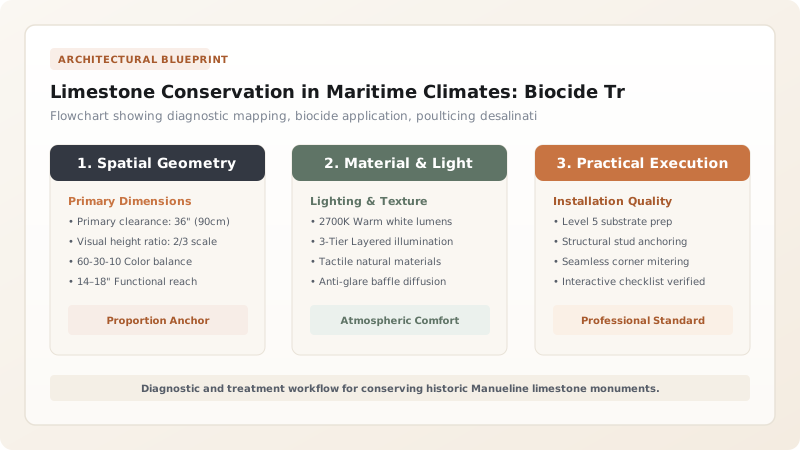
Documenting Decay and Salt Concentrations
Map black crusts, exfoliation zones, and biological growth on photogrammetric elevations. Measure surface salt concentrations using contact conductivity sensors.
Neutralizing Lichens and Cyanobacteria
Apply a 2.5% aqueous solution of benzalkonium chloride using natural bristle brushes. Allow 14 days for biological colonies to desiccate, then gently rinse with low-pressure water.
Extracting Sub-Florescent Salts
Apply 20 mm thick cellulose pulp poultices moistened with deionized water. Wrap in polyethylene film for 24 hours, uncover to allow drying, and peel away salts; repeat until conductivity is <200 µS/cm.
Removing Black Atmospheric Crusts
Use precision micro-abrasive equipment propelling spherical calcium carbonate powder (50 microns at 1.2 bar) to ablate gypsum crusts from carved rope recesses.
Securing Detached Stone Flakes
Inject ultra-fine hydraulic lime micro-grout (NHL 2) into structural fissures behind detached rope fragments, clamping gently with padded timber struts.
Re-Binding Friable Microcrystalline Grain
Apply tetraethyl orthosilicate (TEOS) saturating coats via continuous low-pressure spray until rejection. Cover with plastic film for 72 hours to ensure controlled sol-gel polymerization.
Common Mistakes & Countermeasures
Avoid these costly errors that compromise aesthetics, ergonomics, and budget:
Using Commercial Silane / Siloxane Water Repellents on Salt-Contaminated Stone
Washing Historic Limestone with High-Pressure Bleach Solutions
Project Execution Checklist
Track your physical progress. Checkboxes persist automatically on this device:
Frequently Asked Questions
Does ethyl silicate change the natural golden color of Lioz limestone?
No. Quality ethyl silicate consolidants (such as TEOS with pure ethanol solvent) do not contain resins, acrylic polymers, or pigments. Once the solvent evaporates and the sol-gel reaction precipitates pure amorphous silica, the refractive index matches stone pores, leaving the natural golden-white coloration completely unaltered.
Why is laser cleaning preferred for high-value Manueline carvings?
Nd:YAG laser cleaning works by selective photothermal absorption: the dark black gypsum crust absorbs the 1064 nm light energy and vaporizes instantly, while the underlying white limestone reflects the laser wavelength, making the process naturally self-limiting with zero mechanical abrasion or chemical residue.