Carving authentic Portuguese Manueline architectural ornamentation requires mastering three-dimensional geometry, deep undercut relief carving, and nautical maritime iconography. The stonemason starts by squaring the limestone ashlar, drafting the geometric layout directly onto the stone with iron compasses. For helical twisted rope mouldings (cabos entrançados), the cylindrical profile is divided into equal helical spirals, hollowed with curved gouges and shaped into convex twisted strands with rasp files. Armillary spheres are carved from monolithic stone cubes by stepping through concentric circular rings, hollowing the negative space behind the ecliptic and equatorial bands with narrow rifflers and diamond drills. Articulated kelp seaweed and ocean coral sprays are carved with sottoquadro undercuts, detaching elements from the background stone to produce dramatic light-and-shadow dynamics.
At a Glance: Key Takeaways
- Core Iconography: Helical ship ropes, armillary spheres, coral branches, seaweed
- Relief Depth: High relief (alto-relevo) with deep sottoquadro undercuts (50-120 mm)
- Drafting Instruments: Proportional dividers, steel compasses, flexible spiral templets
- Carving Chisels: Curved stone gouges (goivas), bullnose chisels, toothed claw chisels
- Detailing Tools: Double-ended stone rifflers, rasp files, fine hand abrasive stones
- Visual Aesthetic: Exuberant organic vitality celebrating maritime oceanic navigation
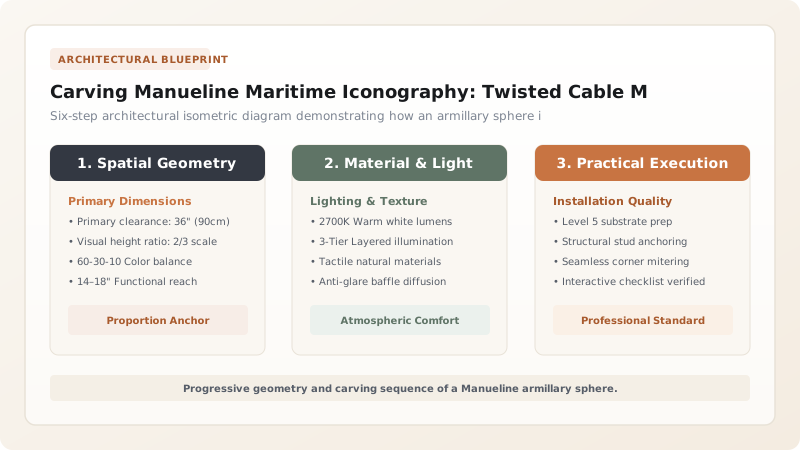
Geometrical Layout of Twisted Cable Mouldings (Cabos)
The twisted ship's rope (cabo náutico) is the most pervasive hallmark of Manueline stone carving. Far from a simple decorative spiral, a true Manueline rope captures the taut tension, twisting torque, and strand geometry of a multi-ply hemp mooring hawser under load.
To carve a three-strand cable, the mason turns or dresses a cylindrical colonnette. The circumference is divided into three equal 120-degree segments using compasses. A flexible paper or zinc spiral templet—cut to the precise pitch angle (typically 45 to 60 degrees)—is wrapped around the cylinder to scribe continuous helical guidelines. The mason then uses a narrow v-chisel (buril) to incise the boundaries between strands. Curved stone gouges (goivas) excavate deep helical troughs between the strands, after which the mason rounds each individual strand into a full semicircular cross-section, texturing the surface with microscopic longitudinal grooves to simulate individual twisted hemp yarns.
Monolithic Armillary Spheres: Spatial Geometry in Stone
The armillary sphere (esfera armilar) represents the pinnacle of Manueline carving virtuosity. It consists of an astronomical apparatus of intersecting circular metal bands: the horizontal terrestrial equator, the vertical meridian, the polar axis pin, and the wide diagonal ecliptic band adorned with the signs of the zodiac, all orbiting a central miniature earth.
Executing this complex astronomical instrument from a single monolithic block of limestone without breaking the delicate intersecting rings requires extraordinary discipline. The mason begins with a perfect stone cube, boasting out a solid sphere. Circular guidelines for the outer bands are inscribed with spherical compasses. Using manual drills (traditionally bow drills, today variable-speed diamond core bits) and micro-chisels, the mason methodically removes the negative triangular voids between the intersecting rings. Once light passes through the hollow sphere, curved rifflers and needle rasps refine the interior faces of each band, finishing with the delicate central globe supported on its slender stone spindle.
Articulated Corals, Floating Kelp, & Marine Fauna
Manueline ornamentation rejects the rigid, stylized acanthus leaves of Classical Greco-Roman architecture in favor of wild, dynamic ocean biology. Windows and portals—most famously exemplified by Diogo de Arruda's legendary Chapter House Window at the Convent of Christ in Tomar—are framed by branching marine corals, floating kelp seaweed (algas marinhas), and succulent botanical artichokes.
Carving coral requires replicating its rough, porous, tuberculate surface. The mason carves branching fingers that taper outward, using hollow punch chisels and burrs to texture the stone with hundreds of tiny circular polyp indentations. Kelp fronds are carved with ruffled, waving margins that twist in three dimensions across the moulding, deeply undercut so that natural daylight penetrates behind the leaves, casting organic moving shadows as the sun traverses the sky.
Manueline Ornamental Motifs: Tooling and Carving Methods
Use this reference table to calculate exact physical dimensions, ratios, and specifications before purchasing:
| Motif | Symbolic Meaning | Primary Carving Tools | Critical Execution Challenge |
|---|---|---|---|
| Twisted Ship Rope (Cabo) | Maritime voyage and naval power | V-parting chisel, round gouges, half-round rasps | Maintaining uniform helical pitch across curves |
| Armillary Sphere | King Manuel I emblem / celestial navigation | Drills, narrow flat chisels, rifflers, diamond burrs | Preventing fracture of delicate intersecting rings |
| Cross of Christ | Military Order of Christ patronage | Straight chisel, drafting square, tooth claw | Crisp planar faceting and sharp interior 90° angles |
| Branching Marine Coral | Ocean depths and exotic discoveries | Point chisel, rotary punches, coarse hand files | Achieving naturalistic organic branching without snapping |
Practical Constraints
Every successful decoration project must account for physical and environmental constraints:
Brittle Calcite Cleavage Planes in Lioz Limestone
Lioz contains fossil rudist shells that cleave unpredictably if struck with high-impact chisels at oblique angles. Mitigation: Use sharp tungsten-carbide tipped chisels with light, glancing mallet blows; carve parallel to the shell margins rather than directly across them.
Execution Blueprint & Craftsmanship Sequence
Execute this professional sequence to achieve flawless results without backtracking:
Establishing Datum Faces and Proportions
Square the limestone block on all six faces with a pitching tool and straightedge. Transfer geometrical layout cartoons and helical pitch lines using zinc templets.
Removing Excess Stone Mass
Block out the major architectural projections and depths using a heavy tooth claw chisel and stone mallet, leaving 5 mm of stone around all finished lines.
Chiseling Rope Spirals
Carve deep helical v-grooves along the drafted guidelines using narrow gouges. Round over individual rope strands into full semicircular convex forms.
Hollowing Voids in Armillary Spheres
Drill pilot relief holes through the negative voids of armillary rings. Chisel inward from opposing faces to meet at the center, freeing intersecting bands.
Applying Hemp Yarns and Coral Polyps
Score microscopic fiber lines along rope strands with a comb chisel; punch coral polyp dimples and carve ruffled kelp leaf edges with rifflers.
Smoothing and Patination Preparation
Smooth all delicate undercut surfaces with volcanic pumice stone and emery cloth, ensuring zero tool bruising remains on visible finished profiles.
Common Mistakes & Countermeasures
Avoid these costly errors that compromise aesthetics, ergonomics, and budget:
Using Heavy Pneumatic Hammers on Delicate Undercuts
Carving Asymmetrical or Inconsistent Rope Pitch Angles
Project Execution Checklist
Track your physical progress. Checkboxes persist automatically on this device:
Frequently Asked Questions
How did medieval masons carve hollow armillary spheres without modern power tools?
Master masons employed hand-powered bow drills or strap drills tipped with hardened iron bits to drill intersecting channels through the stone cube. Once the central void was established, they used specialized hooked chisels, curved rifflers, and emery abrasive cords to systematically rasp away the negative space from the inside out.
What tools are used to carve the helical rope spirals?
The initial trough is cut with a curved stone gouge (goiva) or narrow flat chisel. The rounding of the strands is shaped using a tooth chisel (gradina), and the final smooth convex curvature is perfected using half-round stone rasps and flexible abrasive strips.