Traditional finishing and preservation of Portuguese Estremoz white and pink marble centers on a breathable, low-reflective honed satin patina (acabamento amaciado) protected by archival microcrystalline wax. Avoiding impermeable synthetic gloss resins that trap moisture and yellow, artisans hone the stone using progressive diamond abrasives from 120 to 800 grit. A micro-thin barrier of pure microcrystalline wax or carnauba-beeswax paste is buffed into the calcite pores, providing vapor permeability, water repellency, and defense against acidic wine and oil etching.
At a Glance: Key Takeaways
- Surface Finish: Acabamento Amaciado (Honed Satin Matte / 400 to 800 Grit Finish)
- Protective Sealant: Cosmoloid H80 / Renaissance Microcrystalline Wax Barrier
- Natural Polish Alternative: Traditional Bleached Beeswax & Carnauba Paste in Pure Turpentine
- Cleaning Chemistry: pH-Neutral Stone Soap (Potassium Oleate / Vegetable Fatty Acids)
- Acid Vulnerability: Severe Etching Sensitivity to Citric Acid, Vinegar & Wine (pH < 6.0)
The Philosophy of the Acabamento Amaciado (Honed Satin Finish)
In contemporary commercial stone finishing, marble is frequently subjected to aggressive industrial polishing lines, utilizing heavy chemical crystallizers and synthetic buffing bricks to produce an ultra-reflective, mirror-like gloss. While this high gloss may appear dazzling in modern showrooms, it is fundamentally alien to the architectural spirit of historical Portuguese stone masonry.
Historic Portuguese master builders favored the acabamento amaciado—the honed satin finish. An amaciado finish does not mirror light; rather, it absorbs and softly diffuses illumination across its surface. This soft, velvety texture allows the eye to appreciate the profound internal translucency of the calcitic crystal matrix and the delicate, meandering ribbons of Rosa Aurora without being blinded by harsh specular glare. Furthermore, from a functional perspective, an amaciado floor possesses significantly higher slip resistance when wet and gracefully conceals the inevitable micro-scratches caused by daily foot traffic.
Mechanical Diamond Honing Progression
Achieving a flawless acabamento amaciado requires a disciplined sequence of wet abrasive honing. Once the newly laid Estremoz marble floor has cured for at least twenty-eight days to ensure complete moisture stability, master stone restorers begin the mechanical honing process using heavy rotary planetary floor grinders.
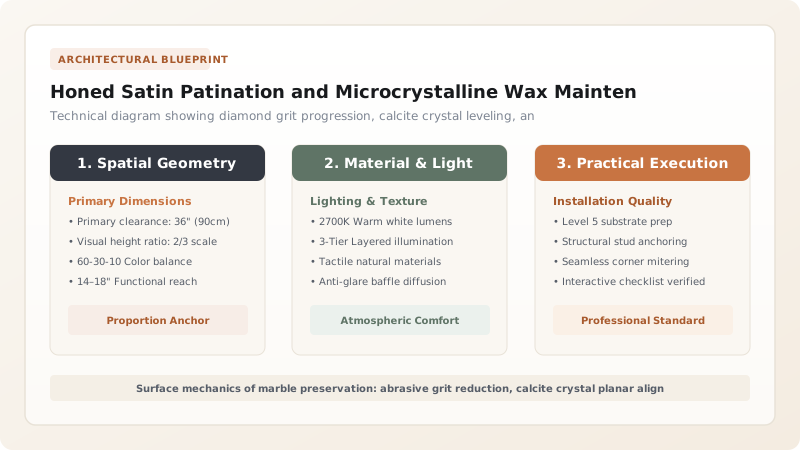
The progression begins with coarse 120-grit resin-bond diamond pads, which level all microscopic height discrepancies (lippage) between adjacent slabs. The operator advances to 220-grit, which erases the coarse cutting scratches, followed by 400-grit to close the surface pores of the calcite crystals. The final pass is executed with 800-grit diamond pads under continuous water flush. At 800 grit, the stone achieves its optical equilibrium: the individual calcite crystals are sheared glass-smooth along their cleavage planes, reflecting light with a dignified, matte-satin glow while leaving the capillary network open and breathable.
The Chemistry of Archival Microcrystalline Wax Barriers
To protect the newly honed calcitic surface from domestic stains without compromising its breathability, traditional conservation science rejects modern synthetic polyurethane, epoxy, or acrylic sealers. These liquid plastics crosslink into an impermeable barrier across the stone face, trapping rising subterranean vapors that inevitably cause the coating to blister, turn milky yellow, and induce subsurface stone spalling.
The premier protective medium is pure microcrystalline wax (such as Cosmoloid H80 or Renaissance Wax). Derived from specialized petroleum refining fractions, microcrystalline wax possesses an ultrafine, branched hydrocarbon structure that remains flexible and elastic over decades. Applied as a micro-thin paste thinned with pure mineral spirits, the wax molecules penetrate the topmost capillary pores of the calcite, forming a hydrophobic, water-repellent layer. Crucially, this barrier is vapor-permeable: it allows moisture vapor from the subfloor to evaporate freely into the room, while its surface tension prevents liquid water, wine, and oils from penetrating the stone.
Conservation Maintenance and Acid Etch Remediation
Preserving an Estremoz marble floor across generations requires strict adherence to pH-neutral maintenance chemistry. Because marble is composed almost entirely of calcium carbonate (CaCO3), it is acutely vulnerable to acidic chemical attack. Any liquid with a pH below 6.0—including red wine, citrus juice, vinegar, tomato sauce, and acidic commercial tile cleaners—reacts instantly with the calcite crystals, dissolving the polished surface into a dull, rough, whitish etch mark.
Daily maintenance is performed using dry microfiber dust mops to remove abrasive quartz sand grains. For damp washing, custodians utilize pH-neutral stone soaps formulated from saponified vegetable oils (potassium oleate). These soaps clean the wax barrier without stripping its protective film. If an acidic spill occurs, the microcrystalline wax acts as a sacrificial shield, slowing acid penetration. If minor etching does occur, the spot is easily remediated in situ by buffing with fine aluminum oxide marble polishing paste and reapplying a localized coat of microcrystalline wax, preserving the timeless palatial grandeur of Portuguese marble for centuries.
Estremoz Marble Protective Treatments & Surface Finishes
Use this reference table to calculate exact physical dimensions, ratios, and specifications before purchasing:
| Treatment Typology | Chemical System | Visual Finish | Vapor Permeability | Maintenance Reapplication |
|---|---|---|---|---|
| Honed Satin + Microcrystalline Wax | Refined petroleum hydrocarbon wax (Cosmoloid H80) | Velvety, soft satin glow (low glare) | High (100% breathable vapor transmission) | Annually in residential; semi-annually in civic spaces |
| Traditional Carnauba-Beeswax | Natural beeswax + Copernicia prunifera wax in turpentine | Warm, organic antique patina with pleasant scent | High (Permeable and fully reversible) | Every 6 to 12 months with mechanical buffing |
| Penetrating Hydrophobic Impregnator | Fluoro-alkyl silane / oligomeric siloxane solution | Completely invisible; preserves natural honed look | High (Chemical bonding inside capillary pores) | Every 3 to 5 years depending on traffic |
| Modern Polyurethane Coating | Cross-linked aromatic/aliphatic polyurethane resin | High plastic gloss (distorts stone depth) | Zero (Impermeable barrier traps moisture) | Requires harsh chemical stripping when failing |
Practical Constraints
Every successful decoration project must account for physical and environmental constraints:
High Porosity and Acid Sensitivity of Calcitic Marble Surfaces
Spilled red wine, lemon juice, or vinegar chemically etches calcium carbonate within seconds of contact. Mitigation: Microcrystalline wax creates a sacrificial barrier that buys time to wipe spills before acid reaches the calcite matrix.
Abrasive Grit Scratching Under Intense Foot Traffic
Quartz sand tracked in from outside scratches the soft calcite crystals (Mohs hardness 3). Mitigation: Install heavy-duty walk-off mats at all exterior entryways and dry dust-mop daily with microfiber pads.
Execution Blueprint & Craftsmanship Sequence
Execute this professional sequence to achieve flawless results without backtracking:
Substrate Cure and Cleaning Verification
Verify that the bedding mortar has cured for at least 28 days. Deep-clean the marble surface with pH-neutral stone cleaner to remove all construction dust, drywall mud, and residue.
Coarse Honing (120 to 220 Grit)
Mount 120-grit resin-bond diamond pads on a low-speed rotary floor machine. Hone the wet floor in overlapping circular passes to eliminate lippage between slabs, transitioning to 220 grit to remove coarse scratch marks.
Fine Satin Honing (400 to 800 Grit)
Advance to 400-grit and finish with 800-grit diamond abrasives with continuous water flush. This produces the traditional Portuguese 'acabamento amaciado'—a silky, non-reflective satin sheen that highlights internal veining without glare.
Slurry Extraction and Deep Drying
Extract all abrasive slurry with a wet-vac, rinse thoroughly with clean water, and allow the marble floor to dry for at least 72 hours until internal relative humidity drops below 3%.
Microcrystalline Wax Application
Apply archival microcrystalline wax (e.g., Cosmoloid H80 or Renaissance Wax) in paper-thin, circular wiping motions using a clean cotton cloth, ensuring 100% coverage without heavy buildup.
Solvent Flash-Off and Mechanical Buffing
Allow the mineral spirit solvent to evaporate for 30 minutes until the wax turns to a hazy matte film. Buff the surface with a heavy floor machine fitted with natural horsehair or white polishing pads.
Establishing Ongoing Conservation Protocols
Instruct maintenance staff to clean the floor using damp microfiber mops with pH-neutral stone soap, avoiding all acidic, ammoniated, or bleach cleaners, and scheduling annual wax buffing.
Common Mistakes & Countermeasures
Avoid these costly errors that compromise aesthetics, ergonomics, and budget:
Applying high-gloss synthetic polyurethane or acrylic topical coatings on Estremoz marble
Using abrasive scouring powders or acidic bathroom cleaners on calcitic marble
Buffing wax onto damp marble that has not thoroughly dried after honing
Project Execution Checklist
Track your physical progress. Checkboxes persist automatically on this device:
Frequently Asked Questions
Why is a honed satin finish preferred over a high-gloss polish for Estremoz marble?
A honed satin finish (acabamento amaciado) provides superior aesthetic and practical benefits. A high-gloss polish creates harsh specular reflections that obscure the subtle, delicate blush-pink veining of Rosa Aurora and shows every footprint and micro-scratch. A honed satin finish diffuses ambient light softly, feels velvety underfoot, hides minor wear, and honors the historic aesthetic of Portuguese palatial architecture.
What is microcrystalline wax and why is it superior to standard automotive wax?
Microcrystalline wax is a refined hydrocarbon wax characterized by extremely fine, branched micro-crystals, unlike paraffin wax which has large, brittle crystalline flakes. It has a higher melting point, superior elasticity, and forms a crystal-clear, non-yellowing, and chemically inert film. Unlike automotive waxes—which contain silicones, polymers, and abrasive polishing agents—pure microcrystalline wax is 100% reversible, non-damaging, and breathable.
How do you treat an acidic etch mark (such as from spilled wine or vinegar) on Estremoz marble?
An acidic etch mark is a physical chemical burn where the acid dissolved the top layer of calcium carbonate. To restore it, the damaged area must be re-polished mechanically. Apply a small amount of fine marble polishing powder (potassium bioxalate or fine aluminum oxide) with water onto the spot, rub in circular motions with a damp felt pad until the satin luster matches the surrounding stone, rinse, and reapply microcrystalline wax.