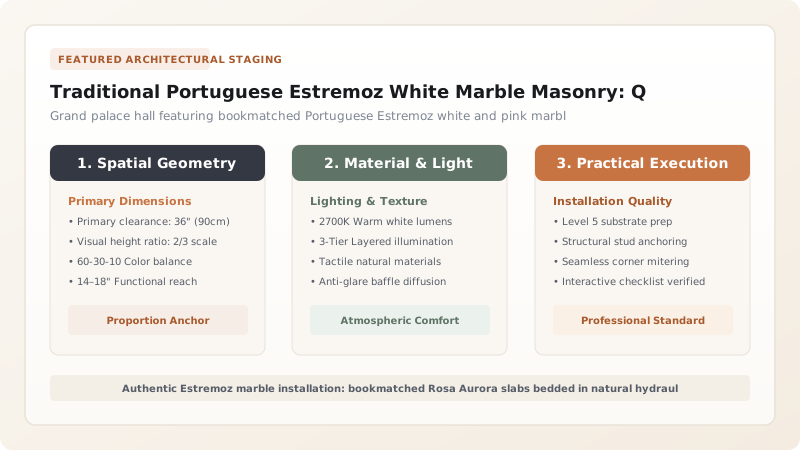
Traditional Portuguese Estremoz White Marble Masonry is an esteemed architectural stone craft centered in the 'Marble Triangle' of the Alentejo region (Estremoz, Borba, Vila Viçosa). Renowned for its fine saccharoidal calcite grain, luminous translucency, and delicate pink veins (Rosa Aurora), Estremoz marble has defined Portuguese royal architecture from the Roman Temple of Évora to the Baroque Mafra National Palace. Master masons install the stone using breathable natural hydraulic lime (NHL) mortars, razor-thin 1 mm tight joints (junta seca), and mirrored bookmatched compositions (livro aberto), finished with honed satin patinas and natural wax barriers.
At a Glance: Key Takeaways
- Geographic Origin: Alentejo Marble Triangle (Estremoz, Borba & Vila Viçosa, Portugal)
- Mineral Composition: Metamorphic Calcitic Marble (>95% CaCO3 with Trace Iron Oxides)
- Signature Veining: Rosa Aurora (Blush Pink), Cream White & Smoky Grey Streaks
- Bedding Mortar: Natural Hydraulic Lime (NHL 2 / NHL 3.5) & Marble Dust Sand
- Architectural Application: Palatial Flooring, Bookmatched Wall Cladding & Baroque Facades
In-Depth Guides in this Directory
Explore specialized subtopic blueprints, technical dimensions, and execution checklists:
Alentejo Pink-Veined Estremoz Marble Quarry Extraction: Geologic Beds, Wire Saws & Block Grading
Technical guide to Estremoz marble quarrying in Alentejo: open-pit extraction, diamond wire saws, bancada bench geology, and Rosa Aurora block grading.
Hydraulic Lime Bedding and Tight-Joint Bookmatching: Traditional Estremoz Marble Installation
Master the installation of Estremoz white and pink marble: Natural Hydraulic Lime (NHL) bedding, razor-thin 1 mm tight joints (junta seca), and mirrored bookmatching.
Honed Satin Patination and Microcrystalline Wax Maintenance for Estremoz White Marble
Comprehensive conservation guide to finishing and preserving Estremoz marble: diamond hone progression, satin patination, microcrystalline wax, and pH-neutral care.
Geological Heritage of the Alentejo Marble Triangle
In the sun-baked plains of the Alentejo province in south-central Portugal lies one of the world's most distinguished geological treasures: the Anticlinal de Estremoz. Spanning an elliptical zone approximately forty kilometers long through the historic municipalities of Estremoz, Borba, and Vila Viçosa, this region—known internationally as the Portuguese 'Marble Triangle'—has supplied royal dynasties and master architects with world-class marble for over two millennia.
Formed during the Variscan Orogeny over three hundred million years ago, original marine limestone deposits were subjected to intense regional metamorphism, undergoing recrystallization under immense heat and tectonic pressure. The resulting metamorphic marble is characterized by a fine to medium saccharoidal (sugary) calcite grain of extraordinary density. With calcium carbonate (CaCO3) purity frequently exceeding 98%, Estremoz marble possesses a rare optical property: exceptional translucency. Ambient light penetrates beneath the surface crystals, scattering within the calcite matrix to produce a soft, warm internal luminosity that distinguished Portuguese monuments from the Roman Temple of Évora to the colossal Baroque pilgrimage palace at Mafra.
Chromatic Varieties: From Branco Puro to Rosa Aurora
While commercial markets often categorize stone by simplistic color tags, master Portuguese quarrymen recognize an intricate chromatic hierarchy within the Estremoz geological strata. The rarest and most prized variety is Estremoz Branco Puro—an immaculate, snow-white stone with minimal clouding, historically reserved for royal statuary and sacred church altars.
Equally famous across Europe is Rosa Aurora (Estremoz Rose). Intercalated with microscopic ribbons of iron oxide, manganese, and trace chlorite minerals, Rosa Aurora exhibits delicate blush-pink, coral, and peach undertones intersected by elegant smoky grey veining. Depending on the depth of the quarry bench, the stone transitions into Estremoz Creme, with warm ivory hues, or Ruivina, a dramatic dark grey to black marble featuring brilliant white calcite flashes. This wide chromatic spectrum allowed Renaissance and Baroque stonecutters to execute elaborate polychrome floor compositions, combining contrasting Portuguese marbles into intricate geometric strapwork and heraldic medallions.
The Masonry Science of Hydraulic Lime Bedding
The installation of high-purity, translucent white marble is one of the most unforgiving challenges in architectural masonry. Because calcitic marble is semi-translucent and possesses open capillary micro-pores, it is acutely vulnerable to subsurface moisture staining. In traditional Portuguese building practice, setting marble in modern grey Portland cement is strictly forbidden.
Portland cement contains high concentrations of soluble alkalis, unhydrated iron oxides, and gypsum sulfates. When moisture passes through the floor, it dissolves these compounds and draws them upward into the marble via capillary action, resulting in irreversible brown rust blooms, yellow shading, and unsightly mineral efflorescence. The historical solution—perfected across centuries of royal building works—is the use of Natural Hydraulic Lime (NHL), specifically NHL 2 or NHL 3.5. Formulated with pure white calcitic lime and pulverized white marble sand, hydraulic lime creates a chemically inert, highly breathable setting bed. It cures slowly through hydration and atmospheric carbonation, allowing sub-floor vapor to dissipate naturally without staining the translucent stone.
Architectural Bookmatching and the Junta Seca Standard
The ultimate expression of Estremoz marble masonry is livro aberto (bookmatching) installed with the traditional junta seca (dry tight-joint). In bookmatching, a quarried marble block is sawn into consecutive sequential slabs. By polishing the opposing faces of adjacent slabs and laying them side-by-side, the natural geological veining mirrors itself across the seam, creating dramatic butterfly wings, diamond crests, and dynamic organic symmetries that transform cold stone into living tapestries.
To avoid disrupting these sweeping vein trajectories with clumsy, wide grout lines, Portuguese master masons developed the junta seca technique. Slabs are gauged and edge-dressed to absolute geometric perfection, then set with razor-thin joints of just 1.0 to 1.5 mm. Once positioned, the microscopic joints are packed with an ultra-fine grout slurry composed of pulverized Estremoz marble flour (0–0.2 mm) and slaked lime putty. When honed to a satin sheen, the joints virtually vanish, creating an unbroken, monolithic stone expanse that reflects light with dignified elegance.
Estremoz Marble Varieties, Geological Grades & Architectural Applications
Use this reference table to calculate exact physical dimensions, ratios, and specifications before purchasing:
| Marble Variety | Coloration & Veining | Calcite Purity | Translucency | Ideal Architectural Application |
|---|---|---|---|---|
| Estremoz Branco Puro | Pure milky white with subtle clouding | >98% Calcite | High (up to 15 mm light transmission) | Monumental sculpture, altar tables, and royal balustrades |
| Rosa Aurora (Estremoz Rosa) | Soft blush pink with delicate grey and rose veins | 95–97% Calcite | High to Medium | Bookmatched feature walls, luxury bathroom claddings, and hearths |
| Estremoz Creme / Ruivina | Warm ivory cream to dark charcoal streaks | 92–95% Calcite | Medium to Low | High-traffic palace courtyard pavers, stair treads, and column bases |
| Estremoz Vigária | White ground with prominent dramatic grey-green veining | 94–96% Calcite | Medium | Large-scale checkerboard flooring and exterior baroque window architraves |
Practical Constraints
Every successful decoration project must account for physical and environmental constraints:
High Translucency and Capillary Staining Susceptibility
Because Estremoz marble is semi-translucent, any dark mortar blobs or trowel ridges telegraph visually through 20 mm slabs. Mitigation: Apply a full 100% flat contact bed of white lime mortar with zero voids, back-buttering each slab completely.
Differential Thermal Expansion Between Calcite Grains (Thermal Hysteresis)
Exterior marble slabs exposed to intense Alentejo summer sun can bow or warp permanently if constrained. Mitigation: Incorporate flexible perimeter expansion joints and utilize minimum 30 mm slab thicknesses for exterior cladding.
Execution Blueprint & Craftsmanship Sequence
Execute this professional sequence to achieve flawless results without backtracking:
Geological Sourcing and Slab Sequencing
Select consecutive slabs cut from a single quarry block. Number each slab at the cutting mill to ensure vein continuity and bookmatch alignment across the installation field.
Substrate Preparation and Moisture Proofing
Inspect the structural concrete slab or masonry vault for levelness. Apply an uncoupling membrane or breathable lime-screed base, ensuring full moisture dissipation pathways.
Hydraulic Lime Mortar Formulation
Mix 1 part white Natural Hydraulic Lime (NHL 2 or NHL 3.5) with 2.5 parts clean, well-graded white marble sand and washed river sand. Maintain a stiff, workable plastic consistency without excess water.
Full-Bed Mortar Application and Back-Butter
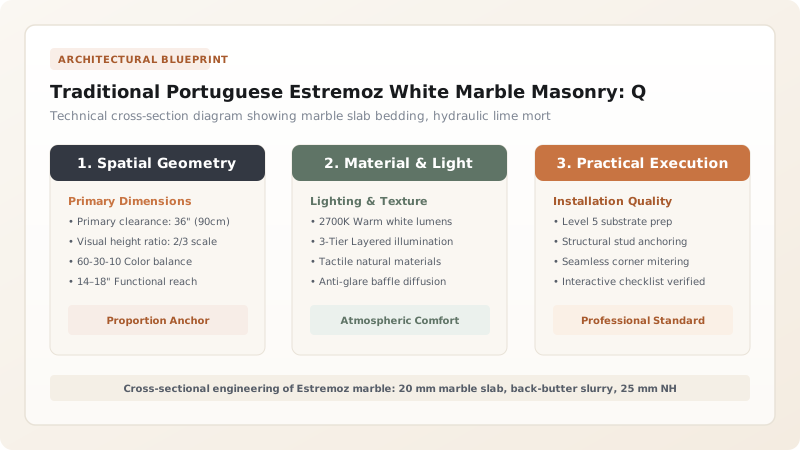
Trowel a continuous 25 mm thick mortar bed across the setting zone. Back-butter the rear face of the marble slab with a thin slurry of pure lime cream to guarantee 100% mechanical contact.
Bookmatched Placement and Alignment
Lower the slab into position using suction lifters. Tap gently with white rubber dead-blow mallets until level, aligning vein patterns with the adjoining mirrored slab to form symmetrical butterfly wings.
Razor Joint Calibration
Insert 1 mm non-compressing lead or plastic shims into the perimeter joints (junta seca). Check across joints with a precision straightedge to eliminate any lippage.
Slaked Lime Slurry Grouting
After 48 hours of initial cure, remove shims and press a fluid grout slurry of fine 0–0.2 mm Estremoz marble flour and slaked lime putty into the joints, wiping clean with damp linen sponges.
Honed Satin Finishing and Wax Sealing
Hone the cured floor using progressive resin-bond diamond pads up to 800 grit. Buff with natural microcrystalline wax to create a soft satin luster and a breathable stain-resistant barrier.
Common Mistakes & Countermeasures
Avoid these costly errors that compromise aesthetics, ergonomics, and budget:
Setting Estremoz white marble with standard grey Portland cement mortars
Applying synthetic polyurethane or epoxy topical sealers over interior marble floors
Using acidic cleaners, vinegar, or citrus solutions on calcitic Estremoz marble
Project Execution Checklist
Track your physical progress. Checkboxes persist automatically on this device:
Frequently Asked Questions
What makes Estremoz marble unique compared to Italian Carrara marble?
While Italian Carrara marble is celebrated for its cool grey-white ground and feather-soft grey veins, Estremoz marble from Portugal possesses a warmer, cream-to-pink undertone and extraordinary translucency. Its fine saccharoidal calcite crystals allow light to penetrate up to 15 mm into the stone, producing an ethereal, warm glow that Italian Carrara cannot match, with signature varieties like 'Rosa Aurora' displaying delicate blush-pink coloration.
Why is Portland cement strictly forbidden in historic Estremoz marble installations?
Portland cement contains high concentrations of soluble alkalis, iron minerals, and sulfate salts. When moisture migrates through a Portland cement setting bed, it leaches these minerals into the porous calcite structure of the translucent marble, causing permanent dark yellow-brown stains, unsightly efflorescence, and irreversible discoloration. Natural Hydraulic Lime (NHL) is chemically benign and prevents this completely.
What is the meaning of 'livro aberto' (bookmatching) in Portuguese stone masonry?
'Livro aberto' (open book) refers to the technique of cutting a single marble block into consecutive slabs and polishing opposing faces. When two adjacent slabs are installed side-by-side, their natural vein trajectories mirror each other like facing pages of an open book, creating stunning, symmetrical butterfly or diamond patterns that showcase the geological artistry of the earth.
How should an authentic Estremoz marble floor be maintained daily?
Daily maintenance requires only dry dust-mopping with a microfiber mop to remove abrasive grit. For damp cleaning, use warm water mixed with a few drops of pH-neutral stone soap (such as pure Castile soap or vegetable oil soap). Never use acidic cleaners, bleach, ammonia, or commercial tile detergents, and reapply a micro-thin coat of microcrystalline wax annually to maintain the protective barrier.