
Portuguese Azulejos are monumental tin-glazed ceramic tile panels that have defined Iberian architecture since the 15th century. Originating from Moorish geometric mosaic tilework (al-zillīj) and revolutionized during the Portuguese Baroque Golden Age (circa 1690–1750), authentic azulejos are crafted from porous calcareous terracotta biscuits coated with an opaque white tin oxide-lead glaze. Master painters execute elaborate cobalt blue (CoO) historiated narratives, trompe-l'œil architectural borders, and biblical or mythological scenes directly onto the unfired powdery glaze using the pouncing (spolvero) charcoal transfer technique. Bedded into historic stone walls using breathable slaked lime mortars (non-hydraulic calcium hydroxide), azulejos provide durable acoustic insulation, thermal dampening, and radiant weatherproofing against humid coastal Atlantic winds.
At a Glance: Key Takeaways
- Calcareous Terracotta Biscuits: Porous 135x135mm clay tiles (chacota) fired at 950°C with thermal expansion matched to tin glazes.
- Tin-Opacified Majolica Glaze: Opaque milky-white glaze formulated from lead, silica, potassium, and 8–10% stannic oxide (SnO2).
- Cobalt Oxide Brushwork: Deep blue pigment (CoO) brushed freehand onto raw absorbent glaze, developing rich gradient depth upon firing.
- Historiated Narrative Panels: Monumental compositions depicting maritime voyages, hagiography, and Baroque theatrical allegories.
- Trompe-l'Œil Architectural Borders: Fictive marble frames, acanthus volutes, putti, and swags seamlessly expanding interior space.
- Traditional Lime Mortar Bedding: Non-hydraulic aged slaked lime (air lime) matrix preventing destructive sub-tile salt efflorescence.
In-Depth Guides in this Directory
Explore specialized subtopic blueprints, technical dimensions, and execution checklists:
Majolica Tin-Opacified Glaze, Cobalt Oxide Brushwork, and Kiln Firing
Technical guide to formulating tin-opacified majolica glazes, compounding cobalt oxide pigments, brushwork techniques, and kiln firing for Portuguese azulejos.
Historiated Narrative Scenes and Trompe-l'Œil Architectural Border Framing
Compositional and architectural guide to historiated narrative azulejo panels, Baroque trompe-l'œil architectural borders, and perspective illusions.
Traditional Lime Mortar Tile Bedding and Substrate Efflorescence Prevention
Technical installation and conservation manual for bedding Portuguese azulejos in traditional air-lime mortar and mitigating soluble salt efflorescence.
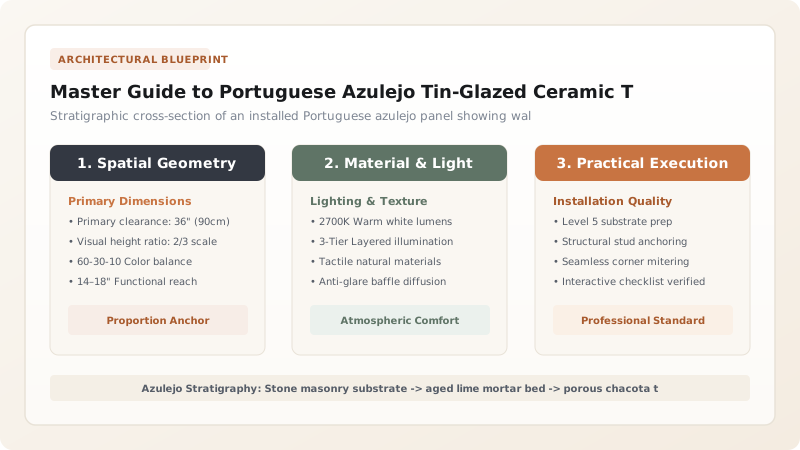
1. Cultural Lineage: From Moorish Alicatado to the Baroque Blue Golden Age
The word azulejo derives from the Arabic al-zillīj (الزليج), signifying a 'polished stone' or geometric tile mosaic. Introduced to Portugal by King Manuel I following his visits to Seville in 1498 and 1503, early Portuguese tilework utilized Moorish cuerda seca and cuenca relief techniques. However, the true artistic revolution occurred in the late 17th century with the arrival of high-fired Dutch Delft imports and Ming Dynasty Chinese porcelain.
Portuguese master painters adapted these monochrome influences to create the Ciclo dos Mestres (Cycle of Masters, 1690–1750). Abandoning polychromatic Renaissance glazes, artists like Gabriel del Barco, Manuel dos Santos, and António de Oliveira Bernardes covered entire cathedral naves, palace cloisters, and public staircases with monumental blue-and-white narrative tapestries in ceramic tile, creating a distinct architectural identity found nowhere else in Europe.
2. Ceramic Chemistry: Calcareous Clay, Stannic Oxide, and Cobalt
The structural and optical durability of an authentic azulejo depends on precise ceramic chemistry:
- Chacota (The Biscuit): The tile biscuit is molded from iron-rich alluvial clay blended with fine calcium carbonate (marl). When fired at 900°–950°C, the calcium reacts with silica to form an open, microporous matrix with a thermal expansion coefficient ($6.5 \times 10^{-6} / ^\circ\text{C}$) that matches the overlying glaze, preventing crazing or peeling.
- Tin-Opacified Glaze: A lead-silicate fritted slip enriched with 8% to 12% tin dioxide ($\text{SnO}_2$). Stannic oxide particles remain undissolved in the glass melt, scattering incident light to produce an opaque, warm milky-white enamel background.
- Cobalt Oxide Pigmentation: Ground cobalt aluminate and cobalt carbonate pigments mixed with water or gum arabic. When painted onto the powdery, unfired glaze, the cobalt appears dull greyish-black; during the 1000°C glost firing, cobalt ions dissolve into the molten glass matrix, transforming into vibrant, luminous royal and indigo blues.
3. Architectural Integration: Moisture Regulation and Thermal Mass
Azulejos were never merely decorative ornaments; they formed an integral environmental skin for stone and adobe buildings in Portugal’s damp maritime Atlantic climate. Massive limestone and schist walls in churches and palaces absorb significant subterranean moisture and airborne condensation.
By cladding internal wall surfaces with porous terracotta tiles bedded in pure slaked lime, builders created a protective barrier against driving rain and indoor humidity while preserving breathability. The vitreous glaze prevents surface staining and salt crystallization from disrupting interior plaster, while the thick terracotta backing and air-lime bed regulate internal ambient humidity, buffering indoor temperatures during hot Lisbon summers and damp coastal winters.
Portuguese Azulejo Chronology, Glaze Typologies, and Ceramic Specifications
Use this reference table to calculate exact physical dimensions, ratios, and specifications before purchasing:
| Historical Era | Dominant Style / Technique | Tile Size (mm) | Palette Composition | Typical Architectural Application |
|---|---|---|---|---|
| Manueline (1495–1521) | Arista / Cuenca relief tilework | 130 x 130 x 20 mm | Polychrome: green, amber, cobalt, manganese | Palácio Nacional de Sintra royal apartments |
| Mannerist (1580–1640) | Padrão carpet patterns | 140 x 140 x 15 mm | Yellow, blue, white chevrons & strapwork | Church nave wainscots and convent halls |
| Baroque Master Cycle (1690–1750) | Monumental historiated scenes | 135 x 135 x 12 mm | Strict monochrome cobalt blue on tin white | Cathedral cloisters, palaces, monumental facades |
| Pombaline (1755–1790) | Post-earthquake standardized pattern | 140 x 140 x 10 mm | Polychrome green, yellow, manganese & blue | Lisbon downtown residential apartment interiors |
| Romanticist (1840–1910) | Industrial stamped exterior cladding | 150 x 150 x 8 mm | Deep blues, yellows, relief majolica florals | Porto and Lisbon residential street facades |
Practical Constraints
Every successful decoration project must account for physical and environmental constraints:
Complex Panel Assembly Puzzle Logistics
Lead Glaze Health & Safety Regulations
Traditional Atelier Fabrication and Installation Sequence for Azulejos
Execute this professional sequence to achieve flawless results without backtracking:
Clay Pugging and Hand-Molding
Blend calcareous red clay with 15% marl sand; press into oiled wooden 140x140mm open molds, leveling with wire strikes.
Slow Drying and Biscuit (Chacota) Firing
Air-dry biscuits between wooden batten racks for 21 days; fire biscuits in wood-fueled updraft kiln to 950°C over 36 hours.
Tin Glaze Dipping
Submerge dry chacota tiles into liquid tin-oxide-lead glaze suspension (density 1.45 g/ml) for 3 seconds, leaving an opaque chalky white face.
Spolvero (Pouncing) Cartoon Transfer
Lay full-scale paper cartoon perforated with needle holes over tile grid; dab charcoal dust bag across holes to transfer faint outline dots.
Cobalt Oxide Grisaille Brushwork
Paint shadows, drapery, and fine contours using varying dilutions of cobalt oxide dissolved in gum arabic water using squirrel-hair brushes.
Second (Glost) Firing
Pack painted tiles into refractory ceramic saggers (casas); glost fire to 1020°C, fusing the cobalt pigment into the vitreous tin glass enamel.
Substrate Leveling with Aged Lime Mortar
Scrabble stone wall; apply 15mm scratch coat of non-hydraulic slaked lime (chaux grasse) and washed silica sand (1:2.5 ratio).
Tile Setting and Buttering
Soak chacota backs in fresh water; butter tile backs with pure lime putty slip and set tiles with tight 1.5mm joints, aligning panel cartoons perfectly.
Common Mistakes & Countermeasures
Avoid these costly errors that compromise aesthetics, ergonomics, and budget:
Setting historic azulejos with modern polymer-modified Portland cement thin-set mortars
Failing to water-soak dry terracotta tiles before setting into traditional lime mortar
Using modern synthetic chemical bleaches or muriatic acid to remove biological grime from exterior azulejos
Project Execution Checklist
Track your physical progress. Checkboxes persist automatically on this device:
Frequently Asked Questions
Why did Portuguese azulejos become predominantly blue and white in the 18th century?
In the late 17th century, the global luxury market was swept by blue-and-white Chinese porcelain brought back by Portuguese maritime trade routes. Simultaneously, Dutch Delft tile imports became prestigious. Portuguese ceramicists embraced this aesthetic, finding that cobalt oxide was the most stable, expressive pigment capable of rendering dramatic Baroque chiaroscuro.
How do you safely clean centuries-old dirty azulejo tiles?
Conservators use neutral deionized water compresses, vulcanized latex sponges (wishabs), and pH-neutral conservation soaps (such as Vulpex or Tween-20). For stubborn atmospheric crusts, poultices of sepiolite clay or ammonium carbonate are applied under Japanese tissue paper.
Can broken or missing azulejos in a historic church panel be replicated?
Yes. Conservation studios recreate missing tiles using identical local calcareous clays and tin-glaze chemistry. Per the Venice Charter, replacement tiles are discreetly dated or marked on the reverse to distinguish authentic historic tiles from modern conservation inlays.


