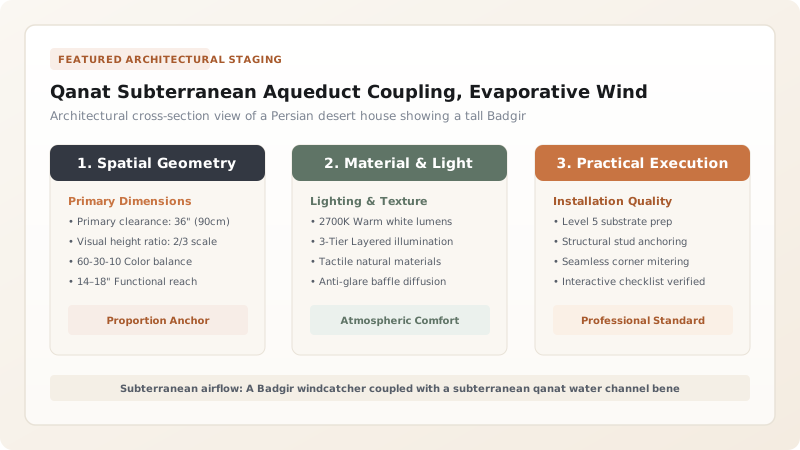
Coupling a Badgir windcatcher with an underground Qanat aqueduct creates a zero-energy evaporative cooling system capable of dropping air temperatures by up to 15°C (27°F). Hot, dry surface air is forced down the badgir shaft into subterranean water channels flowing 10 to 30 meters underground. As dry air sweeps across the cool water, latent heat of vaporization is absorbed, transforming searing 42°C (108°F) desert air into a refreshing 22°C (72°F) breeze with 50% relative humidity.
At a Glance: Key Takeaways
- Subterranean Aqueduct Depth: 10 to 30 meters below desert surface level
- Qanat Water Temperature: 12°C to 16°C (derived from snowmelt aquifers)
- Psychrometric Transition: Sensible heat reduction + latent heat evaporative moisture gain
- Air Temperature Reduction: Outdoor 42°C -> Subterranean cooling -> Indoor 22°C - 25°C
- Humidity Adjustment: Outdoor 8-12% RH -> Delivered comfort 45-55% RH
- Airflow Control: Subterranean masonry dampers and basement Sardab shafts
Psychrometric Thermodynamics: Sensible vs. Latent Heat Transfer
In arid climates like central Iran, conventional wind-driven ventilation suffers from a fundamental thermodynamic limitation: when ambient outdoor air reaches 42°C (108°F), blowing hot air across human skin provides minimal relief once the ambient temperature exceeds skin temperature (33°C). To produce true physiological comfort, the dry-bulb temperature of the air must be physically lowered. The Persian solution couples the Badgir with the Qanat—a network of subterranean, gently sloping water canals engineered to tap mountain water tables.
The thermodynamic process follows the constant-enthalpy wet-bulb line on a psychrometric chart. As hot, dry desert air (dry-bulb temperature $T_{db} = 42^\circ\text{C}$, relative humidity $RH = 10\%$, wet-bulb temperature $T_{wb} \approx 18^\circ\text{C}$) sweeps across the subterranean water surface, moisture evaporates. The energy required to break hydrogen bonds in liquid water ($2,450\text{ kJ/kg}$ of water evaporated) is extracted directly from the sensible heat of the air stream:
$$Q_{\text{sensible}} = \dot{m} C_p \Delta T$$
Simultaneously, the air loses sensible heat via conduction to the cold water (14°C) and the surrounding subterranean earth (16°C). The delivered air emerges into the residential basement (sardab) or central courtyard at approximately 22°C to 24°C with a relative humidity of 50%, representing ideal human thermal comfort without consuming a single watt of synthetic electrical power.
Subterranean Tunnel Architecture: Sardab and Payab Chambers
Integrating a badgir with a qanat requires specialized subterranean architecture. In grand residential estates in Kashan and Yazd, homes feature multiple underground levels:
- The Sardab: A deeply sunken basement chamber situated 4 to 8 meters below courtyard level, featuring vaulted adobe brick ceilings, ornate tilework, and a central marble basin.
- The Payab: A steep staircase tunnel descending 15 to 25 meters down to the subterranean qanat water channel itself.
The down-draft flue of the badgir is engineered to bypass the upper floors, plunging vertically down into the payab. The air travels horizontally through a brick-lined vaulted subterranean tunnel running parallel to the flowing qanat water. The tunnel walls are bedded in hydraulic Saroj mortar to prevent water leakage. Staggered baffle arches in the tunnel force the descending air into close, turbulent contact with the cold water surface, maximizing contact time and evaporation efficiency before the conditioned air ascends through floor grilles into the sardab.
Microclimatic Air Balancing & Seasonal Damper Control
A coupled badgir-qanat system requires careful operational balancing across diurnal and seasonal cycles. If uncontrolled during cool nights or high-humidity days, evaporative cooling can over-saturate indoor air, causing condensation and fungal growth on mudbrick walls.
Persian builders installed wooden butterfly dampers and decorative fretwork screens (moucharaby / darbcheh) at key subterranean junctions. During the peak afternoon heat (12:00 to 17:00), the dampers are fully opened, directing the entire air volume across the qanat. As outdoor temperatures fall after sunset, the qanat dampers are partially closed, and upper courtyard vents are opened. This shifts the system into thermal chimney mode: cool night air enters the courtyard naturally, while the warm badgir masonry pulls air upward, ventilating the upper bedrooms without over-cooling the lower levels.
Thermodynamic Performance of Badgir-Qanat Coupled Air Cooling
Use this reference table to calculate exact physical dimensions, ratios, and specifications before purchasing:
| System Operating State | Inlet Air Conditions | Subterranean Water Contact | Delivered Indoor Conditions | Thermal Comfort Index |
|---|---|---|---|---|
| Peak Afternoon Heat (14:00) | 43°C (109°F), 8% RH | Active qanat stream (14°C) | 23°C (73°F), 52% RH | Optimal Comfort (PMV ~ 0) |
| Mid-Morning Wind (10:00) | 34°C (93°F), 15% RH | Qanat channel + basin | 21°C (70°F), 48% RH | Optimal Comfort (Slightly Cool) |
| Night Stack Chimney (02:00) | 24°C (75°F), 25% RH | Qanat damper closed; courtyard open | 22°C (72°F), 35% RH | Cool, Fresh Night Air |
| Uncoupled Badgir (No Qanat) | 42°C (108°F), 10% RH | Dry shaft (sensible cooling only) | 35°C (95°F), 12% RH | Warm Breeze (Sweat Evaporative) |
Practical Constraints
Every successful decoration project must account for physical and environmental constraints:
Lowering Water Tables from Agricultural Tube Wells
Over-extraction has caused many historic urban qanats to run dry, disabling the evaporative cooling stage. Solution: Retrofit dry subterranean chambers with closed-loop recycled water fountains, subterranean cisterns, or geothermal earth tubes.
Complex Structural Excavation Beneath Existing Heritage Homes
Tunnelling 15 meters below historic adobe foundations poses severe collapse hazards without proper shoring. Solution: Employ experienced traditional qanat well-diggers (muqannis) using traditional timber lagging and arched brick linings.
Execution Blueprint & Craftsmanship Sequence
Execute this professional sequence to achieve flawless results without backtracking:
Subterranean Qanat Alignment Survey
Survey the subterranean qanat depth and flow rate beneath the property. Determine the exact coordinates for the vertical shaft excavation to tap the water tunnel.
Payab Staircase and Air Tunnel Excavation
Excavate the payab staircase down to the qanat water table. Line the tunnel with fired clay bricks and hydraulic Saroj mortar to prevent groundwater contamination.
Down-Draft Badgir Flue Connection
Extend the down-draft flue of the badgir tower directly into the payab air tunnel, creating an airtight brick-lined drop shaft that bypasses upper living rooms.
Evaporative Contact Baffle Installation
Construct stepped brick baffle arches along the water canal surface to force incoming airflow into low-altitude turbulent contact with the moving cold water.
Sardab Basement Floor Grille Integration
Install carved stone or hardwood intake grilles in the floor of the sardab basement, allowing conditioned evaporative air to rise naturally into the room.
Air Damper Calibration
Install adjustable wooden dampers at the subterranean junction. Calibrate damper settings to regulate air velocity and prevent excessive relative humidity.
Common Mistakes & Countermeasures
Avoid these costly errors that compromise aesthetics, ergonomics, and budget:
Allowing Subterranean Humid Air to Stagnate in Basements
Lining Qanat Evaporative Tunnels with Unfired Mud Plaster
Coupling Windcatchers to Contaminated Greywater Drains
Project Execution Checklist
Track your physical progress. Checkboxes persist automatically on this device:
Frequently Asked Questions
What is a 'Qanat' and how does it bring water to the desert?
A Qanat is an ancient Persian water management system dating back 3,000 years. It consists of a series of vertical well-like shafts connected by a gently sloping underground tunnel that taps unconfined aquifers in mountain foothills and transports water by gravity over dozens of kilometers to arid desert plains without evaporation losses.
Does the humidity added by the Qanat make the desert house feel muggy?
No. In desert regions like Yazd, ambient summer humidity is dangerously low (often below 10%), causing dry skin, eye irritation, and respiratory discomfort. Adding water vapor via qanat evaporation brings relative humidity to 45%-55%, which is universally recognized as the optimal human thermal comfort range. Because the air is cooled to 22°C, it feels crisp and refreshing, not muggy.
How did ancient builders prevent bad odors from the qanat entering the home?
Historic Qanats carried pristine, cold mountain snowmelt water flowing continuously at high velocity over clean gravel beds, naturally aerated by vertical shafts. The water was crystalline and odorless. If water carried silt, sediment basins trapped it before entering the residential air tunnel.