
Hasba compass drafting is the mathematical foundation of Moroccan Zouaq, translating geometric principles into intricate 8-, 12-, 16-, and 24-pointed star polygons (khatam). Coupled with the flowing vegetal arabesques of 'tawriq' and interlaced Kufic or Thuluth calligraphic friezes, the master artist (maâlem) creates infinite ornamental cycles on cedar boards using copper-tipped compasses, wooden proportional dividers, and perforated parchment pouncing stencils.
At a Glance: Key Takeaways
- Calligraphic Scripts: Flourished Maghrebi Kufic & Classical Andalusian Thuluth
- Drafting Methodology: Euclidean Compass & Straightedge (Hasba Unit System)
- Primary Star Systems: Octagonal (8-fold), Duodecimal (12-fold), Hexadecimal (16-fold)
- Vegetal Style: Tawriq (Intertwined Acanthus & Palmette Leaves)
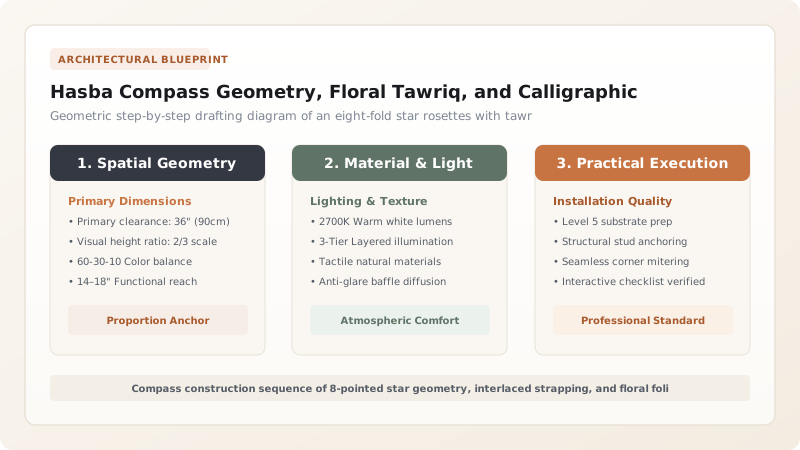
The Mathematical Discipline of Hasba Geometric Proportion
In Moroccan craftsmanship, geometry is not merely decorative; it is a sacred intellectual discipline. The Hasba system functions as an integrated modular proportion grid. Rather than measuring in arbitrary millimeters, the master artisan establishes a base circle whose diameter equals the module of the timber ceiling tray.
By inscribing equilateral squares, triangles, and hexagons within concentric guiding circles, the artist generates the classical khatam (star rosette). Subdivisions produce secondary polygonal tiles: the saft (kite-shaped radial rays), qandil (lantern-shaped bridges), and khamis (connecting pentagonal infills).
Tawriq and Tachjir: Dynamic Floral and Vegetal Flourishes
Complementing the rigid discipline of star polygons is tawriq (foliage ornamentation) and tachjir (tree-like bifurcating stems). These free-flowing arabesques emerge from the vertices of geometric bands, weaving over and under timber ribs in continuous undulating rhythms.
Artisans employ specialized dual-line calligraphic brushes to paint ribbons of contrasting color, rendering each leaf with graded highlights (dhil and daou—shadow and light). This three-dimensional trompe l’œil effect imparts visual movement to static timber beams.
Epigraphy: Maghrebi Kufic and Andalusian Thuluth Borders
Perimeter friezes and central transverse girders frequently bear monumental epigraphy celebrating spiritual verses, poetic dedication couplets, or chronograms dating the construction. The scripts employed are predominantly square geometric Kufic or fluid, majestic Maghrebi Thuluth.
Letters are drafted so that their ascending vertical shafts (alifs and lams) terminate in stylized floral palmettes that lock seamlessly into the adjacent tawriq fields. The calligraphic text is typically picked out in radiant white or burnished gold leaf, framed by intense azurite blue or vermilion backgrounds.
The Pounce Technique: Parchment Perforation and Charcoal Transfer
Because coffered ceilings often comprise dozens or hundreds of identical coffer trays, master artisans preserve complex geometric designs on heavy oiled tracing paper or vellum known as the kharta. Every stroke of the geometric layout and vegetal motif is pricked with a fine brass needle (25–35 holes per linear inch).
Artisans hold the perforated stencil firmly against the primed taourij gesso surface and pat it with a porous linen bag filled with pulverized grapevine charcoal or crushed red chalk. The dust penetrates the needle perforations, leaving an ultra-fine dotted master map that guides rapid, confident brushwork.
Geometric Motif Classification in Zouaq Woodwork
Use this reference table to calculate exact physical dimensions, ratios, and specifications before purchasing:
| Motif Pattern | Symmetry Fold | Structural Location | Primary Symbolism | Brush Outlining Gauge |
|---|---|---|---|---|
| Khatam Thumniya | 8-Fold Star Symmetry | Center of Octagonal Coffers | Cosmic balance & four cardinal directions | 00 Kolinsky sable (0.4mm) |
| Khatam Ithna-Ashariya | 12-Fold Star Symmetry | Koubba Dome Centerpieces | Twelve signs of zodiac / celestial dome | 0 Kolinsky sable (0.6mm) |
| Tawriq & Tachjir | Continuous Sinusoidal Curve | Transverse Girders & Joist Faces | Eternal life & paradisiacal gardens | No. 1 Squirrel-hair brush |
| Maghrebi Thuluth Script | Continuous Horizontal Frieze | Upper Wall Cornice / Entablature | Poetic invocations & historic patronage | Chiseled flat-edge ox hair |
Practical Constraints
Every successful decoration project must account for physical and environmental constraints:
Parallax Distortion When Viewed from Below
Ceiling geometry must be drawn with subtle optical expansions so lines appear undistorted from ground-level raking angles.
Charcoal Residue Smudging Wet Tempera Colors
Pounce marks must be gently blown with a rubber hand bulb before painting, leaving only faint micro-specks on the gesso.
Execution Blueprint & Craftsmanship Sequence
Execute this professional sequence to achieve flawless results without backtracking:
Substrate Modular Dimensioning
Establish the exact length and width of the cedar coffer panel, calculating the Hasba module to ensure whole integer star repetitions.
Master Drafting on Parchment
Using heavy drafting vellum, scribe concentric proportional circles with a precision brass beam compass, drawing interlocking squares to form the 8-star khatam.
Freehand Arabesque Integration
Sketch flowing tawriq foliage along the outer star points, balancing negative space to maintain harmony with the geometric skeleton.
Needle Perforation of the Master Kharta
Place vellum on a wool felt pad and prick every drawn line with a sharp steel needle at uniform 1mm intervals.
Charcoal Pounce Transfer
Align the perforated stencil against the primed cedar panel and tamp lightly with a powdered charcoal pounce bag, revealing coordinate dots.
Tahrid Freehand Outlining
Follow the charcoal dots with fluid, unbroken strokes of black or white tempera using fine pointed sable brushes to secure the design.
Common Mistakes & Countermeasures
Avoid these costly errors that compromise aesthetics, ergonomics, and budget:
Using Inaccurate Laser or Plastic Stencils with Rigid Uniform Lines
Overcrowding Vegetal Arabesques in Small Coffer Trays
Project Execution Checklist
Track your physical progress. Checkboxes persist automatically on this device:
Frequently Asked Questions
What is the role of the 'Maâlem' in Zouaq drafting?
The Maâlem is the master craftsman who has attained oral mastery over geometric systems. He drafts the original Hasba blueprints, directs the pounce pricking, and paints the critical outlines and calligraphic faces himself.
Can CAD software be utilized to draft Hasba geometry?
Yes, contemporary restoration architects frequently draft Hasba star networks in vector CAD software to verify proportional symmetry before printing full-scale pounce transfer masters.


