
Atlas Cedar Carpentry for Zouaq involves shaping slow-grown high-altitude Cedrus atlantica heartwood into coffered trays, interlocked beams, and carved brackets. Before any polychrome painting begins, the timber undergoes 'taourij'—an artisanal grounding system where wood pores are sealed with hot hide-glue sizing and leveled with multiple coats of pulverized Bologna chalk gesso, creating a dimensionally stable, velvet-smooth micro-ground.
At a Glance: Key Takeaways
- Glue Sizing: Rabbit-skin / Bovine collagen (6-8% solution)
- Ground Layer: Bologna chalk / Champagne gesso (2-3 passes)
- Moisture Content: 10% ± 1.5% target equilibrium
- Timber Density: 560 kg/m³ (Atlas Cedar Heartwood)
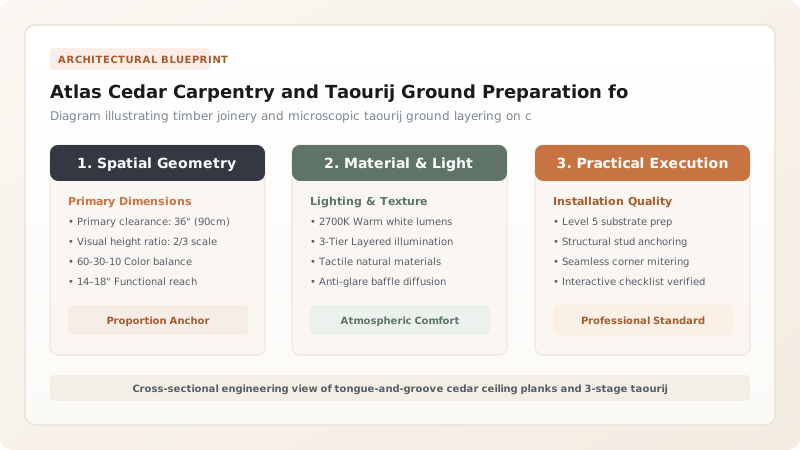
Atlas Cedar (Cedrus atlantica) Selection and Structural Seasoning
True Moroccan architectural joinery relies almost exclusively on Atlas cedar harvested from the Middle and High Atlas mountain ranges. Characterized by high concentrations of natural cedrene and thujopsene sesquiterpenes, the heartwood possesses exceptional biological resistance against termites, powder-post beetles, and dry rot fungi.
For Zouaq ceilings, timber must be quarter-sawn rather than plain-sawn. Quarter-sawing ensures that tangential shrinkage and swelling across radial grain lines remain under 1.2%, preventing the severe dimensional shifting that fractures delicate gesso paint grounds.
Carpentry Systems: Berber Canopies, Koubba Ribs, and Lap-Joint Trays
Moroccan ceiling framing utilizes modular carpentry systems designed to span interior courtyard salons without intermediate column supports. Master carpenters (nejjarin) fabricate primary transverse girders (qantarat) resting on carved cantilever brackets (mutaka).
Ceiling infill panels (tahtan) are fitted into continuous rabetted grooves. Hand-hewn wooden dowels and concealed tenons permit minor seasonal timber expansion without warping the decorative ceiling plane or exerting outward structural thrust on earthen or brick masonry walls.
Formulating and Applying the Traditional Taourij Gesso Ground
Raw cedar contains natural volatile oils that can inhibit paint adhesion if left untreated. The first stage of Taourij involves degreasing the surfaced wood with mild alcohol or lye water, followed by a penetrating barrier coat of warm animal hide glue sizing (6% to 8% w/v concentration at 50°C).
Next, levigated calcium carbonate (whiting or Bologna chalk) is sifted into the warm glue until saturation. Applied in two to three whisper-thin passes across alternating grain directions, the ground cures into a micro-porous, shock-absorbing substrate that permanently locks mineral tempera to the wooden substrate.
Leveling, Dry-Scraping, and Surface Preparation for Drafting
Once the final taourij coat cures for 24 hours, artisans avoid wet-sanding, which can re-emulsify the collagen binder. Instead, the surface is dry-scraped using curved cabinet scrapers (racloirs) and fine abrasive horsetail rush (Equisetum) or 400-grit silicon carbide paper.
The finished surface must exhibit zero sanding swirl marks, micro-pores, or high spots. A flawlessly leveled matte white field provides the optical reflectance necessary for mineral pigments to achieve their vibrant luminosity under natural raking light.
Cedar Timber Grade & Ground Preparation Protocol
Use this reference table to calculate exact physical dimensions, ratios, and specifications before purchasing:
| Application Area | Timber Grain Spec | Sizing Pass Ratio | Gesso Thickness | Abrasive Polish |
|---|---|---|---|---|
| Flat Tray Planks (Tahtan) | Quarter-Sawn Radial Heartwood | 7% Rabbit-skin glue @ 50°C | 100–120 microns (3 thin coats) | 320 to 400-grit dry finish |
| Structural Beams (Qantarat) | Dense Mixed Heartwood | 8% Bovine hide glue @ 55°C | 80–90 microns (2 coats) | 240 to 320-grit dry finish |
| Carved Cornice Brackets (Mutaka) | Straight-Grain Knot-Free Cedar | 6% Hide glue penetrant | 50–70 microns (single spray/brush) | Natural horsetail rush polish |
| Perimeter Friezes (Boutana) | Edge-Glued Cedar Strips | 7% Collagen size | 100 microns (2 coats) | 400-grit ultra-fine hand hone |
Practical Constraints
Every successful decoration project must account for physical and environmental constraints:
Resin Bleeding from Immature Cedar Sapwood
Sapwood must be strictly rejected during timber grading; only mature, golden-brown heartwood can be employed.
Workshop Temperature and Gel Time Control
Cold atelier conditions (under 16°C) cause hot hide glue to gel instantly before soaking into timber pores, requiring heated brush kettles.
Execution Blueprint & Craftsmanship Sequence
Execute this professional sequence to achieve flawless results without backtracking:
Moisture Calibration and Planing
Acclimatize Atlas cedar in the installation facility for 14 days, verifying moisture content between 9% and 11% before precision hand planing.
Collagen Glue Sizing Bath
Dissolve high-grade rabbit-skin glue pearls in warm distilled water at 50°C; apply an even sizing coat to seal natural cedar resins.
Taourij Slurry Compounding
Gradually sift levigated Bologna chalk into hot size glue until a creamy consistency is reached, straining through cheesecloth to remove unground particles.
Multi-Coat Brush Application
Brush the first coat along the grain; allow 6 hours drying, then apply a second coat across the grain with wide badger-hair brushes.
Micro-Finishing and Surface Cleanliness
Dry-scrape with a flexible steel scraper and vacuum away all fine dust with HEPA filtration before transferring geometric blueprints.
Common Mistakes & Countermeasures
Avoid these costly errors that compromise aesthetics, ergonomics, and budget:
Overheating Animal Hide Glue Above 65°C
Applying Heavy Single Coats of Gesso
Project Execution Checklist
Track your physical progress. Checkboxes persist automatically on this device:
Frequently Asked Questions
Why is Atlas cedar preferred over pine or spruce for Zouaq ceilings?
Atlas cedar has tight growth rings, high dimensional stability, and natural biocidal oils that prevent insect attack for centuries without chemical preservation.
Can gypsum be used instead of Bologna chalk for Taourij ground?
Yes, high-purity dead-burned gypsum (gesso sottile) is historically authentic, providing comparable flexibility and optical brilliance when mixed with hide glue.


