Chiseling Zellige requires rhythmic athletic precision. Sitting before a stone or iron anvil, the artisan strikes a glazed rezola tile with a 1.3 kg double-beveled menqach hammer, shearing geometric polygons. The tile is then chamfered (kharmata) at a 45-degree angle on its reverse side. This allows pieces to interlock seamlessly with zero surface gaps, guided by the classical hasba geometric system of multi-pointed star rosettes.
At a Glance: Key Takeaways
- Chiseling Hammer: Menqach (forged high-carbon steel, 1.2 to 1.5 kg, dual wedge blades)
- Support Anvil: Sindan (hardened iron rail or dense basalt block embedded in wood)
- Primary Cutting Operation: Taqsir (primary perimeter scoring and shearing)
- Reverse Chamfering: Kharmata (45-degree back beveling leaving sharp glazed lip)
- Geometric Canon: Al-Hasba (proportional compass division of the circle)
- Surface Tolerance: 0.0 mm hairline butt joint between glazed facets
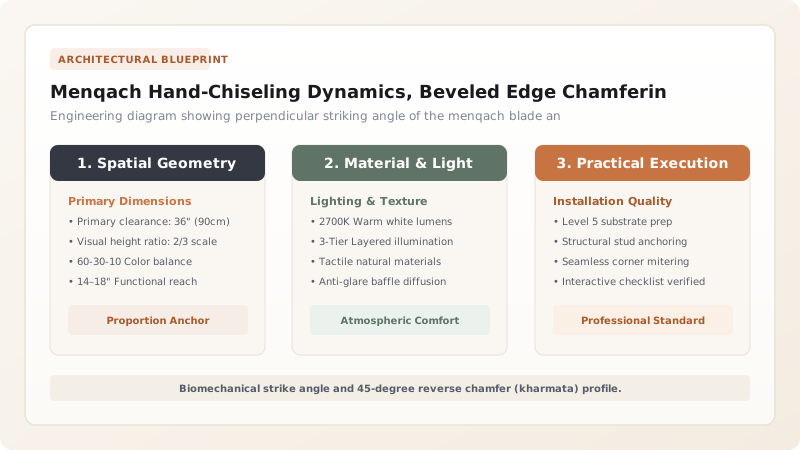
The Menqach Hammer: Biomechanics of the Dynamic Strike
The signature tool of the Moroccan tilemaker is the menqach (or manqash). Forged from a solid billet of high-carbon tool steel, the menqach weighs between 1.2 and 1.5 kg and features a short turned olive-wood handle. Its head terminates in two opposing, razor-sharp wedge-shaped cutting blades oriented parallel to the handle. The tool's center of gravity is balanced precisely at the eye.
The artisan (kassas) sits cross-legged or on a low three-legged stool before a heavy iron anvil (sindan), typically fashioned from an inverted section of railroad track embedded in an olive-wood log. The cutting action does not rely on heavy arm swings; instead, the artisan rests his forearm on his knee, using a rapid, whip-like flick of the wrist. The heavy steel head delivers high kinetic momentum over a short 100 mm arc. When the sharp blade strikes the glazed tile edge, it cleaves the brittle terracotta biscuit cleanly in a single blow without shattering the delicate vitreous enamel surface.
Kharmata Back-Beveling: Engineering the Zero-Grout Joint
The secret that allows Moroccan Zellige to achieve its continuous, grout-free mosaic appearance is kharmata (back-chamfering). If tiles were cut with straight 90-degree square edges, microscopic surface irregularities in the clay would prevent pieces from touching cleanly, resulting in wide, jagged grout gaps.
After cutting the primary geometric polygon, the artisan immediately flips the piece upside down. Resting the raw terracotta edge on the anvil, he strikes light glancing blows with the menqach at a 45-degree angle. This chips away the underside of the terracotta biscuit, thinning the back while leaving a razor-sharp, knife-like edge on the glazed front face. When hundreds of these beveled pieces are assembled edge-to-edge, the glazed top surfaces touch with absolute zero clearance, while the chamfered reverse sides form wide triangular channels that provide deep mechanical anchorage for the backing mortar.
Hasba Sacred Geometry: Radial Starburst Tessellations
The layout of Zellige mosaics follows al-hasba—an ancient mathematical discipline passed down orally through master guilds. All patterns originate from a single circle divided into equal sectors using a straightedge and compass. By interconnecting intersection points, artisans generate interlocking multi-pointed star rosettes (khatem) governed by rigorous symmetry groups:
- 8-Pointed Symmetry (Octagonal): Built on 45-degree angles, creating classic Marinid stars flanked by square tiles (tesserae).
- 12-Pointed Symmetry (Dodecagonal): Developed on 30-degree subdivisions, creating graceful expanding floral rosettes surrounded by saft chevrons.
- 16 and 24-Pointed Grand Rosettes: Monumental royal medallions found in palace courtyards, where up to 2,000 individually chiseled pieces radiating outward in concentric rings of mathematical perfection.
Each individual shape is named and memorized by the maâlem: the central star (khatem), surrounding petals (mousattas), intermediate triangles (tirkon), and perimeter knotwork bands (djedaïl), forming an infinite visual tapestry celebrating cosmic order.
Zellige Tesserae Classifications and Menqach Tooling Protocols
Use this reference table to calculate exact physical dimensions, ratios, and specifications before purchasing:
| Tessera Name | Geometric Definition | Typical Yield per Rezola | Menqach Edge Operation | Geometric Placement |
|---|---|---|---|---|
| Khatem (Center) | Regular 8 or 12-point star | 1 to 2 stars per tile | 16 to 24 primary strikes + full back chamfer | Focal nucleus of radial mandala |
| Mousattas (Petal) | Hexagonal elongated polygon | 8 to 12 pieces per tile | 6 perimeter cuts + 45° reverse chamfer | Surrounds central star in dense ring |
| Saft (Arrowhead) | Convex-concave chevron | 12 to 16 pieces per tile | 4 rapid angle cuts + edge dressing | Forms directional radiating spokes |
| Tirkon (Spandrel) | Right-angled triangle | 16 to 24 pieces per tile | Single diagonal shear cut | Fills corner spandrels between stars |
| Khamsa (Penta) | Pentagonal symmetry polygon | 6 to 8 pieces per tile | 5 faceted cuts + deep kharmata | Used in rare 10 and 20-point rosettes |
Practical Constraints
Every successful decoration project must account for physical and environmental constraints:
Carpal Tunnel and Repetitive Motion Fatigue
Delivering 15,000 hammer strikes per day can cause chronic repetitive strain injury in artisans' wrists and forearms. Solution: Ensure ergonomic anvil heights, wrap tool handles in leather grip tape, and mandate regular rotational breaks.
Eye Injury from High-Velocity Flying Ceramic Chips
Chiseling brittle glazed tiles ejects sharp, razor-thin ceramic shards at high velocity. Solution: Mandate polycarbonate safety glasses and maintain leather aprons across all cutting workstations.
Execution Blueprint & Craftsmanship Sequence
Execute this professional sequence to achieve flawless results without backtracking:
Zinc Stencil Pattern Tracing
Place zinc geometric stencils over the glazed rezola face. Trace outlines using a bamboo stylus dipped in red ochre water or charcoal.
Anvil Positioning and Wrist Calibration
Sit before the rail anvil (sindan). Rest the glazed tile edge over the anvil crowned with a small piece of inner-tube rubber to absorb rebound.
Primary Perpendicular Shearing (Taqsir)
Strike firmly with the menqach blade at a 90-degree angle along traced lines, shearing the geometric shape from the parent tile in swift strokes.
Reverse Kharmata Chamfering
Flip the piece glazed face down. Chisel along the back edge at a 45-degree angle, removing terracotta core to leave a sharp 0.5 mm glazed lip.
Arris Truing and Edge Dressing
Check the cut piece against a master zinc template. Trim any minor burrs with light taps from the menqach edge, ensuring sharp, crisp corners.
Color Sorting and Tessera Batching
Sort chiseled pieces into wooden trays by shape and color (cobalt stars, turquoise petals, white diamonds) ready for the master assembler.
Common Mistakes & Countermeasures
Avoid these costly errors that compromise aesthetics, ergonomics, and budget:
Striking the Tile with Heavy Full-Arm Swings
Leaving Back Edges Square Without Reverse Chamfer
Using a Dull, Rounded Menqach Blade
Project Execution Checklist
Track your physical progress. Checkboxes persist automatically on this device:
Frequently Asked Questions
How long does it take an artisan to become a master Zellige cutter?
Mastering the menqach hammer requires an intensive traditional apprenticeship starting in youth. It takes approximately 5 to 7 years of daily practice for an artisan to develop the muscle memory, wrist rhythm, and geometric intuition required to chisel complex polygons to sub-millimeter tolerances without measuring.
Why don't modern Zellige producers cut tiles with waterjet or CNC machines?
Waterjets and CNC diamond cutters produce cold, sterile, unnaturally straight edges that lack soul. Furthermore, waterjets cut perpendicular 90-degree edges and cannot easily produce the essential 45-degree under-chamfer (kharmata). Hand-chiseling with a menqach creates subtle faceted hammer marks that scatter light dynamically, giving authentic Zellige its legendary living sparkle.
What happens if a single piece in a complex star rosette is cut wrong?
In Islamic radial tessellations, geometry is absolute. Because shapes interlock in concentric rings, an error of just 0.5 mm or 1 degree on a single petal will compound as the rosette expands. By the third outer ring, the pieces will fail to close, forcing the master to dismantle the entire section and re-cut the defective pieces.