The carving of horseshoe arch voussoirs and epigraphic calligraphic bands represents the high-water mark of Moroccan stone ornamentation. Sourced from fine-grained Taza limestone, the voussoirs are cut according to stilted geometric stereotomy with interlocking joggle bed joints that distribute lateral arch thrust. Master carvers inscribe Quranic verses and poetic dedications in foliated Kufic or Thuluth scripts directly across the arch face, excavating the background ground to 15–25 mm depth with flat chisels and gouges to create dramatic chiaroscuro contrast against the polished relief letterforms.
At a Glance: Key Takeaways
- Arch Typology: Stilted Moorish horseshoe arch (Arc en fer à cheval outrepassé)
- Stereotomic Joinery: Radiating tapered voussoirs with interlocking joggle (tongue-and-groove) beds
- Calligraphic Scripts: Foliated monumental Kufic and fluid cursive Thuluth
- Relief Excavation Depth: 15 mm to 25 mm deep undercut background with punched texture
- Structural Centering: Heavy timber cintre falsework with sand-box lowering jacks
Stereotomy of the Stilted Horseshoe Arch: Geometric Origins
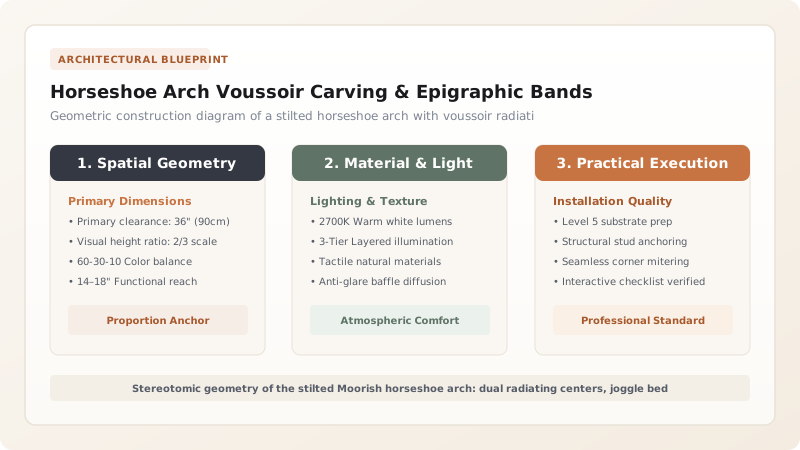
The horseshoe arch (arc outrepassé or arc en fer à cheval) is the quintessential structural and visual emblem of western Islamic architecture, perfected under the Umayyads of Cordoba and refined across seven centuries of Moroccan dynasty building. Unlike standard semicircular arches whose curve springs directly from the horizontal impost plane, the Moroccan horseshoe arch is "stilted"—its vertical center point is elevated above the impost line by a distance equal to one-sixth to one-third of the radius. Furthermore, the curvature does not cease at the horizontal diameter; it sweeps downward and inward past the 180-degree mark, creating its iconic keyhole silhouette.
This geometry introduces complex stereotomic demands. If voussoir bed joints were radiated from a single geometric center, the lower voussoirs would have acute, feather-edged angles that would instantly crush under compression. Moroccan master stonemasons (maalems) solved this by drafting a dual-center or multi-center layout on a full-scale plaster floor (épure). The upper voussoirs radiate from the true geometric center of the upper arc, while the inward-sloping lower voussoirs radiate from eccentric center points shifted laterally and downward. This ensures that every stone joint meets the curved intrados at a strict 90-degree right angle, maximizing compressive strength and eliminating edge-shearing stresses.
Joggle Joinery & The Physics of Arch Thrust
Because the lower voussoirs of a horseshoe arch slope inward toward the opening, gravitational loads and horizontal thrust create a tendency for the lower stones to slide downward into the void. To counteract this without relying on modern steel reinforcement, Moroccan stonecutters developed interlocking "joggle" joints—known in traditional French-Maghrebi stereotomy as claveaux à crossettes or claveaux engrenés. Rather than dressing the mating beds of the voussoirs as flat planes, the mason cuts stepped, curved, or tongue-and-groove profiles into the stone.
These interlocking keys physically bind each voussoir to its neighbor. When the central keystone (la clé d'arc) is driven home at the summit of the arch, the entire ring is placed into high compression. The joggle joints convert any inward sliding tendency into pure compressive force directed downward through the curve into the massive supporting jambs. To prevent point-loading and stone fracture caused by minute irregularities, the beds are not laid dry; they are bedded on thin lead shims and a fine paste of slaked fat lime, crushed marble dust, and washed river sand, which cures slowly by carbonation to create a monolithic, ductile stone ring.
Sacred Epigraphy: Laying Out Thuluth & Kufic Inscriptions
In Moroccan architectural stonecraft, the structural framework of the arch is inseparable from the sacred text it displays. The perimeter of the arch is framed by the alfiz—a rectangular masonry border enclosing the spandrels—which serves as the canvas for continuous calligraphic friezes. Two distinct script families dominate: archaic Kufic and classical Thuluth. Kufic, with its rigid vertical ascenders, right-angled geometries, and intricate floral terminals (foliated Kufic), is traditionally reserved for foundation dates and Quranic proclamations of divine unity. Thuluth, with its sinuous, overlapping ligatures and dynamic fluid ascenders, is used for poetic dedications and benedictions.
The execution of an epigraphic frieze across multiple stone blocks requires rigorous planning. The calligrapher drafts the continuous inscription onto full-scale paper scrolls. Crucially, the stone arch must be fully cut, numbered, and dry-assembled on the workshop floor before any carving begins. The paper cartoons are aligned over the stones, and the design is transferred using charcoal pounce bags dusted through pricked needle holes. By carving the script while the stones are temporarily clamped together, the carver guarantees that letterforms flow seamlessly across stone joints without the slightest visual break or alignment error when erected on site.
Chisel Techniques: Excavating the Ground & Modeling Letterforms
Carving epigraphic bands into fine-grained Taza limestone requires a deliberate progression of chisel work. The carver begins by outlining every letterform and floral flourish with a narrow, razor-sharp 10-millimeter flat chisel (ciseau droit) driven by light, controlled taps of a wooden mallet. The chisel is held at an angle of 75 degrees, cutting a clean, vertical incision approximately 2 millimeters deep into the stone. This initial scoring isolates the delicate edges of the letters, preventing accidental chipping or tearout when the adjacent background stone is removed.
Next, the carver excavates the background ground to a uniform depth of 15 to 25 millimeters using narrow gouges (gouges) and flat chisels. The excavated floor is textured with a multi-point hand punch, creating a rough, stippled surface that scatters light and provides a dark, non-reflective field. Finally, the carver returns to the raised letterforms, delicately beveling the edges and modeling the three-dimensional ribbons of the script. The high-relief letters catch the bright Moroccan sunlight, while the deep, shadowed background makes the sacred text stand out with breathtaking, sculptural legibility across the courtyard.
Stereotomic & Epigraphic Specifications for Moroccan Arches
Use this reference table to calculate exact physical dimensions, ratios, and specifications before purchasing:
| Arch Zone / Component | Stereotomic Geometry | Carving Motif / Script | Relief Depth | Joinery & Assembly |
|---|---|---|---|---|
| Impost & Springline Voussoirs | Inwardly inclined beds (<90° to vertical) | Geometric palmette rinceaux & strapwork | 12–15 mm relief | Dowel-pinned into abacus; lead shims on bed |
| Flank Voussoirs (Reins) | Eccentric radiating taper (dual-origin) | Foliated Kufic script with floral ascenders | 18–22 mm relief | Interlocking joggles (claveaux à crossettes) |
| Keystone (Clé d'arc) | Symmetrical vertical wedge profile | Central heraldic rosette or seal of Solomon | 25 mm high relief | Driven snugly with lime putty slurry; no dowels |
| Spandrel (Écoinçon) Panels | Flat rectangular ashlar infill slabs | Dense sebka interlacing with vegetal rinceaux | 15 mm relief | Concealed copper tie cramps into structural wall |
| Arch Framing Frieze (Alfiz) | Rectangular perimeter border frame | Continuous Thuluth Quranic inscription | 20 mm deep ground | Shiplapped bed joints; non-staining lime mortar |
Practical Constraints
Every successful decoration project must account for physical and environmental constraints:
Extreme outward horizontal thrust generated by wide-span horseshoe arches
Can cause spreading of supporting courtyard columns or portal jambs if unbraced. Mitigation: Integrate concealed cedar tie-beams (tirants) at the impost level or build massive stone abutments behind spandrels.
Fragility of delicate calligraphic ascenders during handling and stone hoisting
Chipping off the tips of letters (alifs and lams) ruins the sacred inscription permanently. Mitigation: Pack relief carving cavities with damp clay and cover carved faces with padded timber boards during transport.
Execution Blueprint & Craftsmanship Sequence
Execute this professional sequence to achieve flawless results without backtracking:
Full-Scale Stereotomic Drafting (Épure)
Draw the full-scale horseshoe arch geometry on a white-plaster floor, determining the stilt height, the inward curve below the center, and the radiating voussoir angles.
Template Fabrication & Stone Scribing
Cut rigid zinc or plywood templates for each unique voussoir, scribing the exact curved face, extrados, intrados, and bed joint angles onto squared Taza stone blocks.
Voussoir Sawing & Joggle Joint Cutting
Saw voussoirs along scribed bed lines; carve interlocking male and female joggle joints (crossettes) on mating beds to physically prevent lateral slippage under thrust.
Shop Dry-Assembly & Clamping
Assemble the complete arch dry on the workshop floor, locking all voussoirs tightly together with heavy timber framing to form a seamless, continuous stone surface.
Calligraphic Cartoon Pouncing & Scribing
Pounce full-scale calligraphic cartoons across the assembled stone arch with charcoal dust, scoring letter outlines into the limestone with a sharp steel scriber.
Relief Excavation & Letter Modeling
Chisel away the background stone to a depth of 20 mm using flat chisels and gouges, beveling letter contours and texturing the recess with a multi-point punch.
Timber Centering Erection & Hoisting
Erect curved timber falsework centering (cintre) in the architectural opening, resting the support posts on wooden sand boxes for controlled lowering.
Bedding, Keystoning & Controlled De-Centering
Bed voussoirs in pure slaked lime mortar over the centering, drive the central keystone snugly, cure for 14 days, and drain the sand boxes to ease the arch into compression.
Common Mistakes & Countermeasures
Avoid these costly errors that compromise aesthetics, ergonomics, and budget:
Radiating all arch voussoir joints from a single central focus point
Carving calligraphic inscriptions across individual voussoirs before dry-fitting the arch
Failing to provide sand-box lowering jacks beneath timber arch centering
Project Execution Checklist
Track your physical progress. Checkboxes persist automatically on this device:
Frequently Asked Questions
What are joggle joints (claveaux à crossettes) and why are they used in horseshoe arches?
Joggle joints are interlocking tongue-and-groove or stepped profiles cut into the mating bed faces of adjacent voussoirs. In a horseshoe arch, where the lower voussoirs curve inward toward the opening, gravity and lateral thrust exert shearing forces that could cause individual stones to slip inward. Joggle joints physically interlock the voussoirs like three-dimensional puzzle pieces, preventing slippage and transferring load across the entire arch ring without relying on mortar adhesion.
What is the cultural and architectural role of the alfiz frame in Moroccan portals?
The alfiz is a rectangular architectural molding that encloses the outer curve of a horseshoe arch, creating triangular spandrel spaces (écoinçons) between the circle of the arch and the square of the frame. In Moroccan stonecraft, the horizontal and vertical bands of the alfiz are almost always carved with continuous epigraphic inscriptions in Thuluth script. It symbolizes the cosmological transition from the earthly terrestrial square to the celestial spiritual circle of the arch.
How is Thuluth script carved differently than Kufic script in Taza limestone?
Kufic is an archaic, rectilinear, geometric script with strong horizontal baselines, right-angled corners, and floral terminal flourishes (foliated Kufic), requiring precise straight-line chiseling with flat firming chisels. Thuluth is a fluid, sweeping, cursive script characterized by soaring vertical ascenders (alifs and lams) that interlace with sweeping, rounded descenders. Carving Thuluth requires curved gouges and skew chisels to model three-dimensional undulating ribbons with subtle changes in surface elevation.