
Natural Mineral Cobalt Blue and Antimony Pigment Brushing represents the artistic zenith of Mexican Talavera decoration. Painted onto raw, unfired white tin enamel with long-bristled horsehair brushes, master decorators work freehand without preliminary pencil sketches. Using authentic mineral oxides—most celebrated is royal cobalt blue (azul fino), accompanied by antimony yellow, copper green, and iron orange—the artist loads the brush heavily, depositing thick beads of mineral slip. In the glost kiln at 1050°C, the cobalt dissolves into the melting tin glass, rising in signature tactile three-dimensional relief ridges.
At a Glance: Key Takeaways
- Azul Fino (Royal Cobalt Blue): Pure cobalt oxide ground with glass flux, firing to an intense oceanic sapphire hue.
- Azul Claro (Light Cobalt Blue): Washed, diluted cobalt wash creating atmospheric watercolor shading.
- Amarillo Antimonio (Antimony Yellow): Brilliant golden yellow derived from calcined antimony and lead oxides.
- Raised Relief Painting (Gota Gorda): Heavy brush loading leaving raised mineral ridges palpable to the touch after firing.
- Unfired Tin Enamel Canvas: Painting directly onto powdery, absorbent unfired white glaze with zero room for error.
- Glost Vitrification at 1050°C: Fusing metallic chromophores into an unscratchable, lightfast vitreous glass glaze.
1. Color Chemistry: Natural Mineral Chromophores
Unlike modern industrial ceramics decorated with screen-printed synthetic stains, authentic Talavera Poblana permits strictly six natural mineral pigments derived from inorganic ores calcined in the workshop:
- Azul Fino (Dark Cobalt Blue): Prepared from cobalt oxide (CoO) or smalt imported historically from Saxony and Spain; high concentrations create a deep, imperial midnight blue.
- Azul Claro (Light Blue): The same cobalt oxide diluted with white enamel slip, creating a soft, translucent sky blue.
- Amarillo (Antimony Yellow): Prepared by roasting antimony sulfide with lead oxide, producing Naples yellow (lead antimonate), a brilliant, opaque golden yellow.
- Verde (Emerald Green): Copper carbonate or copper oxide, yielding rich leaf greens.
- Almagre (Orange): Calcined red iron oxide blended with antimony.
- Negro (Black): Manganese dioxide combined with iron oxide soot.
2. Calligraphic Technique: Painting the Raised Gota Gorda
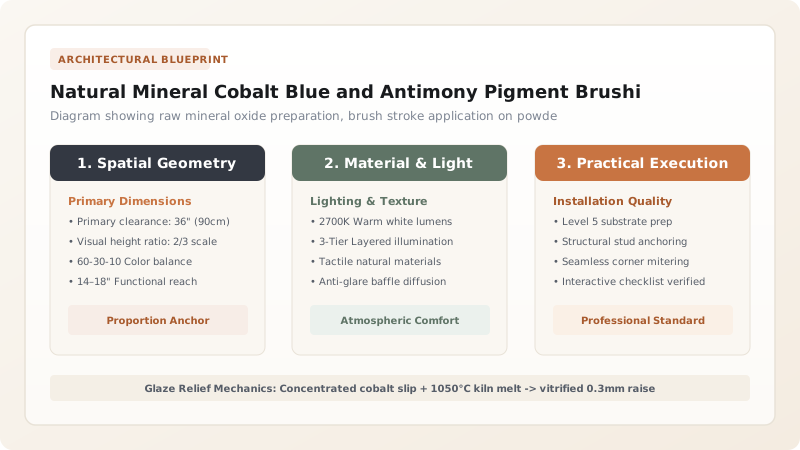
The defining physical signature of authentic Talavera is its raised relief brushwork (gota gorda / fat drop). If you run your fingers across an authentic Talavera tile, the blue lines do not feel flat; they stand up in palpable, rounded ridges 0.2mm to 0.4mm proud of the white background.
Decorators achieve this through specialized brushwork. Using long, supple brushes crafted from natural horse mane or ox ear hair, the painter scoops up a heavy droplet of viscous cobalt slip. Moving across the tile without resting the wrist on the fragile powder, the artisan lets the liquid slip flow off the tip of the brush in a continuous, thick bead. In the kiln, the high mineral density prevents the blue slip from flattening completely, preserving the sculptural relief.
3. Thermal Fusion: The 1050°C Glost Transformation
Decorated tiles are stacked inside the kiln inside cylindrical refractory clay saggars (cajas de barro) or on kiln shelves separated by ceramic pins to shield them from wood ash and direct flame impingement.
The kiln is brought up over 12 hours to a peak temperature of 1050°C (Pyrometric Cone 04 to 03). At this temperature, the chalky white tin glaze and the painted mineral oxides melt simultaneously into a boiling, bubbling sea of liquid glass. The cobalt and antimony dissolve into the silicate flux. As the kiln soaks and slowly cools over 36 hours, the bubbles heal, leaving a mirror-smooth, high-gloss glass revetment that permanently encapsulates the colors.
Talavera Mineral Pigment Chemistry & Visual Relief Standards
Use this reference table to calculate exact physical dimensions, ratios, and specifications before purchasing:
| Pigment Hue | Active Metal Ion | Preparation & Milling | Glost Firing Behavior | Finished Surface Relief |
|---|---|---|---|---|
| Azul Fino (Dark Blue) | Co2+ (Cobalt silicate) | Milled with glass frit for 24 hrs | Dissolves partially; high viscosity | Prominent raised 0.3mm relief ridge |
| Azul Claro (Light Blue) | Co2+ (Diluted cobalt) | Blended 1:4 with white glaze slip | Flows smooth and level | Flat, semi-transparent watercolor wash |
| Amarillo (Yellow) | Sb3+ (Lead antimonate) | Calcined antimony oxide + litharge | Opaque, dense glass fusion | Semi-raised smooth glossy bead |
| Verde (Green) | Cu2+ (Copper silicate) | Copper shavings reacted with vinegar | Fluid glass; slight micro-crazing | Glass-smooth translucent emerald pool |
| Negro (Black) | Mn4+ / Fe3+ (Manganese/Iron) | Pyrolusite ore + lampblack | Refractory; low flow | Crisp matte-to-satin outline calligraphy |
Artistic & Atmospheric Constraints
Every successful decoration project must account for physical and environmental constraints:
Zero Error Tolerance
Painting on raw, absorbent tin powder cannot be erased; a single slip of the brush permanently ruins the tile, requiring it to be washed and re-dipped.
Kiln Atmosphere Cleanliness
Smoke or soot entering the saggars during firing reduces copper green to dull brown and clouds the white tin glaze.
Protocol for Freehand Mineral Painting and Glost Firing
Execute this professional sequence to achieve flawless results without backtracking:
White Enamel Dipping & Air Dry
Submerge porous bisque tile into stirred tin-lead glaze suspension; dry 24 hours until chalky white, powdery surface forms.
Charcoal Pounce Transfer (Optional)
For complex repeating patterns, lightly pounce charcoal dust through pricked paper cartoon to transfer faint geometric coordinates.
Cobalt Pigment Grinding
Grind pure cobalt oxide with pure water and a drop of gum arabic on glass slab until consistency of thick cream is achieved.
Freehand Gota Gorda Painting
Load long horsehair brush heavily with cobalt slip; paint scrolls in flowing, confident strokes without touching white powder with hand.
Kiln Loading in Saggars
Place painted tiles inside refractory clay saggars; separate tiles with three-point ceramic stilts to prevent glaze adhesion.
1050°C Glost Firing Cycle
Fire kiln to 1050°C over 12 hours in oxidizing atmosphere; soak 1 hour; shut dampers and anneal slowly for 36 hours before opening.
Common Mistakes & Countermeasures
Avoid these costly errors that compromise aesthetics, ergonomics, and budget:
Touching the white powdered glaze with fingers before or during painting
Using commercial synthetic ceramic stains instead of pure metallic mineral oxides
Project Execution Checklist
Track your physical progress. Checkboxes persist automatically on this device:
Frequently Asked Questions
Why was cobalt blue historically the dominant color on Puebla Talavera?
In colonial Mexico, cobalt oxide had to be imported from Europe at extraordinary expense. Under the 1653 potters' guild ordinances, master potters were required to decorate luxury first-class wares (loza fina) heavily with cobalt blue to prove their patron's wealth. The more cobalt applied in thick raised relief, the more expensive and prestigious the tile was.
Why do Talavera decorators paint freehand without guidelines?
The powdery, unfired tin glaze is extraordinarily delicate; drawing with a pencil or metal stylus would scrape off the powdery white enamel and ruin the biscuit. Master painters train for ten years to memorize complex Baroque floral and geometric repertoires, executing thousands of identical tiles freehand with remarkable speed and fluid confidence.


