
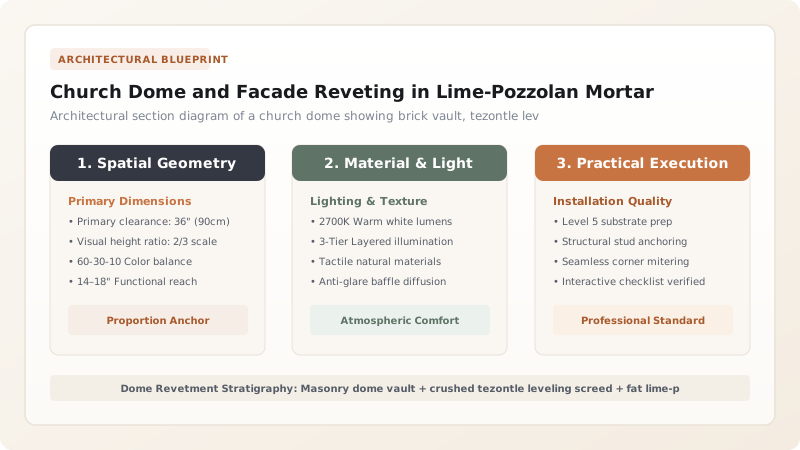
Church Dome and Facade Reveting in Lime-Pozzolan Mortar represents the monumental architectural execution of Mexican Talavera. Covering the sweeping hemispherical domes, drum lanterns, and towering facades of Puebla and Mexico City, tiles were bedded across complex curvilinear masonry surfaces in dazzling geometric zigzags and chevron diamonds. Master masons set each tile in a flexible, vapor-permeable mortar formulated from fat slaked quicklime and crushed volcanic scoria (tezontle), creating an elastic, earthquake-proof ceramic revetment that repels tropical rains while absorbing seismic tremors.
At a Glance: Key Takeaways
- Curvilinear Dome Revetment: Scribing and tiling double-curved hemispherical masonry vaults and bell towers.
- Tezontle Volcanic Pozzolan Mortar: Blending fat lime with crushed cellular red volcanic rock for lightweight hydraulic strength.
- Geometric Chevron & Diamond Tessellations: Alternating yellow, white, and blue tiles in radiating sunburst patterns.
- Drip-Lap Joint Geometry: Setting tiles on domes with slight overlapping falls to shed monsoon rainwater downward.
- Seismic Shear Flexibility: High-elasticity lime-pozzolan beds preventing tile spalling during severe Mexican subduction earthquakes.
- High-Altitude UV & Weather Resistance: Vitrified glass glazes defying intense 2,200m altitude solar degradation for centuries.
1. Sacred Geometry: The Dome as the Crown of the City
In colonial Puebla, over 70 Catholic churches puncture the skyline, each crowned with one or more dazzling ceramic domes. Tiling a hemispherical dome presents an extreme stereotomic challenge: a flat square tile cannot naturally cover a compound spherical curve without gaping joints.
Mexican masons solved this through polar coordinate tessellation. Domes are divided into vertical segments (ribs or gajos) that converge at the top lantern. Masons laid tiles in radiating zigzag zigzags, concentric diamond bands, and chevron scales. As courses ascended toward the apex, tiles were custom-chiseled with tapered sides, creating the optical illusion of dynamic, spinning celestial movement under the radiant Mexican sun.
2. Material Science: The Tezontle Volcanic Mortar Bed
Covering thousands of square meters of high-elevation domes with heavy ceramic tiles poses severe structural weight and adhesion challenges. Standard sand-cement mortar is heavy, rigid, and cracks under thermal expansion.
Colonial builders utilized tezontle, a porous, vesicular red basaltic scoria unique to the volcanic Trans-Mexican Volcanic Belt. Crushed into fine gravel and sand, tezontle is extraordinarily lightweight (saving up to 40% dead weight on vaults) and acts as an active natural pozzolan. When blended with fat slaked lime putty, the reactive volcanic glass forms a flexible hydraulic bond with low modulus of elasticity that grips the porous tile biscuit like an iron fist while allowing thermal breathing.
3. Environmental Dynamics: Defeating Earthquakes and Monsoons
Central Mexico is one of the most seismically violent regions on Earth, subject to massive subduction-zone earthquakes from the Cocos Plate. If dome tiles were set in brittle modern cement, seismic wave vibrations would snap the bond, showering city streets with deadly tile shrapnel.
The fat lime-tezontle matrix possesses natural micro-ductility. The matrix deforms plastically under seismic shear, dissipating kinetic energy through microscopic internal friction. Furthermore, on dome surfaces, tiles are laid with a subtle 2mm overlapping step (shingle fall) from top to bottom, ensuring that torrential summer monsoon downpours cascade off the glassy glaze like scales on a fish, completely protecting the structural brick vault beneath.
Mexican Architectural Ceramic Facade Setting Standards
Use this reference table to calculate exact physical dimensions, ratios, and specifications before purchasing:
| Architectural Zone | Tile Geometry & Dimensions | Setting Mortar Formulation | Joint Width (mm) | Environmental Exposure |
|---|---|---|---|---|
| Hemispherical Dome (Cúpula) | 150x150mm tapered diamonds | 1 Lime Putty : 2 Crushed Tezontle | 2mm - 3mm shingled lap | Torrential rain & intense UV radiation |
| Lantern & Finials (Linternilla) | Specialized molded curved tiles | 1 Lime : 1.5 Fine Pozzolana sand | Hairline (< 1.5mm) | Extreme windward shear & lightning |
| Church Facade (Fachada) | 100x100mm & 150x150mm squares | 1 Lime Putty : 2.5 River sand | 1.5mm - 2mm flat joints | Urban pedestrian scuff & seismic vibration |
| Bell Tower Drum (Campanario) | Hexagonal alfardón tiles | 1 Lime : 2 Tezontle + brick dust | 2mm flush pointed | Driving rain & bell harmonic resonance |
Safety & Altitude Constraints
Every successful decoration project must account for physical and environmental constraints:
Severe Dome Fall Hazards
Working on a 30-meter high 60° curved dome requires specialized curved pipe scaffolding, harness lines, and tethered tool bags.
Earthquake Safety Protocols
Following any regional seismic tremor > 6.0 Richter, historic tiled domes must undergo drone inspection to identify loosened tiles.
Protocol for Reveting a Curvilinear Masonry Dome in Talavera
Execute this professional sequence to achieve flawless results without backtracking:
Dome Vault Surface Preparation
Rake out brick mortar joints 20mm; wash vault with water; apply rough scratch coat of lime-tezontle mortar; allow 14 days cure.
Polar Axis String Layout
Attach central compass arm at dome apex lantern; snap vertical meridional guide lines dividing dome into 12 symmetrical triangular ribs (gajos).
Tile Pre-Soaking & Taper Dressing
Submerge jahuete tiles in clean water for 30 minutes; chisel sides of upper-course tiles with diamond nippers to follow dome taper.
Tezontle Pozzolan Mortar Bedding
Mix fat lime putty with screened 2mm red tezontle volcanic aggregate; apply 20mm bed across bottom dome base ring.
Concentric Ring Tile Setting
Bed tiles ascending in concentric rings; tap flush with wooden paddle; maintain subtle 2mm outward shingle fall to shed water downward.
Pure Lime Putty Grouting
Grout joints with creamy slaked lime and volcanic ash slurry; wipe glazed tile faces clean immediately with wet burlap.
Common Mistakes & Countermeasures
Avoid these costly errors that compromise aesthetics, ergonomics, and budget:
Using gray Portland cement mortar to bed Talavera tiles on historic church domes
Laying flat square tiles on a dome without custom tapering
Project Execution Checklist
Track your physical progress. Checkboxes persist automatically on this device:
Frequently Asked Questions
How do Talavera tiled domes resist centuries of volcanic ash and acid rain?
The glost firing of Talavera at 1050°C fuses the glaze into an impermeable, high-density aluminosilicate glass. Glass is completely inert to acidic volcanic gases, sulfur dioxide, and acid rain. When ash from Popocatépetl covers the dome, the smooth glass surface prevents ash from adhering; the first monsoon rain washes the dome completely clean, restoring its sparkling brilliance without human intervention.
What is 'tezontle' and why was it so important in colonial Mexican architecture?
Tezontle is a highly vesicular, porous, iron-rich volcanic basalt rock found throughout the Valley of Mexico and Puebla. Because it is filled with thousands of tiny gas bubbles formed during volcanic eruption, it is lightweight, easy to chisel, and exhibits natural pozzolanic reactivity when ground with lime. Colonial architects built entire palace walls from red tezontle to reduce structural weight on spongy lakebed soils.


