
Cladding exterior church domes (cúpulas) and courtyard patios in Talavera azulejos requires breathable, moisture-regulating masonry systems. Because glazed tiles have zero vapor permeability on their top face, all building moisture must escape through the joints and mortar bed. Master restorers utilize non-hydraulic fat lime or natural hydraulic lime (NHL 2) blended with volcanic tezontle aggregate and river sand. Tiles are set with wide 4mm to 6mm breathable joints, preventing hydrostatic pressure buildup and frost-induced glaze delamination.
At a Glance: Key Takeaways
- Bedding Mortar: 1 Part Natural Hydraulic Lime (NHL 2) : 2.5 Parts Sharp Sand + Tezontle
- Joint Width: 4mm to 6mm breathable lime-grout joints
- Radial Dome Geometry: Tapered trapezoidal tiles tailored to spherical dome radius
- Substrate: Fired brick masonry vaulting or stone masonry walls
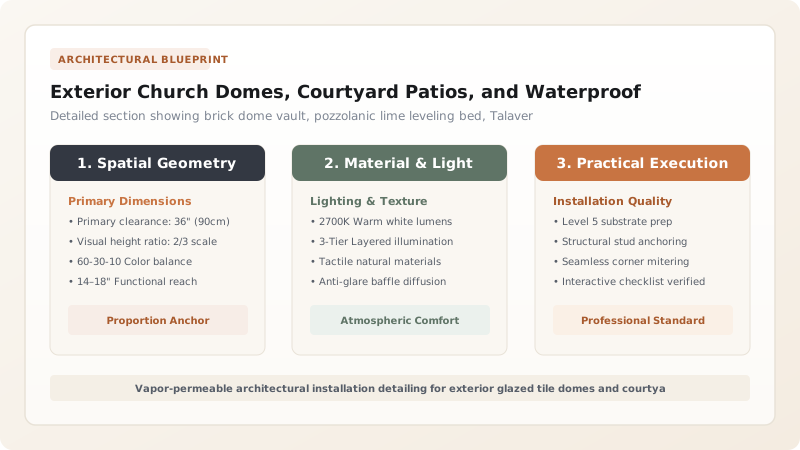
Hyrothermal Dynamics and Vapor Trapping in Glazed Facades
Cladding exterior masonry in vitrified glazed ceramics presents a significant building-physics challenge. While the impenetrable tin-glaze surface creates an exceptional barrier against driving rain, it also forms a total vapor barrier on the exterior face. Any moisture migrating through the interior dome vaults can become trapped directly behind the tiles.
If modern Portland cement or polymer thin-set mortars are used, trapped condensation cannot evaporate. In cold weather, this water expands as ice, exerting tremendous hydraulic cleavage pressures that pop tiles off the dome or spall the entire glazed face. Authentic installations solve this problem through vapor-permeable hydraulic lime bedding.
Natural Hydraulic Lime and Volcanic Tezontle Mortar Formulations
The traditional bedding mortar combines natural hydraulic lime (NHL 2 or NHL 3.5) with coarse, sharp silica sand and finely crushed tezontle—a porous, lightweight reddish volcanic basalt native to the Mexican highlands. The tezontle acts as a natural pozzolan, increasing flexural elasticity and reducing the overall deadweight of the mortar bed on the vaulting.
This mortar matrix remains microporous, allowing internal humidity to breathe laterally outward through open grout joints. Under thermal cycling on sun-drenched domes, the flexible lime accommodates differential expansion between the clay tiles and the brick substrate without breaking adhesion.
Spherical Geometry: Radial Tranches and Chevron Setting
A church dome is a compound three-dimensional curve. Standard square tiles cannot be laid continuously up a spherical dome without creating excessively wide, tapering mortar gaps toward the base. Historic Poblano architects solved this through rigorous geometric paneling.
The dome is divided into vertical gore segments (gajos) separated by raised brick ribs. Within each segment, azulejos are arranged in dynamic zigzags, chevrons, or diamond diapers. For tightly curved lanterns (linternillas) and upper dome tiers, custom trapezoidal tiles are commissioned to maintain uniform 5mm grout seams from springline to apex.
Patio Pavements, Fountains, and Heritage Conservation
In palatial colonial courtyards, Talavera tiles adorn fountain basins, stair risers, and bench dados. For horizontal courtyard pavements subject to foot traffic, thicker 20mm quarry-grade tiles are employed, bedded over well-drained volcanic cinder sub-bases.
Conservation of historic azulejo installations prohibits abrasive pressure washing or harsh chemical acids that etch the delicate tin glaze. Biological growth (moss, lichens) is treated with gentle biocidal compresses (such as quaternary ammonium compounds buffered at pH 7.5), followed by repointing missing lime grout with matching hydraulic lime-tezontle mixes.
Talavera Architectural Setting & Mortar Matrix
Use this reference table to calculate exact physical dimensions, ratios, and specifications before purchasing:
| Architectural Zone | Substrate Type | Mortar Binder Spec | Joint Width | Waterproofing Mechanism |
|---|---|---|---|---|
| Spherical Church Dome | Fired Clay Brick Masonry | NHL 2 : Sand : Tezontle (1:2:0.5) | 4mm – 6mm | Vapor-permeable lateral lime joint breathing |
| Dome Lantern (Linternilla) | Curved Cut Brick / Stone | Lime Putty + Metakaolin (1:1.5) | 3mm – 4mm | Hydraulic pozzolanic micro-sealing |
| Courtyard Fountain Basin | Dense Lime Concrete Core | NHL 3.5 + Ground Terracotta Grog | 3mm – 5mm | Submerged pozzolanic insoluble set |
| Patio Dado Wall / Risers | Adobe / Colonial Brick Wall | Aged Non-Hydraulic Lime Putty | 4mm – 5mm | Breathable evaporative wall fringe |
Practical Constraints
Every successful decoration project must account for physical and environmental constraints:
Scaffolding Safety on Steep Colonial Church Domes
Working on steep spherical vaults at 30-meter heights requires specialized radial ring-scaffolding anchored to dome tie points.
Extreme Solar Surface Temperatures in Highland Mexico
Tiles exposed to direct tropical sun at 2,200m altitude expand significantly, requiring dedicated expansion breaks at dome quadrant ribs.
Execution Blueprint & Craftsmanship Sequence
Execute this professional sequence to achieve flawless results without backtracking:
Substrate Preparation and De-Salting
Inspect brick dome masonry for efflorescence or structural cracks; apply sacrificial clay poultices to extract destructive sub-surface salts.
Pozzolanic Scratch Coat Application
Apply an 8mm roughing coat of hydraulic lime and crushed volcanic tezontle over the pre-wetted brick vault, scratching horizontal keying grooves.
Radial Layout and String Guide Snapping
Establish the vertical centerlines of each dome segment with plumb bobs, snapping radial chalk guides from base springline to dome crown.
Tile Pre-Soaking and Buttering
Submerge Talavera tiles in clean water for 30 minutes to saturate suction pores; back-butter each tile with 10mm of fresh hydraulic lime mortar.
Tile Setting and Alignment
Press tiles firmly into the mortar bed with slight twisting motions, checking alignment with curved wooden templates and inserting 5mm wooden spacers.
Hydraulic Lime Grouting and Mist Curing
Fill joints flush with fine lime-sand grout; clean glaze faces with damp sponge and maintain wet hessian curing screens for 14 days.
Common Mistakes & Countermeasures
Avoid these costly errors that compromise aesthetics, ergonomics, and budget:
Setting Exterior Tiles with Modern Portland Cement Thin-Set
Installing Tiles Bone-Dry Directly from Storage Crates
Project Execution Checklist
Track your physical progress. Checkboxes persist automatically on this device:
Frequently Asked Questions
Why do Talavera tiles on exterior church domes rarely crack from frost?
Puebla's high-altitude climate rarely experiences sustained sub-zero temperatures, and the combination of porous terracotta backing and breathable lime-tezontle joints allows moisture to evaporate rapidly before freezing can occur.
Can missing tiles on an 18th-century dome be replaced with modern replicas?
Yes. Certified Talavera workshops routinely craft bespoke replacement tiles matched to historic curved profiles, original tin-glaze thickness, and weathered mineral color tones.


