
Talavera Poblana is an authentic Mexican tin-glazed ceramic tradition protected by a strict Denomination of Origin (DO, NOM-132-SCFI-1998) in Puebla. Originating in the 16th century through the synthesis of Spanish Talavera de la Reina majolica, indigenous Mesoamerican clay craftsmanship, and Asian porcelain motifs, Talavera facades define baroque churches, palatial patios, and public fountains. Made from a 50/50 blend of black and white local clays foot-trodden and wheel-thrown or pressed, Talavera tiles feature an opaque tin-lead glaze decorated with relief cobalt brushwork (atecolado) using only six traditional mineral pigments.
At a Glance: Key Takeaways
- Clay Formulation: 50% Barro Negro (Black Clay) + 50% Barro Blanco (White Clay)
- Geographic DO: Puebla and surrounding municipalities (NOM-132-SCFI-1998)
- Glaze Technology: Tin-lead majolica glaze opacified with calcined tin oxide (SnO2)
- Official Palette: Strictly 6 mineral pigments: Cobalt, Orange, Yellow, Green, Black, Rust
In-Depth Guides in this Directory
Explore specialized subtopic blueprints, technical dimensions, and execution checklists:
Black and White Clay Blending, Foot Treading, and Tin-Lead Glaze Formulations in Talavera
Technical manual on Puebla clay mineralogy, manual foot treading, aging cellars, and calcined tin-lead majolica glaze compounding.
Cobalt Blue Relief Brushwork (Atecolado) and the Six Regulatory Guild Colors of Talavera Poblana
Master guide to Talavera Poblana atecolado cobalt relief brushwork, pounce stencil transfers, and the six mandatory mineral colors codified by Mexican DO regulations.
Exterior Church Domes, Courtyard Patios, and Waterproof Hydraulic Lime Bedding of Talavera Azulejos
Comprehensive engineering manual on architectural installation of Talavera azulejos on exterior baroque church domes, courtyard patios, and breathable hydraulic lime bedding.
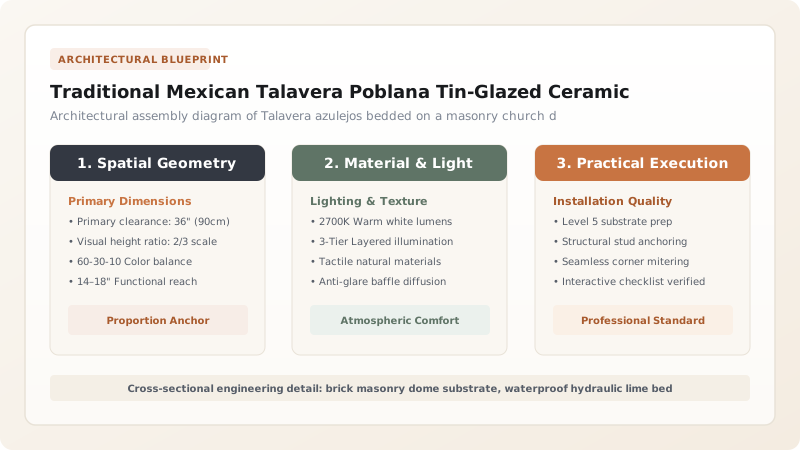
Colonial Genesis and the Legal Denomination of Origin (DO)
When Spanish master potters established guilds in Puebla de los Ángeles around 1580, they encountered exceptional volcanic clay beds and indigenous potters possessing generations of ceramic expertise. By combining Andalusian tin-glaze (majolica) pyrotechnology with local clays and Asian decorative influences imported via the Manila Galleons, Puebla gave birth to Talavera Poblana.
Today, authentic Talavera is strictly governed by Mexican Federal Standard NOM-132-SCFI-1998 and holds UNESCO Intangible Cultural Heritage status. To bear the official DO seal, tiles must be produced exclusively within designated municipalities in Puebla and Tlaxcala, using 100% hand-crafted methods, natural local clays, and mineral pigments without modern chemical driers or decal transfers.
Material Science: Black and White Clay Blending and Maturation
The unique mechanical resilience of Talavera begins with the blending of two distinct regional clays: barro negro (black clay harvested from Loreto), which provides high plasticity and tensile strength, and barro blanco (white clay from San Jerónimo Caleras), which contributes calcium carbonate, reduces drying shrinkage, and prevents warping.
The two clays are mixed in exact 1:1 proportions, submerged in outdoor settling tanks, and foot-trodden by specialized artisans (pisadores) for hours to eliminate internal air pockets. The clay is then aged in damp subterranean dark rooms for up to six months. Architectural tiles are molded by hand in wooden frames, slowly air-dried under burlap for 60 to 90 days, and fired in the first bisque stage (jaguete) at 850°C.
Majolica Pyrotechnology: Tin-Opacified Enamel and Atecolado Relief
The bisque tiles are dipped into a liquid raw glaze slurry composed of silica sand, potassium feldspar, and a calcined frit of metallic tin and lead (approx. 1 part tin to 4 parts lead). The tin oxide (SnO2) acts as an opacifier, transforming what would be a transparent glass into the iconic milky-white, opaque porcelain-like ground characteristic of authentic majolica.
Decoration is painted entirely freehand onto the powdery raw glaze using natural horsehair or mule-tail brushes. The hallmark of fine Talavera is atecolado—thick, raised relief brushwork executed in pure blue cobalt oxide. When fired during the second glaze kiln cycle at 1050°C, the thick cobalt gathers vitrify into raised glassy mounds that can be felt by running fingers across the glazed tile face.
Architectural Installation: Baroque Domes, Patios, and Heritage Conservation
Talavera’s most dramatic architectural expression appears across the gleaming exterior domes (cúpulas) of central Mexico. Domes such as Santa María Tonantzintla and the Puebla Cathedral incorporate curved yellow, blue, and white tiles arranged in radiating zigzag chevron patterns that resist blistering high-altitude ultraviolet radiation.
Installing tiles on curved exterior domes requires breathable, non-hydraulic or moderately hydraulic lime mortars (NHL 2) mixed with volcanic pozzolan (tezontle). Modern cement mortars must be avoided as their high moisture retention and soluble salts cause glaze delamination. Periodic maintenance consists of gentle water washing and repointing eroded lime grout joints.
Talavera Poblana Architectural Tile Grading & Specifications
Use this reference table to calculate exact physical dimensions, ratios, and specifications before purchasing:
| Tile Application | Standard Dimensions | Clay Formulation | Glaze Firing Cone | Anchorage Bedding |
|---|---|---|---|---|
| Church Dome Cúpula Tile | 10cm × 10cm (curved profile) | 50/50 Black/White Clay | Cone 04 (1050°C) | NHL 2 hydraulic lime + pulverized tezontle |
| Palatial Courtyard Azulejo | 15cm × 15cm × 15mm thick | 50/50 Black/White Clay | Cone 04 (1050°C) | Pure lime putty + coarse quartz sand |
| Relief Dado Border (Listel) | 5cm × 15cm × 18mm thick | Aged dense clay blend | Cone 04 (1050°C) | High-suction lime butter bed |
| Fountain Basin Lining Tile | 10cm × 10cm × 12mm thick | High-iron vitrified body | Cone 03 (1080°C) | Waterproof pozzolanic hydraulic mortar |
Practical Constraints
Every successful decoration project must account for physical and environmental constraints:
Strict Environmental and Health Standards for Lead Release
While exterior architectural tiles retain authentic tin-lead frits, culinary wares must comply with strict non-toxic lead-leaching standards.
Curvature Variations on Historic Spherical Domes
Spherical church domes require custom radial wedge tiles shaped individually to avoid wide, vulnerable mortar joints at the apex.
Execution Blueprint & Craftsmanship Sequence
Execute this professional sequence to achieve flawless results without backtracking:
Clay Harvesting and 50/50 Blending
Combine equal volumes of Loreto black clay and San Jerónimo white clay; soak in water tanks and foot-tread until fully homogenized.
Molding and Extended Air-Drying
Press clay into wooden tile molds, strike flush with wire bows, and dry slowly inside shade-controlled drying rooms for 60 to 90 days.
First Bisque Firing (Jaguete)
Load bone-dry tiles into traditional gas or wood kilns; fire slowly to 850°C over 10 hours, creating porous terracotta bisque.
Tin-Opacified Raw Glaze Dipping
Submerge bisque tiles in liquid tin-lead glaze slurry; allow the water to absorb instantly into the porous tile, leaving a powdery white enamel coat.
Pouncing and Relief Cobalt Painting (Atecolado)
Transfer designs via charcoal pounce stencils; paint relief motifs in dense cobalt oxide and traditional mineral pigments using mule-hair brushes.
Second Glaze Firing and Quality Certification
Fire tiles to 1050°C for 30 hours; inspect finished tiles for authentic crazing, relief thickness, and stamp the workshop DO registration mark.
Common Mistakes & Countermeasures
Avoid these costly errors that compromise aesthetics, ergonomics, and budget:
Using Commercial Chemical Pigments or Decal Transfers
Bedding Exterior Facade Tiles in Portland Cement
Rushing the 60-Day Clay Drying Phase
Project Execution Checklist
Track your physical progress. Checkboxes persist automatically on this device:
Frequently Asked Questions
What is the origin of the name 'Talavera' in Mexico?
The technique was imported from Talavera de la Reina in Toledo, Spain, where master ceramicists produced Spanish majolica. In Puebla, the style evolved into an independent tradition renowned for thicker clay bodies and heavy cobalt relief.
How do you verify authentic Talavera Poblana from counterfeit ceramics?
Authentic Talavera has a visible red-terracotta unglazed base, palpable raised cobalt relief (atecolado), fine micro-crazing in the milky-white tin glaze, and the official workshop signature and DO certification number hand-inscribed on the back.
Why are Talavera tiles so widely used on Mexican church domes?
The reflective tin glaze sheds heavy tropical rains and reflects intense solar heat, protecting the underlying brick vaulting from thermal shock and moisture ingress while serving as a radiant beacon visible across the Puebla valley.


