Traditional Mexican Santa Clara hammered silver and pewter is a celebrated metallurgical art from Santa Clara del Cobre and Michoacán. Rooted in indigenous Purépecha metalworking and Spanish Colonial Baroque repujado, artisans hand-hammer sheets of silver and lead-free pewter over chaser’s pitch bowls, using specialty steel punches and chisels to sculpt high-relief architectural mirror frames, retablos, and lanterns with rich oxidized patinas.
At a Glance: Key Takeaways
- Center of Excellence: Santa Clara del Cobre & Pátzcuaro, Michoacán, Mexico
- Indigenous Origins: Pre-Hispanic Purépecha (Tarascan) metallurgical traditions
- Primary Alloys: Sterling silver (.925 Ag) and architectural lead-free pewter (tin-antimony-copper)
- Core Techniques: Repujado (repoussé & chasing), planishing, hand-hammered raising, pitch bowl tooling
- Iconic Applications: Arched colonial mirror frames (espejos), decorative coronas, retablo panels, lanterns
In-Depth Guides in this Directory
Explore specialized subtopic blueprints, technical dimensions, and execution checklists:
Repoussé Pitch Bowl Embossing & Chasing Chisel Linework: Chasers Pitch, Punches & Plastic Flow
Master Mexican repoussé and chasing techniques: chaser’s pitch bowl compounding, reverse embossing, and steel punch linework on silver and pewter.
Sterling Silver & Pewter Architectural Mirror Framing: Joinery, Wooden Substrates & Tinwork Accents
Crafting Mexican colonial architectural mirror frames: solid pine carcasses, repujado sheet metal wrapping, mitered joinery, and arched coronas.
Flame-Torch Annealing & Liver of Sulfur Antiqued Patinas: Work Hardening, Oxidation & Carnauba Sealing
Guide to flame-torch annealing and liver of sulfur patinas in Mexican metalcraft: crystal recovery, chemical oxidation, highlight relieving, and wax sealing.
Metallurgical Legacy of the Purépecha Craftsmen in Santa Clara del Cobre
In the misty pine highlands of Michoacán, Mexico, surrounding the volcanic basin of Lake Pátzcuaro, stands Santa Clara del Cobre—a town that echoes with the hypnotic, rhythmic ringing of hundreds of anvils. Long before Hernán Cortés landed on the shores of Veracruz, the indigenous Purépecha (Tarascan) people were the most advanced metallurgists in Mesoamerica. While the Aztecs focused primarily on ceremonial gold and feathers, the Purépecha mastered the smelting, cold-hammering, and alloy casting of copper and silver, forging sacred ritual discs, axes, and musical bells (cascabeles).
Following the Spanish conquest in the 1530s, the visionary humanist bishop Vasco de Quiroga transformed Michoacán into an archipelago of specialized artisan villages. Santa Clara was designated as the exclusive center of metallurgy. Spanish smiths introduced bellows-driven brick forges, iron pitch bowls, and European Baroque metal-embossing techniques known across Latin America as repujado. Over five centuries, local master coppersmiths and silversmiths fused indigenous metallurgical genius with Spanish Colonial decorative exuberance, creating an unbroken tradition of architectural metalcraft celebrated worldwide.
Repoussé and Chasing (Repujado y Cincelado) Mechanics on Sheet Metal
The technical foundation of Mexican hammered silver and pewter is the classical two-phase sculpting technique of repoussé (embossing from behind) and chasing (surface detailing from the front). Rather than cutting away metal like a stone carver, the metalworker manipulates sheet metal through plastic deformation. The sheet is mounted into a cast iron hemispherical pitch bowl (tazón de brea) filled with a dense, elastic mixture of pine rosin, pulverized brick dust, and tallow.
This pitch bed provides an indispensable physical support: it yields under hammer blows to allow the metal to stretch into deep volumetric curves, while offering firm resistance that prevents the sheet from puncturing or tearing. Working from the reverse with smooth wooden and brass dapping punches, the artisan raises the bold three-dimensional volumes of acanthus leaves, cherubs, and scalloped coronas. The sheet is then warmed, inverted, and bedded face-up on the pitch, where the smith uses fine steel chasing chisels (cinceles) to cut razor-sharp boundary lines, delicate leaf ribs, and stippled background textures.
Hand-Hammered Textures, Planishing Dimples, and Architectural Reliefs
Beyond high-relief repujado ornament, Mexican metalwork is famous for its distinctive hand-peened background surfaces. In machine-manufactured goods, sheets are rolled dead-flat by industrial rolling mills, producing cold, lifeless surfaces. In Santa Clara, sheets of silver, pewter, and copper are systematically hand-hammered across polished steel anvils using rounded planishing hammers.
This manual planishing covers the surface in thousands of tiny, overlapping concave dimples. When daylight or flickering candlelight strikes the finished piece, each hammer facet acts as a miniature reflector, scattering light in a shimmering constellation of highlights that shifts with the viewer’s angle of approach. In colonial interior architecture—often characterized by dark timber beams, rustic terra-cotta floor tiles, and whitewashed adobe walls—these shimmering hammered metal surfaces provide radiant focal points of extraordinary warmth and kinetic energy.
Architectural Framing Applications: Mirrors, Coronets, and Retablo Surrounds
While Santa Clara smiths produce celebrated vessels, bathtubs, and hollowware, the highest expression of colonial luxury metalcraft is found in architectural mirror framing (marcos de espejo) and religious altar retablo cladding. Large hanging mirrors were status symbols in colonial Mexico, reflecting natural light across shadowy hacienda courtyards and formal living salons. Michoacán craftsmen evolved distinctive mirror silhouettes characterized by arched tops crowned with elaborate crestings (coronas) and scalloped ears (orejas).
Artisans mount the chased silver or pewter sheets over a solid timber carcass of Michoacán white pine, wrapping the metal edges around the wooden rails and securing them with domed silver tacks. Accented with pierced tinwork filigree, mirrored glass bevels, and oxidized sulfur patinas, these monumental architectural mirrors stand as timeless monuments of Mexican craftsmanship, marrying the rugged resilience of hand-worked metal with the soaring drama of New World Baroque art.
Mexican Metalcraft Alloys, Tooling & Architectural Specifications
Use this reference table to calculate exact physical dimensions, ratios, and specifications before purchasing:
| Metal Alloy | Composition & Gauge | Tooling System | Pátzcuaro Architectural Application | Finish & Patina Character |
|---|---|---|---|---|
| Sterling Silver (.925) | 92.5% Ag : 7.5% Cu (18–22 gauge) | Steel chasing chisels & iron pitch bowl | Luxury colonial mirror crowns & religious altar retablos | Lustrous white-metallic brilliance with deep black sulfide shadows |
| Architectural Pewter | 92% Sn : 6% Sb : 2% Cu (20–24 gauge) | Embossing wheels, wooden dapping punches | Broad mirror perimeter casing & wall sconces | Soft, satin moonlit sheen resembling antique provincial silver |
| Hammered Red Copper | 99.9% Pure Copper (14–18 gauge) | Cross-peen hammers, wooden raising anvils | Monumental bathtubs, fire screens & sink surrounds | Fire-scaled dark amber to warm reddish-brown hand-peened finish |
| Hoja de Lata (Tinplate) | Tin-coated thin steel sheet (28 gauge) | Hand snips, soldering irons, piercers | Punched tin lanterns (faroles) & light fixtures | Sparkling stenciled pin-prick patterns scattering warm candlelight |
| Silvered Brass Alloy | 70% Cu : 30% Zn with silver wash | Chasing chisels & brass wire buffing | Stately cabinet pulls, hinges & escutcheons | Warm golden undertones peeking through rubbed high-relief silver |
Practical Constraints
Every successful decoration project must account for physical and environmental constraints:
High Thermal Sensitivity and Low Melting Point of Pewter
Architectural pewter melts at roughly 240°C–290°C; applying standard silver-soldering torches melts holes in sheet metal within two seconds. Mitigation: Use specialized low-temperature bismuth-tin solders (melting point ~140°C) with electric temperature-controlled soldering irons and paste flux.
Pitch Residue Entrapment in Deep Undercut Repoussé Pockets
Sticky pine pitch trapped inside high-relief reverse cavities attracts dirt, softens under warm lamps, and stains wooden framing backings. Mitigation: Burnish residues with citrus solvent or kerosene baths after torch burnout, followed by ultrasonic or boiling soap-water scrubbing.
Execution Blueprint & Craftsmanship Sequence
Execute this professional sequence to achieve flawless results without backtracking:
Sheet Metal Sizing and Annealing Preparation
Cut sheets of .925 sterling silver or lead-free pewter to size. Heat silver sheets with a propane-oxygen torch until dull cherry red, then quench in water; warm pewter gently to relieve internal stress.
Mounting the Sheet in the Chaser's Pitch Bowl
Warm the surface of an iron hemispherical pitch bowl filled with pine rosin and brick dust. Press the annealed metal sheet firmly into the warm pitch, ensuring zero air bubbles beneath.
Reverse Embossing (Repoussé) from Behind
Using rounded wooden punches, dapping balls, and repoussé hammers, strike the metal from the back to raise high-relief botanical scrolls, scalloped crests, and floral blossoms.
Face Chasing and Detail Definition (Cincelado)
Warm the pitch, invert the sheet, and bed it face-up. Using steel liners, planishers, and matting punches, crisply define leaf veins, border beads, and background textures.
Thermal Pitch Release and Solvent Degreasing
Pass a soft torch flame over the metal to soften the pitch, lifting the chased plate with tongs. Soak in turpentine or citrus-terpene solvent to dissolve all black resin residues.
Fabricating the Solid Timber Mirror Carcass
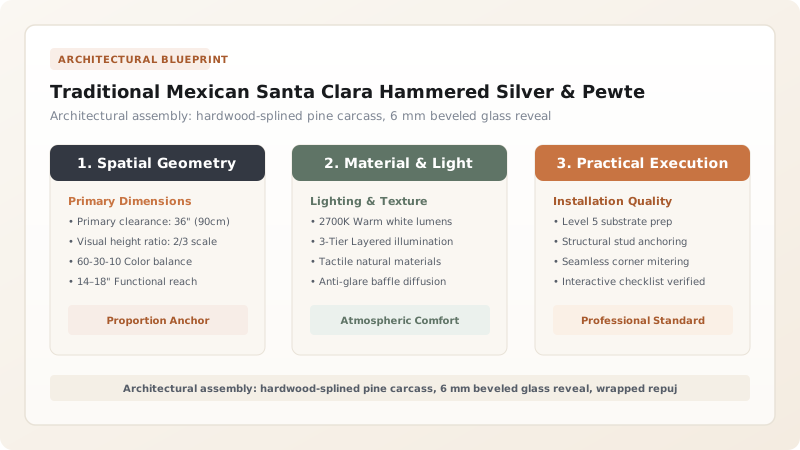
Build an arched Colonial mirror substrate from seasoned Michoacán white pine. Cut rabbets for 6 mm beveled glass and backing boards, reinforcing miter joints with hardwood splines.
Wrapping and Blind-Tacking Metal Over Timber Carcass
Wrap chased pewter or silver border strips tightly around the wooden frame rails. Fasten through concealed edges using round-headed silver tacks or decorative dome rivets.
Liver of Sulfur Patination and Carnauba Sealing
Brush a warm potassium polysulfide (liver of sulfur) solution into chasing recesses. Buff high spots with fine steel wool to reveal bright metal, then seal with buffed carnauba wax.
Common Mistakes & Countermeasures
Avoid these costly errors that compromise aesthetics, ergonomics, and budget:
Hammering silver or pewter repeatedly without periodic torch annealing
Using brittle, unplasticized pitch or working on pitch that is ice-cold
Using leaded solder or toxic antique pewter alloys on architectural pieces
Project Execution Checklist
Track your physical progress. Checkboxes persist automatically on this device:
Frequently Asked Questions
What is the historical origin of metalworking in Santa Clara del Cobre?
Before the Spanish conquest, the indigenous Purépecha people of Michoacán were the undisputed master metallurgists of Mesoamerica, fashioning copper and silver into sacred bells, axes, and ornaments. In the 1530s, Spanish bishop Vasco de Quiroga organized the village of Santa Clara into a specialized craft guild for hammered metalwork, blending indigenous hammering techniques with Spanish Baroque repujado.
What is "repujado" and how does it differ from ordinary metal stamping?
Repujado is the traditional Latin American term for repoussé and chasing—the artistic hand-embossing of malleable sheet metal. Unlike industrial machine stamping, which stamps identical shapes mechanically, repujado is sculpted entirely by hand using hammers, punches, and styluses against a pitch backing, resulting in subtle organic variations and deep three-dimensional relief.
Why is lead-free pewter used alongside sterling silver in Mexican mirror frames?
While sterling silver is reserved for luxury royal and ecclesiastical pieces, architectural pewter (known locally as peltre or estaño) offers a magnificent alternative. Formulated from pure tin hardened with antimony and copper, pewter possesses a luminous moonlit white sheen resembling silver, will not tarnish aggressively, is highly ductile, and allows large architectural wall mirrors to remain accessible.
How does liver of sulfur create the antique look on hammered silver?
Potassium polysulfide (liver of sulfur) reacts chemically with silver to form a thin surface layer of silver sulfide (Ag₂S). When applied warm, it turns the metal deep jet-black within seconds. The craftsman then buffs the raised high-relief surfaces with fine pumice or steel wool, leaving the dark sulfide locked in the deep chasing recesses, creating dramatic chiaroscuro contrast.