Remediating decayed Mexican Cantera stone requires non-destructive conservation protocols. Conservators extract damaging subterranean nitrate and sulfate salts using multi-cycle deionized water and sepiolite clay poultices. Biological crusts and urban soot are safely removed using low-pressure micro-steam (0.5 to 1.5 bar). Crumbling volcanic tuff is consolidated with ethyl silicate (TEOS), followed by breathable oligomeric alkylalkoxysilane water repellents that preserve vapor permeability while shedding driving rain.
At a Glance: Key Takeaways
- Decay Pathologies: Arenización (sanding), sub-florescence spalling, crosta negra
- Primary Destructive Salts: Sodium chloride (NaCl), calcium sulfate (gypsum), nitrates
- Desalination Matrix: Sepiolite clay + Arbocel B800 cellulose pulp + deionized water
- Cleaning Technology: Low-pressure saturation micro-steam (120°C at 1.0 bar)
- Consolidant System: Tetraethyl orthosilicate (TEOS) with 75% solvent carrier
- Hydrophobic Treatment: Monomeric/oligomeric alkylalkoxysilane (100% vapor permeable)
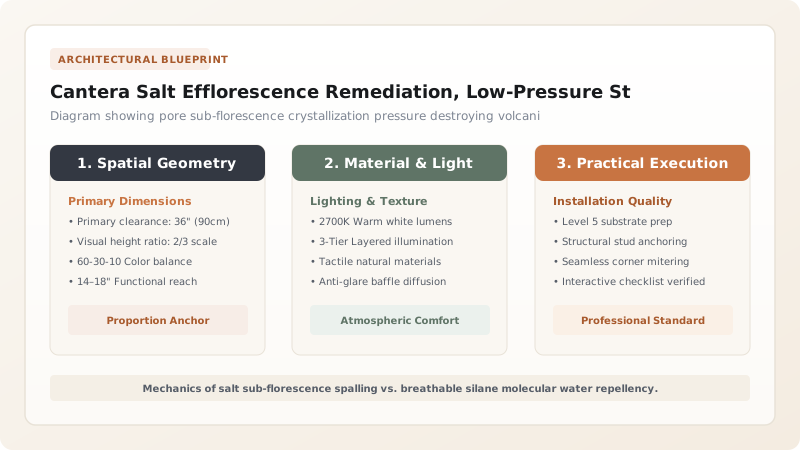
Salt Crystallization Physics: Cryptoflorescence & Sanding
Due to its high open capillary porosity (often exceeding 30%), Cantera acts as a massive hydraulic pump. In Mexican colonial plazas, rising damp carries dissolved soluble salts—principally sodium chloride ($NaCl$), sodium sulfate ($Na_2SO_4$), and potassium nitrate ($KNO_3$)—upward through foundation footings. When groundwater evaporates at the stone surface, salt concentration increases until saturation is reached.
If evaporation is rapid, salts precipitate beneath the surface within the microscopic pore throats (a phenomenon known as cryptoflorescence or sub-florescence). As anhydrous sodium sulfate hydrates into thenardite ($Na_2SO_4 \cdot 10H_2O$), its molar volume expands by over 300%, generating crystallization pressures exceeding 150 MPa within the pores. Because the tensile strength of porous volcanic tuff is typically only 2 to 4 MPa, these crystallization forces easily shatter the glassy ash matrix, causing the stone surface to disintegrate into loose volcanic sand (arenización) and spall in thick, jagged sheets.
Sacrificial Poulticing & Low-Pressure Micro-Steam Protocols
Treating salt-contaminated Cantera requires multi-cycle extraction. Conservators apply a sacrificial poultice formulated from a 1:1 blend of purified Arbocel cellulose fiber pulp and sepiolite (hydrated magnesium silicate clay) slaked with pure deionized water (< 5 µS/cm conductivity). The wet poultice (15 mm thick) is applied across the stone face and covered with polyethylene film for 48 hours to allow water to dissolve crystallized salts deep within the capillaries.
The plastic film is then removed. As the poultice dries from the outside, capillary evaporation draws the salt-saturated water outward into the cellulose fibers where the salts precipitate harmlessly. Poultice cycles are repeated until conductivity measurements of the extracted water drop below 200 µS/cm. Following desalination, biological algae, lichens, and urban soot are cleaned using low-pressure micro-steam (saturated dry steam at 120°C delivered at 0.5 to 1.5 bar pressure). The thermal energy melts organic residues and softens gypsum crusts without eroding the fragile volcanic ash matrix.
TEOS Mineral Consolidation & Breathable Silane Impregnation
Once the stone is clean and desalinated, crumbling volcanic grains must be structurally re-bonded. Conservators saturate the stone with tetraethyl orthosilicate (TEOS). The low viscosity of monomeric TEOS allows it to penetrate up to 40 mm into the porous volcanic tuff. Over a 3 to 4-week reaction period, TEOS hydrolyzes with ambient atmospheric moisture and condenses, depositing a resilient, three-dimensional network of amorphous silica ($SiO_2$) that permanently binds the loose glass shards and phenocrysts back into a cohesive stone body.
To protect the consolidated stone from future driving rain without creating an impermeable vapor barrier, conservators apply a breathable alkylalkoxysilane water repellent (such as isooctyltriethoxysilane). Unlike acrylic sealers that form an airtight plastic film over the surface, silane molecules are tiny enough to penetrate deep into the capillaries, chemically bonding to the silicate minerals inside the pores. The organic alkyl tails project outward into the pore throats, lowering surface energy to make the pores strongly hydrophobic. Liquid rainwater beads up and runs off the surface, while the open pore channels remain 100% breathable, allowing indoor water vapor ($Sd < 0.05\text{ m}$) to vent freely to the atmosphere.
Conservation Treatment Sequence for Decayed Cantera Facades
Use this reference table to calculate exact physical dimensions, ratios, and specifications before purchasing:
| Treatment Phase | Reagent / Technology | Application Method | Mechanism / Target | Safety / Reversibility |
|---|---|---|---|---|
| 1. Desalination | Arbocel B800 + Sepiolite (1:1) in Deionized Water | 15 mm sacrificial poultice under plastic for 48 hrs | Capillary salt extraction into cellulose fibers | 100% Reversible; zero stone surface loss |
| 2. Biological Cleaning | Low-pressure micro-steam (120°C, 1.0 bar) | Specialized rotary steam nozzle held 100 mm away | Thermal softening of algae & atmospheric soot | Non-chemical; preserves historic stone patina |
| 3. Structural Consolidation | Ethyl silicate (TEOS) with solvent carrier | Low-pressure capillary flood brushing to refusal | Deposits amorphous SiO2 binding loose ash grains | Irreversible mineral integration; high breathability |
| 4. Water Repellency | Oligomeric Alkylalkoxysilane (Isooctyltriethoxysilane) | Two wet-on-wet spray or brush flood coats | Molecular pore lining repelling liquid rainwater | Breathable (Sd < 0.05m); UV-resistant for 15+ yrs |
Practical Constraints
Every successful decoration project must account for physical and environmental constraints:
Persistent Rising Damp in Urban Colonial Plazas
If the water table cannot be lowered, rising damp will continue to feed salts into the stone indefinitely. Solution: Install physical damp-proof barrier courses, chemical horizontal silane injection lines, or perimeter ventilated gravel drainage trenches.
Flammability and Vapor Hazards of Solvent-Based Silanes
Alcohol and solvent carriers in TEOS and silanes produce flammable vapors during large facade applications. Solution: Enforce strict no-smoking rules, use explosion-proof ventilation, and mandate organic vapor respirators for applicators.
Execution Blueprint & Craftsmanship Sequence
Execute this professional sequence to achieve flawless results without backtracking:
Diagnostic Mapping and Salt Conductivity Profiling
Drill micro-core samples at varying heights to test electrical conductivity and identify soluble salt anions (nitrates, sulfates, chlorides) via ion chromatography.
Sacrificial Desalination Poultice Application
Mix Arbocel cellulose and sepiolite with deionized water into a paste. Trowel 15 mm thick over the stone; seal with plastic for 48 hours, then uncover to allow drying and salt absorption.
Conductivity Monitoring and Re-Application
Test poultice extracts for conductivity. Repeat poultice applications until extract conductivity stabilizes below 200 µS/cm, confirming salt remediation.
Low-Pressure Micro-Steam Cleaning
Clean soot and biological grime using dry saturated micro-steam at 1.0 bar pressure. Gently wipe loosened dirt with soft natural sponges, avoiding abrasive brushes.
Ethyl Silicate (TEOS) Mineral Consolidation
Apply TEOS consolidant by continuous brush flooding until the stone ceases to absorb liquid. Cover with plastic sheets for 21 days to facilitate slow hydrolysis.
Breathable Silane Hydrophobic Impregnation
Allow stone to dry for 14 days after TEOS cure. Apply two wet-on-wet coats of alkylalkoxysilane water repellent using low-pressure sprayers, checking beading effect.
Common Mistakes & Countermeasures
Avoid these costly errors that compromise aesthetics, ergonomics, and budget:
Applying Acrylic or Silicone Sealers Directly Over Salt-Laden Cantera
Washing Cantera with Hydrochloric or Muriatic Acid
Using Municipal Tap Water for Mixing Poultices
Project Execution Checklist
Track your physical progress. Checkboxes persist automatically on this device:
Frequently Asked Questions
What causes the white powder that appears on historic Cantera walls?
The white crystalline powder is efflorescence, composed of soluble mineral salts (such as sodium sulfate, calcium sulfate, or potassium nitrate). As moisture wicks through the porous volcanic stone and evaporates into the air, dissolved salts are left behind on the surface. While surface efflorescence can be brushed off harmlessly, sub-surface salt crystallization (sub-florescence) generates massive pressures that cause the stone to crumble.
Why is ethyl silicate (TEOS) superior to epoxy for consolidating crumbling Cantera?
Epoxy resins have large molecular structures that cannot penetrate deep into microscopic pores, forming a dense plastic plug that yellow in sunlight and blocks vapor transmission. Ethyl silicate (TEOS) is an ultra-low viscosity liquid that penetrates up to 40 mm into the stone. When it reacts with moisture, it deposits pure amorphous silica ($SiO_2$)—the exact same mineral naturally present in volcanic rock—strengthening the matrix while leaving pores 100% open to breathe.
How long does a breathable silane treatment last on an exterior Cantera facade?
High-quality oligomeric alkylalkoxysilanes chemically bond to the internal silica minerals inside the stone capillaries. Because the silane molecules reside within the pores rather than on the surface, they are protected from abrasive wind wear and surface UV breakdown. A professionally applied silane treatment typically maintains excellent water repellency for 12 to 18 years before requiring a refresh.