Mexican Cantera is a porous volcanic tuff (ignimbrite) formed by consolidated pyroclastic ash flows from the Trans-Mexican Volcanic Belt. Prized for its remarkable workability when freshly quarried and available in celebrated hues of rose-pink (rosa), silver-gray (gris), and amber-yellow (amarillo), Cantera became the definitive medium of New Spain's Baroque and Churrigueresque architecture. In regional centers like Querétaro and San Miguel de Allende, indigenous Otomi stonemasons synthesized European classical orders with indigenous floral and cosmographical reliefs. While naturally durable under dry highland conditions, Cantera's high porosity (25-35%) makes it vulnerable to urban salt efflorescence and black crusting, demanding vapor-permeable ethyl silicate consolidants and non-hydraulic lime mortars.
At a Glance: Key Takeaways
- Geological Classification: Rhyolitic to andesitic volcanic tuff (pyroclastic ignimbrite)
- Historic Quarry Basins: Querétaro (El Marqués), San Miguel de Allende, Morelia (Michoacán)
- Color Spectrum: Cantera Rosa (rose-pink), Cantera Gris (silver-gray), Cantera Amarilla (gold)
- Architectural Synthesis: Mexican Baroque / Churrigueresque paired with indigenous Otomi carving
- Effective Porosity: High open porosity (25% to 35% capillary volume)
- Conservation Protocol: Ethyl silicate (TEOS) consolidation; alkylalkoxysilane breathability
In-Depth Guides in this Directory
Explore specialized subtopic blueprints, technical dimensions, and execution checklists:
Cantera Volcanic Tuff Quarrying, Pyroclastic Ash Petrology, and Pink-to-Grey Color Strata in Central Mexico
Geological and quarrying analysis of Mexican Cantera. Learn pyroclastic ash welding petrology, quarry sap chemistry, diamond wire cutting, and chromatic strata across Querétaro and Morelia.
High-Relief Baroque Church Portals, Foliate Acanthus Moldings, and Otomi Vernacular Floral Motifs
Craftsman stonecarving guide to Mexican Baroque Cantera portals. Learn Churrigueresque estipite geometry, deep undercut chiseling, acanthus volutes, and indigenous Otomi botanical iconography.
Cantera Salt Efflorescence Remediation, Low-Pressure Steam Desalination, and Breathable Alkylalkoxysilane Protection
Conservator guide to protecting porous Mexican Cantera facades. Learn salt crystallization mechanics, cellulose poultice desalination, low-pressure micro-steam cleaning, and breathable silane consolidation.
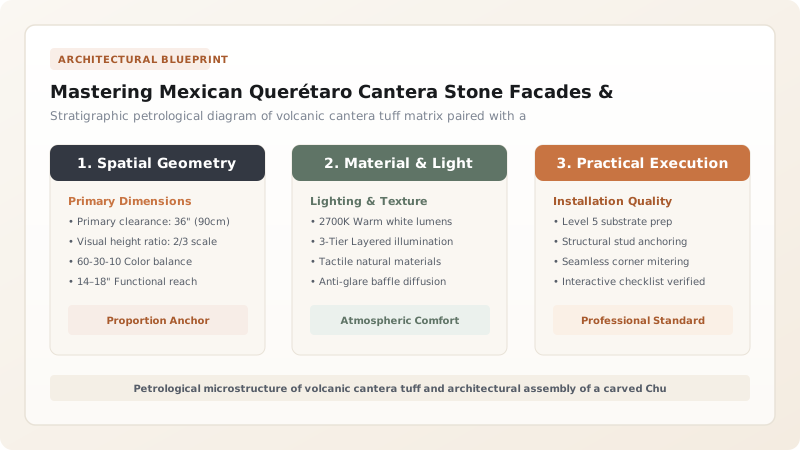
Volcanic Petrology & Trans-Mexican Pyroclastic Deposits
The monumental colonial architecture of central Mexico—from the pink palaces of Morelia to the ornate aqueduct arches and convents of Querétaro—draws its substance from volcanic fury. Cantera (literally 'quarry' in Spanish, but used in Mexico to designate volcanic ash stone) is a pyroclastic tuff or welded ignimbrite deposited during Miocene and Pliocene eruptions along the Trans-Mexican Volcanic Belt.
Petrologically, Cantera consists of fine volcanic glass shards, pumice fragments, microcrystalline quartz, and sanidine feldspar phenocrysts welded together under intense heat and lithostatic overburden. Its distinctive chromatic variations reflect regional geochemical environments: Cantera Rosa (from Querétaro and Morelia) owes its warm blush to finely disseminated hematite iron oxides; Cantera Verde (from Oaxaca) contains altered celadonite and chlorite minerals; while Cantera Gris (from San Luis Potosí) represents iron-free rhyolitic ash. When extracted from deep quarry benches ('bancos'), Cantera is exceptionally soft, saturated with subterranean quarry water, and easily shaped with iron adzes and chisels; upon prolonged exposure to air, secondary silica precipitates in the outer pore network, case-hardening the stone face.
The Otomi-Baroque Synthesis: Tequitqui Reliefs & Estipite Columns
During the 17th and 18th centuries in the Bajío region, Franciscan and Augustinian friars commissioned indigenous Otomi and Chichimeca stonemasons to carve monumental church portals, cloister fountains, and patrician casonas. This cultural convergence birthed the unique Mexican Churrigueresque or Ultra-Baroque architectural style, often termed Tequitqui sculpture.
Otomi canteros mastered European classical treatises (Vignola and Serlio) while infusing stone facades with indigenous animist vitality. Planar European acanthus leaves transformed into stylized corn stalks, cacao pods, native marigolds (cempasúchil), and sunbursts. A signature feature is the estipite column—an inverted, tapering pilaster divided into geometric segments (shaft, bulbous nodule, and capital) encrusted with high-relief cherub heads, floral garlands, and religious medallions carved in deep, crisp undercuts. The soft volcanic tuff permitted an astonishing density of sculptural detail that would have been cost-prohibitive in harder European granites or marbles.
Quarrying Benches & Traditional Cantero Tooling Techniques
Historic Cantera quarries—such as the famed El Marqués pits near Querétaro—operate in open-cast hillside terraces. Canteros (quarrymen) identify homogenous, fissure-free beds free from clay-rich 'calichoso' layers. Traditionally, extraction was performed with iron wedges (cuñas), pickaxes (talachos), and sledgehammers. Today, modern quarries utilize diamond wire saws and low-vibration hydraulic splitters to extract colossal monolithic blocks without introducing internal micro-fractures.
Carving proceeds through an established vernacular sequence:
- El Desbaste (Roughing): Removing quarry waste using heavy pick hammers (picos) to block out the architectural mass.
- El Cincelado (Chiseling): Defining architectural moldings and reliefs using forged flat chisels (cinceles) struck with round wooden or iron mallets (macetas).
- El Labrado Fino (Fine Dressing): Smoothing flat margins with toothed claw chisels (gradillas) or textured bush hammers (boccardas).
- El Asentado (Honing): Rubbing surfaces with wet volcanic pumice stones (piedra pómez) to achieve a smooth, matte finish that accentuates the stone's delicate volcanic crystal flecks.
Conservation Petrology: Salt Efflorescence, Black Crusts, and Silanes
Because Cantera possesses an interconnected capillary porosity between 25% and 35%, it is exceptionally vulnerable to moisture-related decay. In historic Mexican urban plazas, rising groundwater saturated with dissolved nitrates (from historic sewage) and modern road deicing salts wicks up into the stone. As water evaporates from the facade, salts crystallize inside the stone pore throats (sub-florescence), generating crystallization pressures exceeding 100 MPa that pulverize the soft volcanic ash matrix into loose sand (arenización).
Furthermore, modern automotive traffic deposits sulfur dioxide ($SO_2$) which converts atmospheric dust into dark gypsum encrustations that flake off in thick blisters. Traditional conservation strictly condemns Ordinary Portland Cement for repointing; rigid cement traps moisture and salts inside the soft cantera. Modern conservation mandates deep desalination using sepiolite and cellulose clay poultices, joint repointing with pure hot-mixed non-hydraulic lime mortars, and consolidation using tetraethyl orthosilicate (TEOS) or breathable oligomeric alkylalkoxysilane water repellents that preserve 100% of the stone's natural vapor breathability.
Mexican Cantera Varieties and Architectural Applications
Use this reference table to calculate exact physical dimensions, ratios, and specifications before purchasing:
| Cantera Variety | Primary Quarry Region | Petrographic Color & Minerals | Workability / Hardness | Typical Architectural Usage |
|---|---|---|---|---|
| Cantera Rosa de Querétaro | El Marqués, Querétaro | Warm rose-pink; hematite iron-rich tuff | High workability; Mohs 3.0 | Baroque church portals, courtyard fountains, balustrades |
| Cantera Rosa de Morelia | Morelia, Michoacán | Deep dusty rose; compact rhyolitic matrix | Moderate hardness; Mohs 3.5 | Monumental aqueduct arches, cathedral ashlar walls |
| Cantera Gris de San Luis | Escalerillas, San Luis Potosí | Silver-gray with black biotite specks | High density; Mohs 4.0 | High-traffic floor pavers, exterior steps, column shafts |
| Cantera Amarilla de Guanajuato | Guanajuato / San Miguel | Warm golden-buff; hydrated iron silicates | Soft, easily carved; Mohs 2.5 | Intricate church retablos, interior cloister friezes |
| Cantera Verde de Oaxaca | Ixcotel, Oaxaca | Sage green to jade; chlorite/celadonite tuff | Medium hardness; Mohs 3.0 | Colonial palace facades, church of Santo Domingo |
Practical Constraints
Every successful decoration project must account for physical and environmental constraints:
Micro-Cracking from Heavy Traffic Ground Vibrations
Heavy city bus traffic near historic colonial centers shakes historic cantera portals, loosening cantilevered corbels. Solution: Anchor loose sculptural elements internally using blind Grade 5 titanium pins set in flexible epoxy grouts.
Chromatic Variations Across Adjacent Quarry Benches
Cantera Rosa can vary from salmon to violet across a single deposit, causing visually jarring mismatched restoration patches. Solution: Extract all restoration stones from the exact historic quarry pit using digital spectrophotometer color matching.
Execution Blueprint & Craftsmanship Sequence
Execute this professional sequence to achieve flawless results without backtracking:
Quarry Bed Inspection and Extraction
Select sound, crack-free volcanic tuff strata in the quarry bench. Saw primary extraction blocks using diamond wire saws, preserving natural quarry moisture for carving.
Squaring and Full-Scale Template Tracing
Square the block with broad flat chisels. Trace 1:1 scale zinc templates of the Baroque molding or Otomi floral relief onto the stone face using charcoal pencils.
Rough Massing (El Desbaste)
Remove waste stone along drafted borders using a forged steel pico hammer, stepping down the three-dimensional depth planes of the sculptural relief.
High-Relief Chisel Sculpting
Carve deep undercuts, acanthus volutes, and cherub facial details using flat and gouge chisels struck with light wooden maceta mallets, working with the grain.
Surface Texturing and Pumice Honing
Texture background fields with fine bush hammers (boccardas) or smooth relief faces by wet-rubbing with natural volcanic pumice stones and clean water.
Breathable Lime Mortar Setting and Consolidation
Set carved components in hot-mixed non-hydraulic lime mortar (1:3 lime to volcanic sand). If stone exhibits sanding, apply ethyl silicate (TEOS) consolidant.
Common Mistakes & Countermeasures
Avoid these costly errors that compromise aesthetics, ergonomics, and budget:
Repointing Cantera Stone with Hard Portland Cement Mortar
Sealing Cantera with Acrylic or Polyurethane Gloss Sealers ('Wet Look')
Sandblasting Carved Baroque Reliefs to Clean Dirt
Project Execution Checklist
Track your physical progress. Checkboxes persist automatically on this device:
Frequently Asked Questions
Why is Mexican Cantera so widely used for Baroque architectural carving?
Cantera is a volcanic ash tuff that possesses an ideal balance of soft workability and long-term durability. Freshly quarried blocks can be carved with hand chisels almost as easily as dense timber, allowing artisans to create intricate, deep undercuts and exuberant Churrigueresque ornaments. Once exposed to dry air, natural silica precipitates in the outer pores, hardening the surface into weather-resistant stone.
What is 'Tequitqui' art in Mexican Cantera sculpture?
Tequitqui is a Nahuatl-derived term coined by art historians to describe the unique hybrid art produced by indigenous (Otomi, Nahua, Maya) stonemasons carving European Christian iconography under Spanish colonial rule. It is characterized by flattened two-dimensional relief planes, intense decorative density, and the subtle incorporation of pre-Columbian floral, solar, and animal motifs into Catholic portals.
How do you protect Cantera fountains from algae and water erosion?
Traditional Mexican cantera fountains are protected by applying multiple coats of slaked lime wash or lining interior submerged water basins with waterproof hydraulic lime mortars (cal hidráulica). In modern conservation, breathable fluoropolymer or silane water-and-oil repellents are applied to submerged surfaces to prevent algae root penetration while permitting the stone to breathe.