Formwork-free aerial bricklaying is the core craftsmanship methodology of Mexican bóveda construction. Master masons (bovederos) erect arched ceilings suspended mid-air without timber centering by combining hand-molded terracotta cuña bricks with quick-setting hemihydrate gypsum mortar. The mason dips the porous brick into water, spreads a thin ribbon of gypsum paste along the edge, and presses the brick firmly against the previously laid course with an upward rotational motion (cuchareo). Within 20 to 45 seconds, capillary action draws water into the terracotta matrix, accelerating gypsum crystal interlocking and creating instant gravitational adhesion.
At a Glance: Key Takeaways
- Brick Typology: Ladrillo de Cuña (beveled wedge brick, 20 × 10 × 2.5–3.5 cm)
- Mortar Composition: 100% calcined hemihydrate gypsum (yeso) or 4:1 yeso-slaked lime mix
- Initial Grab Time: 20 to 45 seconds under direct hand pressure
- Adhesion Mechanism: Capillary pore suction combined with rapid dihydrate needle crystal formation
- Daily Vault Output: 12 to 20 square meters per master bovedero team
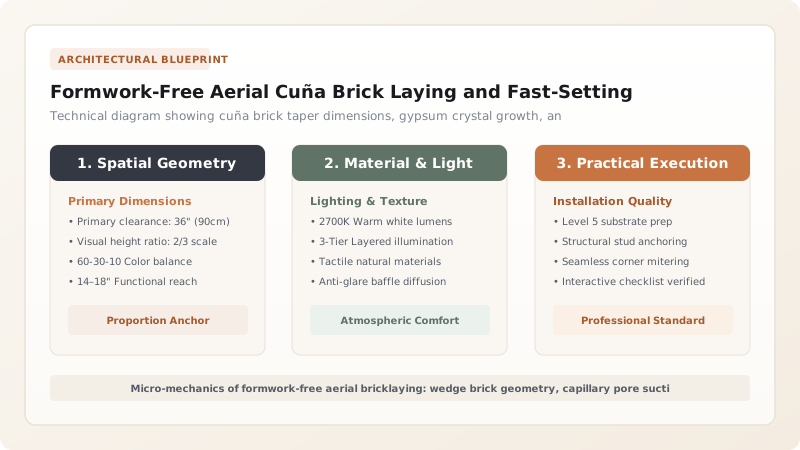
The Micro-Physics of Rapid Aerial Masonry Adhesion
To witness a Mexican maestro bovedero constructing an aerial vaulted ceiling is to see gravitational physics apparently suspended. Standing on a high scaffold platform beneath empty space, the mason reaches out with a raw clay brick, applies a dollop of white paste, presses the unit against the edge of a curved ceiling void, holds it for twenty seconds, and lets go. The brick remains fixed in mid-air, fully capable of supporting adjacent masonry units.
This phenomenon is neither magic nor structural trickery; it is an exquisite exploitation of inorganic chemistry and capillary fluid dynamics. The calcined gypsum used in Mexico (yeso de construcción) consists predominantly of calcium sulfate hemihydrate (CaSO4·0.5H2O). When mixed with water, it quickly forms a supersaturated solution from which microscopic, needle-shaped crystals of gypsum dihydrate (CaSO4·2H2O) nucleate and radiate outward in three dimensions, physically bridging the interface between brick and mortar.
Anatomy and Manufacture of the Ladrillo de Cuña
Standard flat bricks or modern industrial extruded pavers cannot be used for formwork-free vaulting. The craft relies entirely on the ladrillo de cuña, a specialized terracotta unit molded by hand in wooden frames. Typically measuring 20 to 22 cm in length, 10 to 11 cm in width, and tapering from 3.5 cm down to 2.2 cm across its thickness, this trapezoidal wedge profile allows consecutive units to form circular or parabolic arcs with uniform 4 mm to 6 mm mortar joints along the ceiling soffit.
Equally critical is the brick’s physical density and mineral composition. Masons seek out wood-fired bricks crafted from silty riverbed clay containing natural organic matter. When fired in traditional clamp kilns, the burnout of fine organic fibers leaves behind an open network of microscopic capillary pores. When the moist gypsum paste is applied, these dry capillaries exert immense capillary tension, drawing excess mixing water into the brick's subsurface. This accelerated de-watering causes the mortar paste to stiffen rapidly, locking the needle crystals into the rough clay fissures.
The Bovedero Toolset and Ergonomic Rhythm
The execution of aerial vaulting requires specialized tools and rhythmic teamwork. A standard bovedero crew consists of two individuals: the maestro (master mason) who works on the scaffold, and the chalan (tender or apprentice) who remains at the mortar mixing station. Because gypsum plaster begins to lose its binding efficacy within 4 to 6 minutes of contact with water, the tender must mix continuous micro-batches in flexible rubber buckets made from recycled automotive tires (artesas de llanta).
The master utilizes a lightweight, triangular masonry trowel with rounded tips (cuchara bovedera), a sharp brick hammer (marro) for precision chipping, and a fine nylon string line (hilo guía) stretched between permanent reference pins. The placement stroke, known as el cuchareo, involves scooping just enough paste to coat the brick’s mating edge, aligning the unit with the guiding string, and applying firm, pulsing manual pressure with the heel of the palm while vibrating the brick slightly to eliminate entrapped air voids.
Quality Assurance, Curing Phases, and Ring Interlocking
Quality control in formwork-free vaulting is tactile and immediate. Within 60 seconds of placement, the mason checks for structural grab by gently tapping the brick with the wooden handle of the trowel; a dull thud indicates a sound crystalline bond, while a hollow ring or microscopic movement reveals a failed interface that must be removed immediately. Once an entire transverse ring is completed and keyed at the apex (la clave), the mechanics shift instantly from chemical mortar adhesion to arch compression.
As consecutive rings are laid leaning back against the gable wall or starting arch at an angle of 60 to 75 degrees, the masonry units form a monolithic, imbricated shell. Once cured for 24 hours, the gypsum crystallizes fully, providing a rigid matrix that is subsequently reinforced on the extrados with breathable hydraulic lime mortars, creating a permanent structural canopy engineered to endure for generations.
Mortar Systems for Formwork-Free Aerial Masonry Construction
Use this reference table to calculate exact physical dimensions, ratios, and specifications before purchasing:
| Mortar Formulation | Initial Grab Window | Tensile / Shear Bond | Breathability & Vapor Flux | Application Suitability |
|---|---|---|---|---|
| Pure Calcined Gypsum (Yeso Puro) | 30–60 seconds | High initial; brittle long-term | High (open crystalline pore matrix) | Aerial ring bonding only; strictly sheltered interior |
| Gypsum-Lime Composite (Yeso + Cal 4:1) | 60–120 seconds | High initial; ductile & flexible | High (carbonation increases durability) | Standard bovedero mix; optimal balance of speed & flexibility |
| Natural Hydraulic Lime (NHL 3.5) | 2–4 hours | Slow initial; superior ultimate | Very High; completely breathable | Extrados structural grouting; requires formwork |
| Type M/S Portland Cement Mortar | 1–3 hours | Zero initial grab; high compressive | Low; impermeable dense matrix | Perimeter concrete ring beams; completely unsuited for aerial work |
Practical Constraints
Every successful decoration project must account for physical and environmental constraints:
Ambient Temperature Exceeding 35°C (Desert & Lowland Microclimates)
Extreme heat accelerates gypsum hydration prematurely, causing flash setting before bricks can be plumbed. Mitigation: Shield raw materials from direct sun, use chilled mixing water, and incorporate 0.5% citric acid or bone glue as a retarder.
High Humidity or Direct Moisture Infiltration in Bathrooms / Kitchens
Gypsum remains water-soluble; repeated moisture saturation softens joints and causes spalling. Mitigation: Apply a breathable siloxane water-repellent impregnator and finish exposed interior surfaces with hydraulic lime wash.
Execution Blueprint & Craftsmanship Sequence
Execute this professional sequence to achieve flawless results without backtracking:
Brick Pre-Conditioning and Quality Screening
Sort wood-fired cuña bricks by thickness and taper. Wipe away kiln soot and briefly dip each unit in clean water for 2 seconds to remove dust without saturating the internal capillary channels.
Scaffold Rigging and Workstation Ergonomics
Erect stable tubular scaffolding positioned precisely 1.2 meters below the vault springing line, providing the bovedero with ergonomic eye-level sightlines across the arch arc.
Small-Batch Gypsum Mortar Preparation
Sift fresh hemihydrate gypsum into a clean rubber bowl filled with water (approx. 1:1 by volume) without stirring for 30 seconds to allow wetting, then blend quickly with a margin trowel into a lump-free paste.
Applying Mortar Bed and Wedge Adjustment
Trowel a 6 mm layer of gypsum paste onto both the edge of the brick and the mating face of the preceding masonry ring, ensuring the thicker edge of the wedge faces toward the extrados.
Aerial Placement and Rotational Lock (El Cuchareo)
Press the brick into the aerial arch ring with a firm upward and sliding motion, squeezing out excess paste while aligning the inner face with the master catenary curve string line.
Hand Pressure and Crystallization Grab
Maintain steady manual pressure on the freshly placed brick for 25 to 40 seconds until an exothermic temperature rise indicates that dihydrate crystal interlocking has seized the brick in space.
Joint Scribing and Mortar Scraping
Slice away extruded gypsum flush with the brick faces using the edge of the trowel before the mortar hardens completely, leaving crisp, clean 4 mm joints ready for pointing.
Continuous Ring Progression and Lateral Stepping
Repeat the placement sequence moving along the arch ring, staggering vertical joints by 50% relative to the preceding arch course to ensure full interlocking structural integrity.
Common Mistakes & Countermeasures
Avoid these costly errors that compromise aesthetics, ergonomics, and budget:
Re-tempering gypsum mortar that has already begun its initial set
Pre-soaking bricks in water for prolonged periods before aerial installation
Aligning brick joints across adjacent arch rings in a stacked bond pattern
Project Execution Checklist
Track your physical progress. Checkboxes persist automatically on this device:
Frequently Asked Questions
Why are ladrillos de cuña shaped like wedges instead of standard rectangular bricks?
Ladrillos de cuña are slightly tapered across their width (typically 35 mm at the back edge tapering to 25 mm at the front). This subtle wedge profile naturally accommodates the curved radial geometry of an arch or vault, allowing the bricks to form tight, uniform joints along the exposed interior soffit without requiring excessively thick mortar wedges at the extrados.
Can gypsum mortar hold heavy bricks permanently against gravity?
Gypsum serves primarily as an installation adhesive. Once a complete arch ring is closed at the keystone (la clave), the individual bricks are locked into a state of continuous compressive thrust. The arch's geometry—rather than the tensile strength of the mortar—carries the weight. The cured gypsum easily handles the high compressive stresses characteristic of arched structures.
What happens if a bovedero misaligns a brick during aerial laying?
Because gypsum sets within 60 seconds, any realignment must occur immediately. If the bovedero breaks the crystal bond after initial stiffening, the brick must be tapped off, the hardened mortar scraped away down to raw clay, and the brick re-bedded with a fresh mortar mix.
How do masons prevent moisture damage to gypsum joints over time?
In traditional Mexican construction, the exterior of the vault is sealed with waterproof lime-pumice screeds and breathable membranes. Inside, the ceiling is kept dry through cross-ventilation. For wet zones like bathrooms, masons point the interior joints with hydraulic lime mortar or seal the surface with breathable silicone water-repellents.