The Bóveda de Pañuelo (handkerchief vault or sail dome) is the supreme geometric achievement of the Mexican bovedero tradition. Structurally defined as a spherical dome sliced vertically by a square or rectangular room boundary, the vault resembles a billowing cloth anchored at its four corners. Constructed completely without wood falsework, the vault springs from four corner triangular squinches or pendentives, progressing inward along concentric, self-supporting radial brick rings. Compressive forces are channeled three-dimensionally toward the four corner columns, eliminating the need for exposed tie-rods across the central living space.
At a Glance: Key Takeaways
- Geometric Typology: Sail Vault / Handkerchief Dome (spherical calotte on square plan)
- Springing Geometry: Four corner pendentives / triangular squinches (pechinas)
- Centering Falsework: 100% formwork-free aerial concentric ring construction
- Thrust Distribution: Compound diagonal compression channeled exclusively to the 4 corners
- Room Proportions: Square bays (optimal 1:1) or rectangular bays up to 1:1.3 ratio
The Geometry of the Spherical Sail Vault
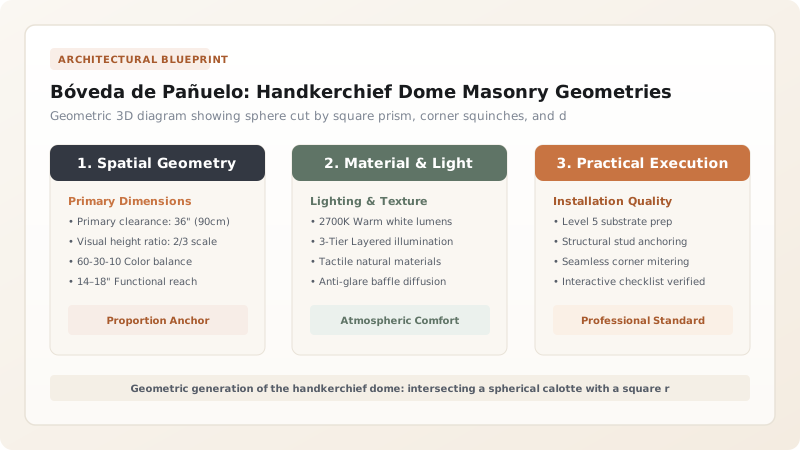
Among the various configurations mastered by Mexican bovederos, the Bóveda de Pañuelo—also known in classical architectural terminology as a sail vault, handkerchief dome, or pendentive dome—represents the pinnacle of geometric sophistication. Unlike a conventional dome that requires a circular drum or massive squinch arches, the handkerchief dome is defined geometrically as a continuous spherical calotte sliced vertically by the four bounding planes of a square or rectangular room.
The resulting architectural form is breathtaking: the vault sweeps upward from four low, sharp corner points, billowing outward and upward like a wind-filled silk canopy. Because the surface is mathematically continuous, there are no groins, ribs, or sharp internal creases; the ceiling reads as a singular, undulating shell of hand-crafted terracotta that naturally draws the human eye toward the soaring central crown.
Corner Squinches and Concentric Ring Construction
Erecting a handkerchief dome without wooden formwork requires profound spatial awareness. The construction begins not at the walls, but at the four interior room corners. In each corner, the mason constructs a pechina—a small triangular bracket or squinch formed by laying consecutive projecting courses of brick buttered with quick-setting gypsum.
These four corner squinches serve as the springing pads from which the aerial vault expands. Rather than laying linear arches across the room, the bovedero lays bricks in closed concentric rings. Starting with small diagonal arcs spanning across each corner, the rings gradually widen until they meet at the midpoints of the room walls, merging into a unified, four-sided curvilinear trajectory that spirals upward toward the zenith.
Three-Dimensional Force Paths and Corner Resolution
The structural genius of the bóveda de pañuelo lies in its compound biaxial curvature. Every brick in the shell is supported in two orthogonal directions, participating simultaneously in an arch ring spanning between corners and a hoop ring circling the dome axis. This double curvature provides extraordinary structural stiffness despite the shell's remarkable thinness—often measuring merely 3 to 4 centimeters of solid terracotta.
Crucially, the horizontal thrust of the vault is not discharged uniformly along the perimeter walls. Instead, the spherical geometry funnels compressive thrust vectors diagonally toward the four room corners. Because these forces arrive at the stiffest points of the building envelope—where perpendicular reinforced masonry walls and vertical columns meet—the building resists lateral spreading with exceptional efficiency, allowing clean, uninterrupted ceilings free of exposed steel tie-rods.
Acoustic Atmosphere, Light Play, and Contemporary Expression
The interior spatial qualities created by a bóveda de pañuelo are unmatched by flat ceiling construction. Acoustically, the gentle spherical curvature disperses vocal frequencies smoothly throughout the room, eliminating the harsh flutter echoes common to parallel flat drywall surfaces while retaining an intimate, warm acoustic warmth. Terracotta's porous texture naturally absorbs high-frequency reverberation, lending living rooms and dining halls an atmosphere of serene sanctuary.
Visually, the concentric brick patterns create a mesmerizing radial tapestry. When illuminated by low-angled pendant lighting or morning sun glancing through clerestory windows, the subtle variations in kiln fire, red iron clay, and white gypsum jointing shimmer in warm amber gradients. In modern architecture, the handkerchief dome remains the quintessential statement of artisanal authenticity, marrying rigorous geometric discipline with poetic vernacular warmth.
Mexican Brick Vault Geometries: Pañuelo vs Cañón vs Cúpula
Use this reference table to calculate exact physical dimensions, ratios, and specifications before purchasing:
| Vault Geometry | Structural Footprint | Thrust Path | Exposed Tie Rods Needed? | Architectural Aesthetic |
|---|---|---|---|---|
| Bóveda de Pañuelo (Handkerchief) | Square or near-square bays (up to 1:1.3) | Diagonal thrust directly to 4 corner columns | No; thrust resolved internally at corners | Billowing, seamless sail vault; dramatic ceiling height |
| Bóveda de Cañón (Barrel Vault) | Long rectangular corridors & rooms | Uniform linear lateral thrust on 2 long walls | Yes; requires exposed tie rods or external buttresses | Classical rustic cellar, corridor, or colonnade arcade |
| Cúpula con Tambor (Hemispherical Dome) | Circular or octagonal drum walls | Radial horizontal ring tension around drum base | No; drum acts as a circular tension hoop | Monumental focal dome, rotunda, or grand foyer center |
Practical Constraints
Every successful decoration project must account for physical and environmental constraints:
Asymmetric Structural Bays in Non-Square Architectural Layouts
Varying spans create elliptical springing profiles that complicate manual brick cutting and catenary curves. Mitigation: Use adjustable telescoping radius rods anchored at the room center to guide brick alignment consistently in 3D space.
High Point Loads on Supporting Corner Columns
Concentrated diagonal thrust from the entire ceiling dead load bears on four isolated corner zones. Mitigation: Size corner reinforced concrete columns (castillos) to support combined axial compression and biaxial bending moments.
Execution Blueprint & Craftsmanship Sequence
Execute this professional sequence to achieve flawless results without backtracking:
Room Layout Verification and Centerpoint Determination
Verify that room diagonals are equal to confirm squareness. Locate the geometric center and erect an adjustable vertical gauge pole set to the calculated apex height of the handkerchief dome.
Corner Squinch Construction (Pechinas de Esquina)
Erect triangular corbelled brick squinches across all four interior room corners, transforming the 90-degree square wall intersection into a sweeping curvilinear transition socket.
String Radius Guide Setup (El Compás de Hilo)
Anchor a non-stretching nylon reference string to a temporary central swivel pin on the floor, cut to the exact spherical dome radius, allowing the mason to sweep any point of the vault sphere.
Laying the First Quadrant Arch Rings
Starting simultaneously from the four corner squinches, lay the first courses of cuña bricks with quick-setting gypsum, stepping out into space along a diagonal trajectory toward the walls.
Concentric Ring Stepping and Self-Supporting Arch Action
Advance the bricklaying in continuous concentric rings, each course leaning inward and locking against its neighbors to form a complete, self-supporting horizontal compression ring.
Zenith Apex Keying (La Clave Central)
As the concentric rings converge at the center of the ceiling, custom-trim four to eight wedge bricks and drive them firmly into the apex aperture with gypsum paste to complete the dome.
Extrados Spandrel Filling with Cellular Pumice (Jal)
Pack the exterior depressions above the four corner squinches with a lightweight insulating mix of volcanic pumice (jal), lime, and low-alkali sand, creating a flat upper floor plane.
Interior Joint Dressing and Clear Siloxane Sealing
Wire-brush all joint burrs, sponge-clean the exposed terracotta surfaces, and apply two coats of breathable micro-porous siloxane sealer to highlight the warm, hand-crafted clay tones.
Common Mistakes & Countermeasures
Avoid these costly errors that compromise aesthetics, ergonomics, and budget:
Attempting to build a bóveda de pañuelo over an excessively elongated rectangular room (>1:1.5)
Failing to maintain continuous concentric rings during aerial brick closure
Inadequately reinforcing the four structural building corners
Project Execution Checklist
Track your physical progress. Checkboxes persist automatically on this device:
Frequently Asked Questions
Why is this vault called a 'bóveda de pañuelo' (handkerchief vault)?
The name originates from the visual metaphor of holding a square cloth or handkerchief by its four corners and allowing the center to billow upward in the wind. Geometrically, it is a sail vault (or pendentive dome) formed by the intersection of a hemisphere with the four vertical planes of a square room.
How does a bóveda de pañuelo eliminate the need for visible ceiling tie-rods?
Unlike a barrel vault that pushes outward uniformly along two parallel walls, a handkerchief dome directs its three-dimensional compressive forces diagonally toward the four room corners. Because these forces converge at rigid corner intersections where two perpendicular walls and heavy columns meet, the building's perimeter concrete bond beams can absorb the thrust without requiring exposed tension rods across the ceiling.
Can light fixtures or ceiling fans be anchored into a bóveda de pañuelo?
Yes, but they must never be anchored into raw brick using expansion anchors, which could crack the thin masonry shell. Instead, electrical conduits and threaded steel junction rods are dropped through the central keystone hole from the extrados before pouring the upper pumice leveling screed, transferring the fixture's dead weight directly to the top concrete floor.
What is the minimum and maximum recommended span for a handkerchief dome?
In residential construction, bóvedas de pañuelo typically span between 3.5 × 3.5 meters and 6.5 × 6.5 meters. Spans beyond 7.0 meters require thickened multi-ring brick shells, heavy structural extrados ribs, and comprehensive finite element structural engineering.