
In traditional Mexican and Pueblo-revival vernacular architecture, an adobe banco is a sculptural built-in earthen bench that emerges organically from structural adobe perimeter walls. Crafted from sun-dried mud bricks (adobes) bonded with clay mortar, bancos curve gracefully around central courtyards, living rooms, and beehive-shaped kiva fireplaces. Coated in breathable earth plasters and burnished with fine colored clay slips (aliz) and natural oils, bancos provide monolithic thermal mass, cooling summer seating, and radiant winter warmth.
At a Glance: Key Takeaways
- Architectural Tradition: Mexican colonial and indigenous Pueblo earthen architecture (Oaxaca, Puebla, Sonora)
- Structural Core: Sun-dried adobe bricks (adobe blocks of subsoil, straw, and water)
- Thermal Role: Stores heat from adjacent kiva fireplaces and radiant afternoon solar gain
- Surface Finishing: Multi-coat earth plaster burnished with natural aliz clay slip and linseed oil
In-Depth Guides in this Directory
Explore specialized subtopic blueprints, technical dimensions, and execution checklists:
Sculptural Adobe Brick Stacking: Ergonomic Seating Radii and Cantilevered Corbels
Technical masonry and ergonomic guide to sculptural adobe bancos: brick coursing layout, curved plan radii, toe kick undercuts, and bullnose profiling.
Kiva Beehive Fireplace Corbelling: Flue Draft Throats and Radiant Heat Storage
Engineering and masonry guide to Southwestern and Mexican kiva beehive fireplaces: parabolic adobe corbelling, Rumford draft throats, and banco integration.
Aliz Fine Clay Slip Plastering: Natural Earth Pigments and River Stone Burnishing
Master artisan guide to traditional aliz clay slip: formulating mineral earth slips, wheat paste binders, river stone bruñido burnishing, and natural oil sealing.
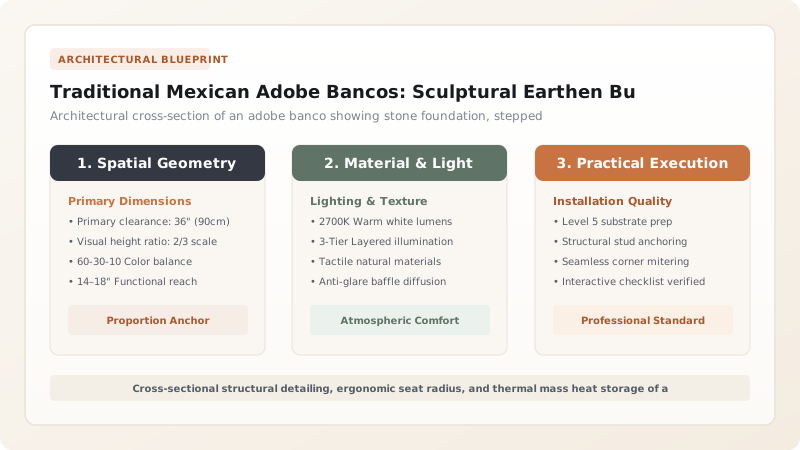
Monolithic Architecture: When Furniture Emerges from the Wall
In conventional Western architecture, furniture consists of detached wooden or metallic objects placed within rectangular rooms. In traditional Mexican earthen architecture, by contrast, furniture is an organic continuation of the architecture itself.
The banco (bench) is literally sculpted from the same sun-dried earth as the exterior walls. Rather than creating sharp 90-degree junctions where walls meet floor, master adoberos sweep the adobe bricks into fluid, undulating curves that form low seating ledges, display niches (nichos), and sleeping platforms. The result is a tactile, sculptural landscape where human living spaces feel cradled by the earth.
Thermal Battery Mechanics: Diurnal Climate Moderation
In arid high-desert climates—such as northern Mexico and the American Southwest—temperatures swing dramatically from scorching 38°C daytime heat to freezing 4°C desert nights. The high volumetric heat capacity of an adobe banco acts as a passive thermal battery.
During the day, the massive earthen core (often 400 to 500 mm deep) absorbs ambient solar radiation and body heat, keeping the seating surface cool and comfortable to the touch. In the evening, as room temperatures drop, the stored thermal energy slowly radiates back into the living space. When integrated alongside a wood-burning kiva fireplace, the banco becomes a gently heated bench, radiating warmth directly into bathers and sleepers throughout the night.
Ergonomics of the Mud Curve: Radii, Cantilevers, and Coves
Erecting comfortable furniture from rigid rectangular mudbricks requires sophisticated geometric manipulation. Adoberos lay out the banco base with a generous 450 to 500 mm seat depth, elevating the top surface roughly 420 to 450 mm above finished floor level.
To prevent the bench from digging into the back of seated legs, masons step the front lower brick course inward, or carve a deep continuous toe kick (zócalo). The junction between seat and vertical wall is softened into a parabolic curved cove (curva sanitaria) that supports the lumbar spine naturally, finished with hand-rounded Bullnose bullnose bullnose edges that prevent chipping.
Aliz Clay Slip and Natural Oil Burnishing: Velvet Armor
Raw adobe mud is powdery and vulnerable to abrasive friction from jeans and clothing. To create a durable, silk-smooth finish, artisans apply aliz—a traditional finishing slip made of fine, mica-rich ball clay, pulverized wheat paste (starch binder), and natural earth pigments.
Troweled on in multiple micro-thin layers, the leather-hard aliz is hand-burnished using smooth river stones (piedras de bruñir) or flexible plastic Japanese trowels. The burnishing compresses clay platelets into parallel alignment, creating a soft, light-scattering satin sheen. Finally, the surface is saturated with boiled linseed oil or beeswax, producing a waterproof, dust-free surface that feels warm and velvety to human skin.
Built-In Seating: Traditional Adobe Banco vs Frame-and-Drywall Built-Ins
Use this reference table to calculate exact physical dimensions, ratios, and specifications before purchasing:
| Design Characteristic | Traditional Sculptural Adobe Banco | Framed Wood & Drywall Built-In Bench |
|---|---|---|
| Thermal Mass Behavior | Colossal thermal inertia; stores 300+ kg of radiant heat | Zero thermal mass; hollow cavity with low insulation value |
| Sculptural Fluidity | Seamless organic compound curves, bullnoses, and niches | Rigid rectilinear planes; visible corner bead tape seams |
| Acoustic Performance | Exceptional bass dampening; eliminates flutter echo | Hollow resonance; acts as an acoustic drum when struck |
| Indoor Air Quality | 100% natural, non-toxic, hygroscopic humidity buffering | Potential off-gassing from synthetic adhesives and paints |
| Durability & Aging | Develops a magnificent hand-burnished antique patina | Prone to drywall dents, scuffs, and chipped corner beads |
Practical Constraints
Every successful decoration project must account for physical and environmental constraints:
Abrasive friction wear from denim jeans and heavy footwear along front edges
Unsealed clay plaster on seat bullnoses will slowly wear into fine dust where occupants repeatedly slide off the edge. Mitigation: Saturate the front bullnose edge with extra coats of boiled linseed oil to achieve a rock-hard polymerized resin matrix, or embed a curved bullnose tile edging.
Long drying time of thick mud mortar layers in enclosed indoor spaces
In cold or humid weather, thick wet adobe mortar beds can take several weeks to dry completely, delaying finish aliz plaster application. Mitigation: Operate commercial dehumidifiers and gentle warm-air circulation fans during the initial structural stacking phase to accelerate safe moisture release.
Execution Blueprint & Craftsmanship Sequence
Execute this professional sequence to achieve flawless results without backtracking:
Foundation Plinth Layout and Moisture Barrier
Lay out the curvilinear banco footprint along the adobe wall. Lay a continuous foundation course of dense river boulders or fired terracotta bricks bedded in hydraulic lime to prevent ground dampness.
Mud Mortar Formulation and Soil Testing
Blend local sandy clay subsoil with 30% fine river sand and chopped wheat straw (paja). Test plasticity to ensure zero shrinkage cracking when dried in the sun.
Stepped Adobe Brick Laying and Core Stacking
Lay sun-dried adobe bricks (typically 350 × 250 × 100 mm) in running bond courses, stepping bricks inward to form the toe kick and curving corners into gentle 300 mm radii.
Carving Lumbar Curves and Bullnose Edges
When mortar reaches leather-hard consistency, carve the seating edge into a smooth, 50 mm radius bullnose using rounded timber scrapers and damp sheepskin sponges.
Applying Base Earth-Straw Scratch Plaster
Trowel a 15 mm base coat of sticky clay plaster reinforced with chopped straw fibers across the entire banco, scoring horizontal key grooves to bond the finish slip.
Formulating Mica-Rich Aliz Clay Finishing Slip
Sift fine red, cream, or golden kaolin clay through a 100-mesh screen. Mix with cooked flour wheat paste, fine mica flakes, and natural earth pigments to a pancake batter consistency.
River Stone Hand Burnishing (Bruñido)
Apply two 1.5 mm coats of aliz slip. As the slip begins to lose its wet sheen, burnish the entire surface with smooth, oiled river stones, rubbing in tight overlapping circles.
Linseed Oil and Natural Beeswax Sealing
Allow aliz to dry for 5 days. Apply two coats of warm boiled linseed oil thinned with citrus solvent, followed by a buffed coat of beeswax paste to create a washable, satin finish.
Common Mistakes & Countermeasures
Avoid these costly errors that compromise aesthetics, ergonomics, and budget:
Applying synthetic acrylic latex paint or polyurethane over an earthen banco
Building an adobe banco directly over bare timber subflooring without isolation
Project Execution Checklist
Track your physical progress. Checkboxes persist automatically on this device:
Frequently Asked Questions
Can cushions and textiles be used on an adobe banco?
Yes! In Mexican and Southwestern homes, bancos are traditionally dressed with vibrant hand-woven Oaxacan wool textiles (zapotec rugs), leather bolster cushions, and colorful throw pillows, creating a cozy and luxurious contrast with the smooth earthen plaster.
How do you clean an oil-burnished adobe banco?
Cleaning is simple: wipe the surface with a soft damp cloth moistened with warm water and mild Castile olive-oil soap. Never use acidic cleaners, chemical degreasers, or abrasive scrubbers. Reapplying a light coat of beeswax paste once a year keeps the surface water-repellent and glowing.
What is the origin of the term 'aliz'?
Aliz (also spelled alis) is a traditional Spanish and Southwestern term derived from the Arabic and Moorish word for smooth or polished slip. It refers to the micro-fine, clay-rich wash applied to earthen walls that acts as both paint and plaster, polished with smooth river stones to create a marble-like sheen.
Can an adobe banco be built inside a modern drywall home?
Yes. Modern natural builders frequently install earthen bancos inside modern timber-framed or drywall homes. As long as floor framing is engineered to support the dead load, the banco adds breathtaking organic character, biophilic texture, and natural humidity regulation to contemporary interiors.


