
The structural heart of a tatami mat is the *tatami-doko* (畳床)—a monolithic core made from 40 kilograms of clean autumn rice straw (*wara*) compressed to one-eighth of its original volume and tightly cross-stitched. This dense core provides high compressive firmness with subtle ergonomic elasticity, forming the physical basis of the Japanese *Ken* architectural modular grid.
At a Glance: Key Takeaways
- Core Material: 100% natural un-threshed rice straw (*Wara-doko*) or composite wood-fiber
- Straw Density: Approximately 40 kg of dried rice straw compressed into a single 55mm mat
- Compression Ratio: 8:1 (400mm loose straw layer compacted to 50–55mm final thickness)
- Stitching Thread: Multi-strand linen, hemp, or polyamide twine stitched at 30mm intervals
- Grid Proportions: Ken module: Length is exactly twice the width (2:1 aspect ratio)
- Layout Rules: Syugi-shiki (auspicious non-crossing T-junctions) vs Fushugi-shiki (funeral grid)
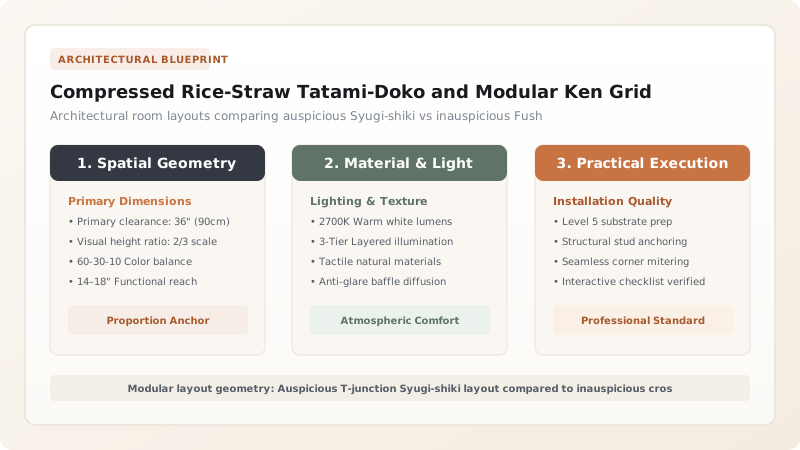
Rice Straw Compression Engineering and Wara-Doko Mechanics
In agricultural pre-modern Japan, rice straw was abundant after autumn harvests. To convert light, hollow straw into a structural floor capable of supporting human weight and heavy furniture without denting, artisans developed the Wara-doko core:
- Layering: Clean, dry straw is arranged in 6 to 8 distinct layers. Crucially, the straw grain orientation alternates by 90 degrees with every layer (cross-lamination), similar to modern structural plywood.
- Hydraulic / Mechanical Pressing: The 400mm-tall loose stack is compressed under massive deadweight or hydraulic rams into a dense slab exactly 50 to 55 mm thick.
- Needle Stitching: While held under compression, heavy industrial steel needles pierce the slab, driving thousands of stitches of tarred hemp or nylon cord in tight rows spaced 30 mm apart, binding the straw into an unyielding monolithic block.
The Ken Modular Grid and Auspicious Layout Rules
In classical Japanese architecture, the standard building grid is based on the Ken (typically 6 Japanese feet, or 1.818 meters). Because a tatami mat has an exact 2:1 aspect ratio (one mat length equals two mat widths), mats can be combined into rotating tessellations without fractional gaps.
Mat layouts follow strict cultural and structural rules:
- Syugi-shiki (Auspicious Residential Layout): Mats are arranged in an interlocking spiral or pinwheel pattern around a central focal point. Crucially, four mat corners must never meet at a single point (+ cross). All intersections must form 'T' junctions. This ensures that seams are structurally staggered and walking foot traffic does not concentrate stress at one corner.
- Fushugi-shiki (Inauspicious Grid): Mats are laid in parallel rows with four-corner cross intersections. This layout is strictly reserved for mourning halls, Buddhist funeral ceremonies, or vast palace auditoriums (like the 1,000-mat hall at Edo Castle).
Compressed Rice-Straw Tatami-Doko and Modular Ken Grid Architecture Architectural Decision Matrix
Use this reference table to calculate exact physical dimensions, ratios, and specifications before purchasing:
| Core Typology | Internal Construction | Weight (per mat) | Resilience | Eco / Modern Classification |
|---|---|---|---|---|
| Hon-Wara-Doko | 100% compacted multi-layer rice straw | 30–35 kg | Natural elastic spring, high thermal mass | Traditional authentic luxury standard |
| Sandwich Doko | Rice straw top/bottom, EPS foam center | 18–22 kg | Lightweight, excellent cold insulation | Common modern hybrid residential |
| Wood Fiber Board (Kenf) | Compressed recycled cedar wood fiber | 14–18 kg | Completely pest-proof, zero mold risk | Modern apartment standard |
| Ultra-Thin Doko | High-density fiberboard (15mm) | 8–12 kg | Rigid, zero spring | Direct overlay on modern wood flooring |
Practical Constraints
Every successful decoration project must account for physical and environmental constraints:
Mat Weight and Installation Ergonomics
Precision Millimeter Tolerances
Manufacturing and Squaring a Rice-Straw Core
Execute this professional sequence to achieve flawless results without backtracking:
Straw Sanitation
Bake autumn rice straw in high-temperature dry heat chambers at 85°C for 2 hours to eliminate mites, beetle eggs, and dormant fungal spores.
Cross-Ply Layering
Spread alternating horizontal and vertical layers of straw in the compression bed to a uniform depth of 400mm.
Press Compression
Apply 50 metric tons of hydraulic pressure to compact the straw stack down to 55mm thickness.
Automated Cross-Stitching
Advance multi-needle sewing heads through the compressed core, stitching rows of heavy twine across the entire length at 30mm intervals.
Trimming to Room Modulus
Trim the raw edges using a laser-guided spinning circular blade or hand broad-knife, checking 90-degree squareness with an iron carpenter's square (*Sashigane*).
Common Mistakes & Countermeasures
Avoid these costly errors that compromise aesthetics, ergonomics, and budget:
Using un-sanitized green straw containing grain seeds
Creating a four-corner cross intersection in a private residence
Storing compressed straw cores directly on damp concrete floors
Project Execution Checklist
Track your physical progress. Checkboxes persist automatically on this device:
Frequently Asked Questions
Why did traditional Japanese rooms measure sizes by mat count rather than square meters?
Tatami mats directly correspond to human scale and bodily ergonomics. One mat (approx. 1.8m × 0.9m) accommodates one person sleeping comfortably lying down, or two people sitting in formal seiza posture. Room sizes in mats immediately communicated how many people the room could comfortably hold.
Can heavy modern beds or sofas be placed on a rice-straw tatami floor?
Direct point loads from thin metal or wooden furniture legs will permanently crush the compacted straw core, leaving deep depressions. If heavy furniture must be used, wide flat wooden distribution pads (tatami-ate) must be placed beneath the legs to spread the load.


