
Tatami (畳) is Japan's traditional modular rush-mat flooring system that serves as the architectural foundation of Japanese spatial proportion (*Ken*). Constructed from three components—a compressed rice-straw core (*tatami-doko*), a hand-woven natural rush cover (*tatami-omote* made from *Juncus effusus* dyed with natural clay mud), and brocade fabric borders (*tatami-heri*)—tatami provides ergonomic cushioning, acoustic absorption, and passive seasonal humidity buffering in humid Asian climates.
At a Glance: Key Takeaways
- Origin & Era: Japan, originating in Heian period, perfected during Muromachi Shoin-zukuri era
- Top Woven Cover: Tatami-omote hand-woven from natural Igusa rush (Juncus effusus var. decipiens)
- Structural Core: Tatami-doko (compressed natural rice straw layered 400mm down to 55mm thickness)
- Textile Edging: Tatami-heri (cotton, linen, or patterned silk brocade borders)
- Spatial Modulus: Ken module (approx. 2:1 aspect ratio: Kyo-ma, Edo-ma, Chukyo-ma dimensions)
- Environmental Profile: Regulates humidity (absorbs 500ml water vapor per mat), purifies indoor air (absorbs NO2)
In-Depth Guides in this Directory
Explore specialized subtopic blueprints, technical dimensions, and execution checklists:
Natural Igusa Rush Mud-Dyeing and Loom Weaving in Japanese Tatami
Agronomy of Juncus effusus (Igusa), traditional Sendo clay mud dyeing (Tsuchi-zome), and precision loom weaving of premium Tatami-omote.
Compressed Rice-Straw Tatami-Doko and Modular Ken Grid Architecture
Mechanical engineering of compressed straw cores (tatami-doko), compressive elasticity, Ken module spatial planning, and mat layout rules.
Humidity Absorption, Indoor Climate, and Seasonal Aeration of Tatami
Hygroscopic performance, seasonal aeration rituals (Tatami-boshi), mold prevention, and indoor air purification of traditional Japanese rush mats.
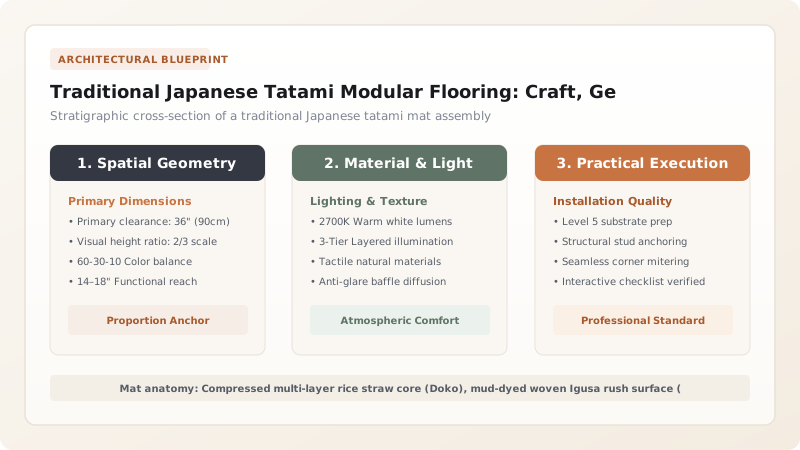
Architectural Modulus and the Ken Spatial System
In traditional Japanese architecture, the room does not dictate the floor; rather, the floor dictates the architecture. During the Muromachi and Azuchi-Momoyama periods, the development of the Shoin-zukuri (residential study) and Sukiya-zukuri (teahouse) styles established the tatami mat as the universal modular building block (the Ken grid).
Every room is designed in whole multiples of tatami mats: 4.5 mats (yojohan), 6 mats (rokujo), 8 mats (hachijo), or grand 10-mat reception halls. Three regional standard dimensions developed across Japan:
- Kyoto Module (Kyo-ma): 1.91 m × 0.955 m (The most spacious classical standard, measured column-to-column).
- Nagoya Module (Chukyo-ma): 1.82 m × 0.91 m (Common in central Japan).
- Tokyo Module (Edo-ma / Kanto-ma): 1.76 m × 0.88 m (Optimized for dense urban Edo housing, measured column-center to column-center).
Anatomy of the Mat: Doko, Omote, and Heri
An authentic traditional tatami mat is a composite engineering masterpiece assembled without adhesives:
- Tatami-doko (The Core): Formed from dry, un-threshed rice straw (wara). Approximately 40 kg of clean autumn straw is arranged in 6 to 8 alternating crisscross layers, compressed under heavy mechanical presses from 400 mm down to a dense 55 mm thickness, and stitched through with thousands of heavy hemp or nylon cords.
- Tatami-omote (The Rush Face): Woven from 4,000 to 7,000 individual stems of Igusa rush (soft rush). Harvested in Kumamoto prefecture, the fresh rushes are dyed in natural clay mud (tsuchi-zome) to preserve green color, enhance aroma, and regulate moisture. The rushes are woven on specialized looms using hemp or cotton warp threads.
- Tatami-heri (The Border): Woven fabric strips folded over the long sides of the mat and hand-stitched through the core. Historically, plain black cotton designated commoners, while patterned silks and family crests (kamon) denoted samurai and daimyo nobility.
Thermodynamic Indoor Climatology and Acoustic Serenity
Japan's humid subtropical climate (with summer relative humidity frequently exceeding 80%) demands materials that regulate moisture passively. The cellular structure of natural Igusa rush features a porous, honeycomb-like interior core (aerenchyma). A single tatami mat can absorb up to 500 milliliters of excess moisture on humid summer days and gradually release it during dry winter months.
Furthermore, the dense straw core acts as a high-performance acoustic and thermal damper. It deadens footsteps, cushions the body during floor-sitting (seiza), and absorbs ambient airborne pollutants, such as nitrogen dioxide (NO2) and formaldehyde. The natural scent of freshly woven rush—composed of phytoncides, vanillin, and dihydroactinidiolide—exerts a clinically proven calming effect on the human nervous system.
Traditional Japanese Tatami Modular Flooring: Craft, Geometry & Climate Architectural Decision Matrix
Use this reference table to calculate exact physical dimensions, ratios, and specifications before purchasing:
| Regional Modulus | Dimensions (Length x Width) | Aspect Ratio | Dominant Region | Architectural Style |
|---|---|---|---|---|
| Kyo-ma (Kyoto) | 1.91 m × 0.955 m | Exact 2:1 | Kansai (Kyoto, Osaka, Nara) | Traditional Shoin and Sukiya tea architecture |
| Chukyo-ma (Nagoya) | 1.82 m × 0.91 m | Exact 2:1 | Chubu (Nagoya, Gifu, Shizuoka) | Edo-period merchant and temple halls |
| Edo-ma (Tokyo) | 1.76 m × 0.88 m | Exact 2:1 | Kanto (Tokyo, Yokohama) & North | Dense urban Machiya and modern residences |
| Ryukyu (Okinawa) | 0.88 m × 0.88 m (Square) | Exact 1:1 | National / Modern minimalist | Borderless (Heri-nashi) square woven mats |
Practical Constraints
Every successful decoration project must account for physical and environmental constraints:
Direct UV Photolysis
Shoe Culture and Barefoot Protocol
Master Fabrication of a Traditional Japanese Tatami Mat
Execute this professional sequence to achieve flawless results without backtracking:
Room Laser Dimensioning
Measure room diagonals and column clear widths to the millimeter; each mat in a room is individually sized to fit slight architectural variations.
Straw Core Trimming
Cut the compressed rice-straw core (doko) to exact room dimensions using a heavy Japanese broad-bladed tatami knife (Houchou).
Omote Stretching
Dampen the woven Igusa rush surface lightly; stretch it drum-tight over the straw core using ratcheting clamp levers (Kakeya).
Short-Edge Stitching (Tokubetsu)
Fold the rush cover around the short head ends of the core; hand-stitch securely with heavy linen twine using curved tatami needles.
Heri Border Sewing
Align textile border tape along the long edges; machine- or hand-stitch through the core, fold over, and blind-stitch the underside.
Final Installation & Leveling
Press mats into the room in proper non-cross (syugi-shiki) auspicious layout; tap edges flush with a wooden setting mallet.
Common Mistakes & Countermeasures
Avoid these costly errors that compromise aesthetics, ergonomics, and budget:
Laying mats in an inauspicious four-corner cross layout (Fushugi-shiki)
Walking on tatami with shoes or outdoor slippers
Wiping dirty mats with a wet mop or soaking rag
Project Execution Checklist
Track your physical progress. Checkboxes persist automatically on this device:
Frequently Asked Questions
Why does fresh tatami smell so distinctive?
The signature fragrance of fresh tatami comes from natural chemical compounds in the Igusa rush, including phytoncides, vanillin, and alpha-cedrene, enhanced by the natural clay mud drying process. This scent promotes relaxation, reduces heart rate, and naturally deters insects.
How long does a traditional tatami mat last?
A well-maintained tatami mat lasts 20 to 30 years. The woven surface (omote) is typically flipped over after 3 to 5 years (Ura-gaeshi), replaced entirely with fresh rush after 7 to 10 years (Omote-gae), while the compressed straw core (doko) can survive for decades.


