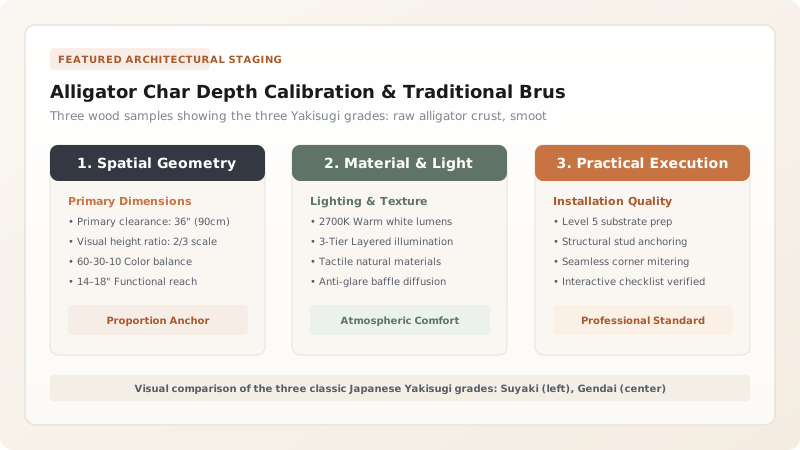
Grading Yakisugi surfaces is determined by char depth (2.0–4.0 mm for heavy outdoor use) and mechanical brushing intensity. Unbrushed 'Suyaki' retains the thick, crackled alligator carbon skin for maximum 80+ year exterior durability; single-brushed 'Gendai' removes superficial loose soot for a touch-safe matte finish; and double-brushed 'Pika' scours out earlywood to expose hardened summer growth rings in dramatic tactile relief.
At a Glance: Key Takeaways
- Heavy Grade (Suyaki): Unbrushed raw alligator crust (3.0–4.0 mm depth)
- Medium Grade (Gendai): Single brushed with stiff Tampico bristles (2.0 mm depth)
- Relief Grade (Pika): Double wire-scoured growth-ring relief (1.0 mm depth)
- Measuring Gauge: Digital depth micrometer or pin penetrometer
- Tactile Property: Ranges from rough mineral scales to smooth silky timber grain
The Morphology of Alligator Char (Suyaki)
When Sugi cedar is subjected to sudden, intense pyrolysis (>900°C), the volumetric shrinkage of cellular lignins causes the surface to crack into irregular polygonal tesserae resembling reptilian scales—hence the Japanese term Suyaki or 'alligator hide'.
This crackled morphology is not a structural defect; it is the hallmark of premium traditional Yakisugi. Each polygonal island acts as an independent carbon shield. When ambient temperatures shift or moisture fluctuates, micro-expansion occurs within the flexible fissures between scales, preventing the overall board from warping or checking across its face.
Measuring and Calibrating Char Depth
In structural and architectural specifications, char depth must be precisely verified. A superficial black color is completely inadequate; true Yakisugi requires measurable sacrificial depth:
- Pin Penetrometer Testing: A calibrated steel needle is pressed into the char layer until it encounters the resistance of virgin hardwood. Char depth must register between 2.0 mm and 4.0 mm across 95% of the board area.
- Carbon Crystallinity: High-quality char exhibits a dense, glassy obsidian sheen under bright light. If the char rubs off as soft, grey, dusty powder, the burn temperature was too low or draft was oxygen-starved.
Single-Brushing (Gendai) for High-Traffic Residential Zones
While raw Suyaki is the gold standard for high exterior gables and sea-facing facades, its residual loose soot will mark clothing and skin upon accidental contact. In residential settings—such as entry porticos, verandas (engawa), and interior courtyards—architects specify Gendai (single-brushed).
Boards are washed under a fine water mist and scoured with medium-stiff natural Tampico plant fiber brushes or nylon filament bristles. This controlled abrasion sweeps away the loose, friable airborne carbon dust while leaving the dense, underlying alligator plate structure intact. The resulting surface is dark charcoal black with a velvety, leather-like tactile feel that is completely clean to the touch.
Double-Brushing (Pika) and Earlywood Differential Scouring
To achieve the dramatic two-tone grain relief known as Pika, boards undergo aggressive mechanical brushing using rotary brass or high-tensile wire wheels. Conifer wood consists of soft, porous springwood (earlywood) and dense, hard summerwood (latewood).
Under wire brushing, the charred earlywood is completely scoured out, while the carbonized latewood ridges resist the bristles. This differential erosion produces a sculpted topography where the dark grain rings rise 1.5 mm above dark golden-brown hollows. Pika finishes are widely specified for luxury interior ceiling paneling, acoustic walls, and bespoke cabinetry.
Technical Specification by Yakisugi Brushing Grade
Use this reference table to calculate exact physical dimensions, ratios, and specifications before purchasing:
| Specification Item | Suyaki (Alligator) | Gendai (Single-Brushed) | Pika (Double-Brushed) |
|---|---|---|---|
| Surface Texture | Rough polygonal carbon scales (2–4 mm) | Velvety smooth matte black leather | Pronounced 3D undulating grain relief |
| Soot Shedding Risk | Moderate on high friction contact | Zero soot transfer once dry | Zero soot transfer; silky polished feel |
| UV & Sunlight Resistance | Maximum; 100% UV reflection by carbon | High; excellent resistance to fading | Moderate; brown earlywood may bleach without oil |
| Fire Retardancy Rating | Class B / Class 1 Flame Spread rating | Class B Flame Spread rating | Standard timber fire performance |
| Recommended Fastener | Hidden clips or stainless ring-shank nails | Stainless screws with black painted heads | Pre-drilled stainless trim screws |
Practical Constraints
Every successful decoration project must account for physical and environmental constraints:
Visual Color Inconsistency Across Timber Growth Batches
Boards from fast-grown sapwood yield thinner, lighter char than dense heartwood Mitigation: Sort boards by grain density prior to burning and group similar boards together for architectural facade elevation zones
Carbon Slurry Disposal Environmental Regulations
Brushing rinse-water contains concentrated carbon particulates that cannot enter storm drains Mitigation: Route wastewater through geotextile filtration ponds or settlement drums to capture solids before discharge
Execution Blueprint & Craftsmanship Sequence
Execute this professional sequence to achieve flawless results without backtracking:
Quenched Board Inspection and Curing Check
Examine air-dried charred boards on inspection benches. Verify zero smoldering embers and uniform black carbonization.
Char Depth Verification with Pin Gauge
Insert a depth penetrometer needle at 6 points along the board face. Confirm minimum 2.5 mm char depth for exterior grades.
Grade Selection and Brushing Setup
Mount boards on heavy workbenches. For Suyaki, bypass brushing entirely; for Gendai/Pika, prepare water misting sprayers and brushing tooling.
First Pass Brushing for Gendai
Brush longitudinally along wood grain using stiff Tampico or nylon bristle brushes under water mist to strip loose soot without flattening alligator plates.
Secondary Wire Scouring for Pika (If Required)
Pass a fine brass wire wheel along boards at 1200 RPM, scouring charred earlywood grooves down to hardened latewood grain ridges.
High-Pressure Water Rinse and De-Dusting
Rinse brushed boards with clean water spray to wash away scoured carbon slurry. Wipe down with lint-free cotton towels.
Dry Rub Cleanliness Verification
Press a clean white cotton cloth firmly against the dry board surface. Confirm zero black carbon residue transfers to the fabric.
Protective Sealer or Oil Priming
Apply a flood coat of pure drying oil (tung or linseed) or breathable water-borne acrylic sealer to lock in final chromatic depth.
Common Mistakes & Countermeasures
Avoid these costly errors that compromise aesthetics, ergonomics, and budget:
Using coarse steel wire brushes on Suyaki finish
Brushing dry charred boards without water mist lubrication
Accepting boards with char depth under 1.5 mm for exterior wall claddings
Project Execution Checklist
Track your physical progress. Checkboxes persist automatically on this device:
Frequently Asked Questions
How long does the deep black color of Yakisugi last outdoors?
In unbrushed Suyaki and single-brushed Gendai, the deep ebony tone remains stable for 30 to 50 years. Over decades of intense sun exposure, the outer carbon face slowly develops a distinguished, shimmering pewter-grey patina while retaining full structural decay resistance.
Can Pika grade be used for exterior siding in rainy regions?
Pika grade has less protective carbon (only 1.0 mm) compared to Suyaki. If used outdoors in wet climates, Pika must be treated with a high-grade penetrating drying oil (such as pure tung oil) every 5 to 7 years to maintain moisture resistance.
What kind of machine is used for commercial brushing of Yakisugi?
Industrial manufacturers use continuous conveyor brush machines equipped with counter-rotating cylindrical Tampico fiber or wire drums, accompanied by dust extraction hoods and high-pressure water spray bars.
Does brushing weaken the board structurally?
Single brushing (Gendai) removes less than 0.3 mm of non-structural loose soot, causing zero loss of strength. Double brushing (Pika) removes up to 1.5 mm of earlywood, which reduces effective thickness slightly; for this reason, Pika boards are typically started from 18 mm stock rather than 15 mm.