Yakisugi (traditionally translated as 'burned cedar' and known colloquially in the West as Shou Sugi Ban) is an 18th-century Japanese vernacular exterior cladding method developed along the Seto Inland Sea. Three planks of Japanese cedar (Cryptomeria japonica / Sugi) are tied together with wet straw rope into a vertical triangular triangular flue, ignited from the base to induce controlled superficial pyrolysis (charring to 2–4 mm depth), and instantly quenched with cold water. The resulting crystalline carbon crust provides 80–100 years of fire retardancy, insect immunity, rot resistance, and dimensional stability without toxic chemical biocides.
At a Glance: Key Takeaways
- Origins: Seto Inland Sea (Setouchi), Japan (Edo Period)
- Timber Species: Japanese Red Cedar / Sugi (Cryptomeria japonica)
- Char Layer Depth: 2.0 mm to 4.0 mm solid carbonaceous alligator crust
- Expected Lifespan: 80 to 100+ years in marine/humid microclimates
- Maintenance Profile: Zero painting required; optional periodic camellia or tung oiling
In-Depth Guides in this Directory
Explore specialized subtopic blueprints, technical dimensions, and execution checklists:
Sugi Cypress Triangular Chimney Pyrolysis & Water Quenching
Technical guide to traditional Japanese triangular chimney burning (Sankaku-yaki), thermodynamic flue drafting, and rapid water quench dynamics.
Alligator Char Depth Calibration & Traditional Brushing Grades
Comprehensive guide to grading Yakisugi finishes: unbrushed Suyaki alligator crust, single-brushed Gendai, and double-wire brushed Pika textures.
Natural Camellia & Tung Oil Exterior Saturation Treatments
Technical guide to formulating and applying natural camellia oil and pure tung oil penetrating finishes on charred Yakisugi timber claddings.
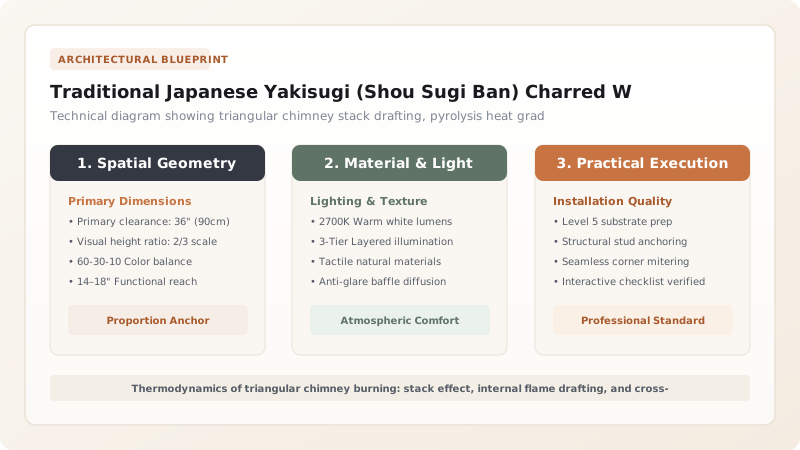
The Vernacular Heritage of Setouchi Sugi Pyrolysis
In the maritime fishing villages surrounding Japan's Seto Inland Sea (Setouchi), wooden structures face brutal weathering: typhoons, relentless salt-spray humidity, wood-boring termites (shiroari), and the ever-present hazard of urban fires. In the late Edo period (18th century), local builders perfected an ingenious, low-cost preservation technique: burning the exterior surfaces of Japanese cedar (Sugi, Cryptomeria japonica) before mounting them onto buildings.
Known natively as Yakisugi (literally 'burned cedar')—and popularized in contemporary Western architecture under the mispronounced Sino-Japanese reading Shou Sugi Ban—this technique converts the exterior cellulose and hemicellulose sugars into an inorganic carbon armor. Far from weakening the timber, controlled superficial charring shields the wood against moisture absorption, fungal decay, ultraviolet radiation, and insect attacks for a century or more.
The Triangular Chimney (Sankaku) Burning Technique
While modern commercial suppliers often use automated propane gas torches to scorch boards horizontally on conveyor belts, genuine traditional Yakisugi relies on a dramatic thermodynamic phenomenon: the triangular chimney stack effect (Sankaku-yaki).
Three long, air-dried Sugi boards (typically 2.0 to 3.0 meters long and 15 mm thick) are bound face-inward with wet straw rope or galvanized wire to form a tall hollow triangular prism. A ball of ignited newspaper or cedar shaving kindling is shoved into the open bottom base. As the flames catch, the chimney acts as a natural forge: thermal buoyancy draws enormous volumes of air upward through the flue, creating roaring temperatures exceeding 800°C to 1,000°C within seconds. In precisely two to three minutes, the wood faces are transformed into a deeply crackled carbon crust, at which point the prism is dropped flat and flooded with cold river water to freeze pyrolysis instantly.
The Physics of Carbon Armor: Alligator Scales and Fire Invariance
The signature textured appearance of traditional unbrushed Yakisugi is known as 'alligator skin' (Suyaki). Under high-temperature pyrolysis, the volatile organic compounds, lignins, and surface starches flash off into flame, leaving behind pure elemental amorphous carbon. This crystalline char layer measures between 2.0 mm and 4.0 mm in thickness.
Because carbon has zero nutritional value for fungi, wood-decaying spores cannot germinate. Termites and carpenter ants cannot digest pure carbon and are repelled by lingering pyroligneous acids. Furthermore, contrary to intuition, charred wood is remarkably fire-resistant: having already undergone complete combustion of its surface volatiles, the carbon layer acts as an effective thermal insulator with very low thermal conductivity, preventing underlying timber from reaching auto-ignition temperatures during neighborhood fires.
Surface Textures and Modern Oil Saturation Regimes
Traditional Yakisugi yields three distinct finish grades depending on post-burn mechanical processing:
- Suyaki (Unbrushed Alligator Char): The thickest, most durable finish. Left completely unbrushed, the heavy carbon plates provide maximum weather and fire protection, aging naturally to subtle silvery tones over 80+ years.
- Gendai (Single-Brushed): Brushed once with stiff wire or horsehair brushes to remove loose soot particles, revealing a firm, crackled leather-like texture that does not rub off on clothing.
- Pika (Double-Brushed / Wire-Brushed): Aggressively scrubbed to scour away soft carbon between annual growth rings, leaving the hardened summer wood raised in high tactile relief with a silky two-tone mocha and ebony sheen.
For modern architectural applications, boards may be conditioned with breathable cold-pressed Japanese camellia oil (tsubaki-abura) or pure raw tung oil, locking down residual soot while nourishing the cellular core.
Yakisugi Surface Finishes: Suyaki vs Gendai vs Pika Comparison
Use this reference table to calculate exact physical dimensions, ratios, and specifications before purchasing:
| Finish Classification | Brushing Intensity | Char Depth | Expected Outdoor Lifespan | Recommended Application |
|---|---|---|---|---|
| Suyaki (Raw Alligator) | Zero brushing; raw quenched crust | 3.0 mm to 4.5 mm | 80 to 100+ years; zero maintenance | Exposed exterior facades, coastal walls, high-exposure gables |
| Gendai (Lightly Brushed) | Single pass with stiff nylon/wire | 2.0 mm to 2.8 mm | 50 to 70 years; occasional oiling | Residential entryways, courtyard walls, covered verandas |
| Pika (Wire-Scoured) | Double pass; full growth-ring relief | 0.8 mm to 1.5 mm | 30 to 50 years; re-oil every 7 yrs | Interior feature walls, cabinetry, ceiling paneling, screens |
| Torch-Scorched (Modern Pseudo) | Shallow handheld propane torching | 0.2 mm to 0.5 mm | 5 to 10 years; rapid fading | Inadequate for exterior exposure; prone to premature decay |
Practical Constraints
Every successful decoration project must account for physical and environmental constraints:
Board Warping and Cupping from Unilateral Heat
Extreme flame heat on one face causes timber to bow concave toward the burned side Mitigation: Quench the reverse unburned face with cold water simultaneously to equalize thermal gradient tension across board thickness
Soot Transfer During Installation and Handling
Unbrushed Suyaki carbon blackens hands, clothing, and adjacent construction materials Mitigation: Handle boards with clean cotton rigging gloves and specify single-brushed Gendai finish for areas subject to direct human touch
Execution Blueprint & Craftsmanship Sequence
Execute this professional sequence to achieve flawless results without backtracking:
Sugi Cedar Board Selection and Moisture Verification
Select air-dried Japanese cedar (Sugi) boards measuring 15 mm × 180 mm × 3000 mm with moisture content strictly between 12% and 15%.
Triangular Chimney Prism Binding
Stand three boards vertically, rough faces inward, forming an equilateral triangle. Bind top, middle, and bottom securely with damp rice-straw rope or steel tie-wire.
Chimney Base Ignition and Draft Generation
Elevate chimney onto two bricks. Insert an ignited ball of dry cedar wood shavings into the bottom cavity to trigger the thermal stack effect.
Timed Pyrolysis Monitoring
Observe roaring flame ejection from top flue opening. Maintain intense internal burn for precisely 120 to 180 seconds until audible crackling indicates 3-mm char depth.
Immediate Water Quenching (Shoushi)
Cut binding ties, drop the three boards flat onto gravel ground char-side up, and flood immediately with cold water hoses to freeze combustion instantly.
Vertical Drying and Air Conditioning
Stack quenched boards vertically in open-air shade racks for 48 hours to evaporate quench water and equalize core moisture balance.
Mechanical Brushing (Optional for Gendai/Pika)
If specified, sweep away loose soot with stiff Tampico fiber brushes or wire scourers under continuous misting to reveal desired texture.
Camellia or Tung Oil Penetrating Treatment
Apply a liberal coat of raw cold-pressed camellia oil or pure tung oil thinned 10% with citrus solvent, allowing 72 hours for deep polymerization.
Common Mistakes & Countermeasures
Avoid these costly errors that compromise aesthetics, ergonomics, and budget:
Using dense resinous woods like Douglas fir or southern yellow pine instead of Sugi cedar
Torching boards flat on the ground with handheld weed burners
Coating charred Yakisugi with film-forming polyurethane or acrylic clear coats
Project Execution Checklist
Track your physical progress. Checkboxes persist automatically on this device:
Frequently Asked Questions
Does Yakisugi rub off black soot when people touch it?
Unbrushed Suyaki will shed a small amount of powdery soot upon direct friction. Single-brushed (Gendai) and double-brushed (Pika) grades, or boards sealed with natural tung or camellia oil, are completely clean to the touch and will not soil clothing or skin.
How does Yakisugi resist exterior fires if it is already made of wood?
During the initial burn, all readily combustible volatile gases and sugars are consumed. The remaining thick layer of amorphous carbon has very low thermal conductivity and no fuel value. When exposed to external fire, the carbon crust acts as a heat shield, preventing flame penetration into structural framing.
Can Yakisugi be used indoors?
Yes. Gendai and Pika grades sealed with natural oils or water-based fixatives are widely used for interior feature walls, ceilings, and cabinetry, offering extraordinary acoustic absorption and natural biophilic textures.
What is the proper fastener for installing Yakisugi exterior siding?
Always use Grade 304 or 316 stainless steel annular ring-shank nails or screws. The natural tannins and pyroligneous acids in charred cedar will rapidly corrode standard galvanized or carbon steel fasteners, causing ugly black streaks.