
Kumiko is the ancient Japanese woodworking art of assembling thin, interlocking wooden slats into intricate geometric fretwork patterns without metal nails, screws, or synthetic adhesives. Originating during the Asuka period (538–710 AD) for temple shrines and perfected in Shoji sliding screens, Kumiko utilizes micro-mitered mortise, tenon, and half-lap joints cut to fractions of a millimeter. Small pieces (Hada-ko) are shaved using razor-sharp Japanese chisels and specialized angled planing guide blocks (Jigane) to friction-fit tightly inside structural cedar or cypress foundation grids (Tsukeko).
At a Glance: Key Takeaways
- Key Patterns: Asanoha (hemp leaf), Goma (sesame seed), Yae-zakura (cherry blossom)
- Primary Geometries: Jigumi (orthogonal base grid) & Mitsukude (triangular 60°/120° grid)
- Slat Thickness: Typically 1.5 mm to 3.5 mm (structural frames 6 mm to 12 mm)
- Traditional Woods: Clear quarter-sawn Hinoki cypress, Akita Sugi cedar, and Sawara
Geometry and Origins: The Sacred Mathematics of Wood
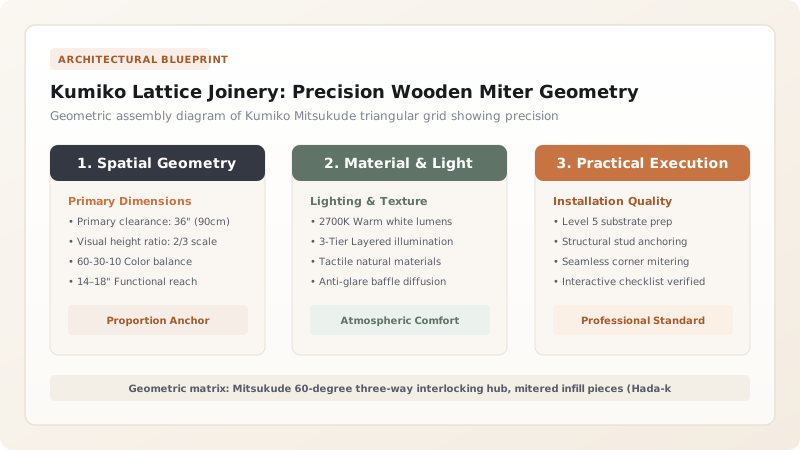
Dating back over a thousand years to the construction of sacred Buddhist temples in Nara, Kumiko evolved into an exquisite decorative discipline where sacred geometry meets structural discipline. The craft relies on two foundational grid typologies: Jigumi (orthogonal 90-degree square grids used in standard Shoji) and Mitsukude (complex three-way triangular matrices with interlocking 60-degree and 120-degree intersections).
Within these structural matrices, master artisans insert dozens of traditional geometric infill patterns. The most revered is Asanoha (the hemp-leaf pattern), symbolizing vitality, resilience, and protection from evil due to the rapid, upright growth of the hemp plant. Other iconic motifs include Goma-gara (sesame flower, associated with health and longevity) and Sakura (cherry blossom, celebrating the ephemeral nature of life).
Timber Science: Straight Grain, Shrinkage, and Seasoning
Because Kumiko pieces are milled to thicknesses between 1.5 mm and 3.5 mm, the slightest internal grain tension will cause the delicate wooden slats to bow, twist, or curl like dried autumn leaves. Only slow-growth, quarter-sawn (Masame) wood with straight, tight annual rings (at least 15 to 25 rings per inch) can be utilized.
Master craftsmen almost exclusively choose Hinoki (Japanese cypress) for its dimensional stability, natural antimicrobial aromatic resin, and silky pearlescent luster, alongside Akita Sugi (cedar) for subtle tonal contrasts. Wood is typically harvested from trees aged over 150 years and air-seasoned in sheltered racks for a decade or more to equalize internal moisture and prevent post-assembly shrinkage.
Artisanal Execution: Planing Jigs, Chisels, and Mitering Angles
A Kumiko craftsman's primary assets are razor-sharp Japanese pull-saws (Dozuki), paring chisels (Tsuki-nomi), hand planes (Kanna), and a suite of custom wooden mitering jigs (Jigane). Because a variation of 0.05 mm across thirty pieces compounds into an unusable lattice that buckles or falls apart, mechanical guide blocks are carved from rock-hard boxwood or white oak with angles precisely calibrated to 22.5°, 30°, 45°, or 67.5°.
Each tiny wooden slat (Hada-ko) is clamped against the guide block and pared down with a hand plane or wide chisel in a single continuous shaving until the tool blade rides flat on the jig's bronze or hardwood reference shoulder. The resulting end-grain miters meet with mirror-like optical precision, creating joints that hold firmly through friction alone.
Architectural Integration: Shoji Framing, Lanai, and Modern Interiors
Once the geometric infill clusters are completed, they are assembled into the main Shoji frame. In classical Shoin-zukuri palaces and teahouses, Kumiko was frequently employed in the Ranma—the decorative transom opening above sliding doors that facilitates passive cross-ventilation while showcasing the family's artistic pedigree.
In contemporary interior architecture, Kumiko has expanded far beyond traditional tea pavilions. Designers integrate freestanding Kumiko space dividers, back-lit acoustic wall panels, and minimalist timber ceiling baffles that diffuse ambient LED illumination, proving that millimeter-precise, zero-hardware joinery remains timeless in modern luxury residential design.
Traditional Kumiko Pattern Geometry & Fabrication Parameters
Use this reference table to calculate exact physical dimensions, ratios, and specifications before purchasing:
| Pattern Name | Grid Foundation | Internal Angles | Number of Infill Pieces | Symbolic Meaning & Use |
|---|---|---|---|---|
| Asanoha (Hemp Leaf) | Mitsukude (Triangular 60°) | 30° and 60° miters | 6 to 12 pieces per unit | Health, resilience & vigor; standard tearoom motif |
| Goma-gara (Sesame Seed) | Mitsukude (Triangular 60°) | 60° and 120° facets | 3 pieces per cell | Longevity & good fortune; common in Shoji friezes |
| Izutsu-tsunagi (Well Crib) | Jigumi (Square 90°) | 45° and 90° half-laps | 4 overlapping keys | Abundant water & household prosperity; entry screens |
| Kikukko (Chrysanthemum) | Mitsukude (Triangular 60°) | Complex multi-angle facets | 18+ micro-pieces | Imperial nobility & nobility; palace Ranma transoms |
Practical Constraints
Every successful decoration project must account for physical and environmental constraints:
Extreme Tool Sharpness Maintenance Demands
Soft Hinoki end-grain crushes and tears unless tools are sharpened on waterstones up to 8,000–12,000 grit every 45 to 60 minutes of active cutting. Mitigation: Establish a dedicated daily honing station with natural Japanese finishing stones (Awasedo) and maintain dedicated paring chisels exclusively for infill work.
Dust and Particulate Accumulation in Intricate Pockets
Complex geometric infills like Asanoha create hundreds of recessed triangular pockets that trap airborne household dust and kitchen grease over time. Mitigation: Sandwich delicate Kumiko panels behind protective float glass or clear acrylic in modern kitchens, or clean periodically with soft natural goat-hair feather dusters (Hatanboki).
Micro-Climatic Wood Shrinkage in Dry Heated Spaces
Dry winter HVAC systems can reduce wood moisture content below 6%, causing friction-fit pieces to loosen and drop out of their grid cells. Mitigation: Calculate a 0.05 mm interference fit during fabrication to ensure adequate mechanical grip remains even under low-humidity winter shrinkage.
Execution Blueprint & Craftsmanship Sequence
Execute this professional sequence to achieve flawless results without backtracking:
Splitting and Quarter-Sawing Flawless Softwood
Select air-dried Hinoki or cedar logs with tight, straight grain. Quarter-saw the timber to produce vertical-grain Masame boards completely free of pitch pockets, knots, or cross-grain deviation.
Milling Slat Strips and Thickness Planing
Rip the lumber into thin strips using a zero-clearance fine-kerf saw table. Pull each strip through a specialized thickness-planing shooting board (Hikikomi) to calibrate uniform thickness to within 0.05 mm.
Notching the Base Structural Grid (Jigumi or Mitsukude)
Bundle matching slats together with paper tape. Cut half-lap mortises across the entire bundle simultaneously using a Japanese Dozuki saw and precision spacing gauge to ensure pitch-perfect grid spacing.
Fabricating Angled Infill Slats with Mitering Jigs
Mount individual infill slats (Hada-ko) into specialized 30-degree, 45-degree, or 60-degree hardwood guide blocks. Pare the tips with a razor-sharp chisel until flush with the guide shoulder.
Hand-Pressing the Geometric Infill Elements
Assemble the outer foundation grid on a flat workbench. Carefully hand-press each mitered infill piece into its designated cell, using the natural spring tension of the wood fibers to lock the pattern in place without glue.
Final Surface Planing and Cleaning
Take micro-thin shavings across the completed face with a finish smoothing plane (Shiage-kanna). Polish the exposed end grain with horsehair brushes to remove dust without dulling the crisp wood edges.
Common Mistakes & Countermeasures
Avoid these costly errors that compromise aesthetics, ergonomics, and budget:
Relying on Sandpaper to Clean or Smooth Kumiko Slats
Applying Liquid Wood Glues to Infill Joints
Mixing Lumber with Differing Growth Ring Densities
Project Execution Checklist
Track your physical progress. Checkboxes persist automatically on this device:
Frequently Asked Questions
What tools are needed to make traditional Kumiko?
Essential Kumiko tools include a fine-toothed Dozuki saw, Japanese paring chisels (Tsuki-nomi), a smoothing hand plane (Kanna), specialized angled wooden mitering guide blocks (Jigane) for 30°, 45°, and 60° cuts, and a shooting board for thickness calibration.
Why is Hinoki cypress preferred over hardwoods for Kumiko?
Hinoki possesses a unique balance of tight, straight grain, silky workability, and natural elasticity that allows micro-mitered joints to compress slightly during insertion and spring open to form a tight, permanent friction lock without splitting.
Can Kumiko panels be used outdoors?
Traditional bare-wood Kumiko cannot endure direct rain or exterior weathering, as UV rays and moisture cycling will cause the thin slats to warp and rot. Exterior applications require sheltering behind glass panels or treatment with specialized breathable natural timber sealants.
What is the meaning behind the popular Asanoha pattern?
The Asanoha pattern represents the geometric hexagonal form of the hemp leaf. In Japanese culture, hemp is admired for its rapid, vigorous, and perfectly upright growth, making the pattern an auspicious symbol of children's good health, vitality, and protection from harm.


