Shoji sliding partitions (障子) represent the quintessential architectural expression of diffuse natural illumination and fluid spatial boundaries in traditional Japanese homes. Comprising a lightweight cedar or cypress perimeter frame, an intricate inner Kumiko lattice, and a backing of translucent handmade mulberry Washi paper, Shoji filters harsh external sunlight into a soft, shadowless interior glow. Operating along wax-lubricated timber floor grooves (Shikii), Shoji partitions dissolve visual mass while gently absorbing ambient indoor sound.
At a Glance: Key Takeaways
- Architectural Role: Sliding exterior light screen & flexible interior room partition
- Structural Framework: Clear quarter-sawn Hinoki or Sugi stiles, rails & Kumiko grid
- Light-Diffusing Membrane: Handmade mulberry Washi paper (Kozo, Mitsumata, or Gampi fibers)
- Adhesive System: Reversible natural rice-flour starch paste (Sokui / Nori)
- Sliding Mechanism: Bottom floor runner (Shikii) & upper ceiling guide (Kamoi) with beeswax
The Evolution of Shoji: From Heian Screens to Edo Sliding Partitions
In the spatial philosophy of Japanese architecture, walls are rarely treated as permanent, immobile barriers. The word Shoji (障子) historically referred to any apparatus that obstructs or filters—initially describing freestanding silk screens, fabric drapes, or solid wooden panels. During the Kamakura (1185–1333) and Muromachi (1336–1573) periods, with the emergence of Shoin-zukuri residential architecture, the Shoji evolved into the sliding translucent partition that defines the classical Japanese room (Washitsu).
Known specifically as Akari-shoji (明かり障子), meaning 'light-transmitting screens', these sliding doors solved an essential environmental challenge of the Japanese climate: how to keep cold winds and driving rains at bay while allowing precious natural daylight to penetrate deep into timber-framed rooms shaded by broad, overhanging roof eaves. By pairing an airy internal lattice of fine cedar splines with translucent mulberry paper, master carpenters created an architectural element of astonishing lightness that could be effortlessly slid aside or removed entirely to merge interior living spaces with the garden.
The Optical Physics of Handmade Washi Paper
The ethereal, serene ambiance of a traditional Japanese interior is largely an optical gift of Washi (和紙). Unlike Western paper manufactured from chemically digested, crushed wood pulp, authentic Japanese Washi is handmade from the long, tough inner phloem bark fibers of indigenous deciduous shrubs—most notably Kozo (paper mulberry, Broussonetia papyrifera), Mitsumata (Edgeworthia chrysantha), and Gampi (Wikstroemia sikokiana).
During the hand-papermaking process (Nagashi-zuki), these extraordinarily long fibers (often exceeding 10 to 15 mm in length) are suspended in a viscous solution derived from the Tororo-aoi plant and scooped onto bamboo screens. As the water drains, the fibers interweave into a resilient, complex three-dimensional web. When harsh, direct solar radiation strikes this membrane, it cannot pass through directly as it does with clear glass. Instead, the sunlight is refracted and scattered through millions of microscopic plant fibers. The resulting light is completely diffuse, eliminating harsh shadows, softening architectural contours, and generating a tranquil, luminous atmosphere that calms the human nervous system.
Joinery Mechanics of the Shoji Frame and Sliding Tracks
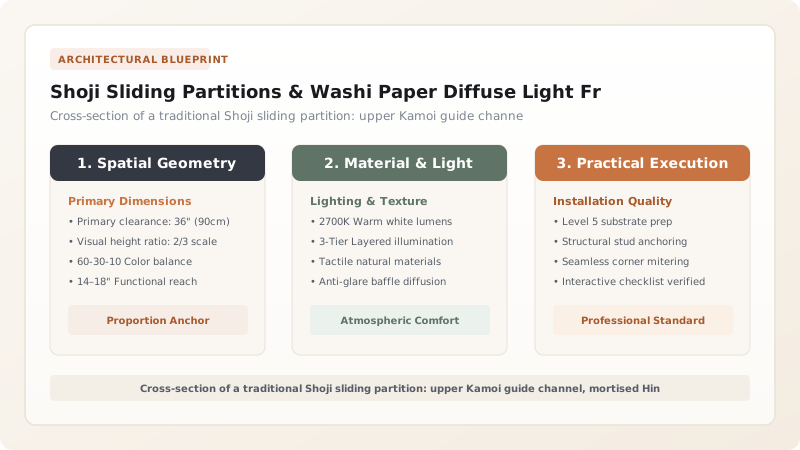
A Shoji partition is a marvel of lightweight structural engineering. The perimeter frame consists of two vertical stiles (Tate-gamachi) and horizontal rails (Yoko-gamachi) crafted from dead-straight quarter-sawn Hinoki or cedar. The corner joints are joined using blind through-mortise-and-tenons, pinned with hardwood dowels. The frame is grooved along its inner edges to capture the perimeter splines of the Kumiko lattice, holding the delicate woodwork firmly under structural containment.
Unlike modern sliding doors that roll noisily on metal ball bearings and steel tracks, Shoji glide along traditional wooden tracks. The bottom track, routed directly into the timber floor, is the Shikii (敷居); the matching upper guide track set into the ceiling header is the Kamoi (鴨居). The wooden runners on the door rails are profiled to fit these shallow grooves with exact 1 mm clearances. When lubricated with unrefined natural beeswax or crushed walnuts, the wooden door slides with a hushed, silky smoothness, offering an intimate, tactile sensory experience that honors the natural spirit of wood.
The Ritual of Rice-Flour Pasting (Nori) and Paper Tensioning
The installation of Washi paper onto the Kumiko lattice is not merely a construction step; it is a time-honored domestic ritual known as Shōji no harikae. Traditional Japanese craftsmen strictly reject modern synthetic adhesives or contact cements. Instead, they use Sokui, a pure starch paste cooked gently from fine white rice flour and water.
Because rice paste contains zero harsh solvents or permanent polymers, it bonds tenaciously to the wood fibers when dry, yet remains completely reversible. When paper requires replacement years later, simply sponging the lattice with warm water dissolves the starch, allowing the old sheet to peel away cleanly without damaging the delicate Hinoki lattice beneath. After the fresh paper is rolled across the pasted grid, it is lightly misted with clean water. As the moisture evaporates, the natural cellulose fibers of the Kozo contract uniformly, drawing the paper drum-tight across the Kumiko grid with a resonant, flawless tension that sings when lightly tapped.
Washi Paper Varieties, Fiber Sources, Light Transmission & Durability for Shoji
Use this reference table to calculate exact physical dimensions, ratios, and specifications before purchasing:
| Washi Paper Type | Botanical Fiber Source | Light Transmission (%) | Tensile Strength & Texture | Typical Interior Setting |
|---|---|---|---|---|
| Kozo Washi (Paper Mulberry) | Broussonetia papyrifera inner bark | 40% to 50% (Warm diffuse) | Extremely high tensile strength; long interlocking fibers | Standard exterior-facing Shoji screens & living pavilions |
| Mitsumata Washi | Edgeworthia chrysantha bark | 50% to 60% (Luminous ivory) | Silky, delicate surface with fine micro-diffusion | Tea ceremony tearooms (Chashitsu) & private alcoves |
| Gampi Washi (Torinoko) | Wikstroemia sikokiana bark | 55% to 65% (Golden amber sheen) | Naturally glossy, highly insect-resistant, rare and precious | Imperial villas, temple altars & prestigious Tokonoma alcoves |
| Unryu-shi (Cloud Dragon Paper) | Kozo fibers mixed with silk strands | 35% to 45% (Textured shadow play) | Decorative fibrous swirls embedded across sheet | Contemporary accent screens, backlit feature walls & lanterns |
Practical Constraints
Every successful decoration project must account for physical and environmental constraints:
Vulnerability of Organic Washi Paper to Tearing and Punctures
Traditional mulberry paper can be easily punctured by curious pets, small children, or sharp moving objects. Mitigation: Install a solid timber lower wainscot panel (Koshitsuki) up to 45 cm above floor level, or employ laminated tear-resistant Washi infused with rayon threads.
Seasonal Binding in Solid Wooden Sliding Grooves
High summer humidity swells the timber stiles and floor tracks (Shikii), causing sliding doors to stick or jam. Mitigation: Plane a generous 2 mm clearance in the upper guide track (Kamoi) and lubricate floor runner tracks biannually with unrefined beeswax or camellia oil.
Execution Blueprint & Craftsmanship Sequence
Execute this professional sequence to achieve flawless results without backtracking:
Stile and Rail Dimensioning and Mortising
Rip and plane quarter-sawn Hinoki stiles (Tate-gamachi) and horizontal rails (Yoko-gamachi). Cut through-tenons and matching mortises, ensuring joints assemble square without twist.
Rout Lattice Receiving Rebates
Rout a clean 6 mm rebate or groove along the interior inside perimeter of the frame to capture the perimeter boundary splines of the Kumiko panel.
Frame and Kumiko Lattice Integration
Insert the pre-assembled Kumiko lattice into the perimeter stiles and rails. Draw the mortise-and-tenon joints tight using drawbore wooden pins or gentle clamping pressure.
Bottom Runner Shaping and Waxing
Shape the bottom rail tenon runners (suberi) to match the width and depth of the floor track (Shikii). Buff the contact surfaces with pure beeswax for silky, quiet sliding.
Rice Paste Preparation
Simmer pure white rice flour in water over low heat, stirring continuously until it turns into a translucent, silky starch paste. Strain through cheesecloth to remove lumps.
Paste Application to Lattice Ribs
Lay the assembled wooden Shoji face down on horses. Using a traditional horsehair brush, paint a thin, uniform line of rice paste along the back edges of every Kumiko spline.
Laying and Bonding the Washi Paper
Roll the roll of mulberry Washi paper across the grid from top to bottom, unrolling slowly while pressing the paper gently against the pasted ribs with a clean dry cloth.
Trimming, Misting, and Shrink-Tensioning
Trim excess paper along the frame edges with a sharp knife and steel rule. Lightly mist the entire paper surface with a fine water sprayer; as it dries, the sheet tightens into a drum-taut membrane.
Common Mistakes & Countermeasures
Avoid these costly errors that compromise aesthetics, ergonomics, and budget:
Using chemical synthetic glues or double-sided tape to adhere Washi paper
Applying completely dry Washi paper tautly across the framework
Installing modern metal rollers or tracks on authentic timber Shoji screens
Project Execution Checklist
Track your physical progress. Checkboxes persist automatically on this device:
Frequently Asked Questions
How often does the Washi paper on a Shoji door need to be replaced?
In traditional Japanese households, Shoji paper is traditionally replaced once a year during the late autumn or winter cleaning festival (Ōsoji) to welcome the New Year with fresh, luminous white light. However, in modern climate-controlled interiors with minimal smoke or dust, quality Kozo paper can remain pristine for three to five years.
How is old Washi paper removed from a Kumiko screen without damaging the wood?
Because traditional rice-flour starch paste is completely water-soluble, removing old paper is effortless. The craftsman sponges lukewarm water along the pasted wooden ribs. After five minutes, the starch softens completely, allowing the old paper to be peeled away cleanly in one sheet without leaving any adhesive residue or splintering the delicate wood.
Why does Washi paper diffuse light so much more effectively than glass or modern plastic?
Unlike machine-made wood-pulp paper or glass, handmade Washi is composed of exceptionally long, irregularly intertwined botanical fibers (such as Kozo mulberry). When light strikes these multi-layered fibers, it is refracted, scattered, and bounced in thousands of omnidirectional paths, eliminating harsh glare, erasing hard shadows, and bathing the room in a gentle, warm, uniform luminescence.
Can Shoji screens be used as exterior windows in modern homes?
Traditional Shoji are not weather-resistant and cannot be exposed directly to rain or driving snow. In traditional Japanese architecture, Shoji are installed behind deep cantilevered roof eaves and protected by outer wooden sliding storm shutters (Amado). In modern architecture, Shoji are installed on the interior side of double-glazed glass windows, providing privacy and light diffusion while the glass handles weatherproofing.